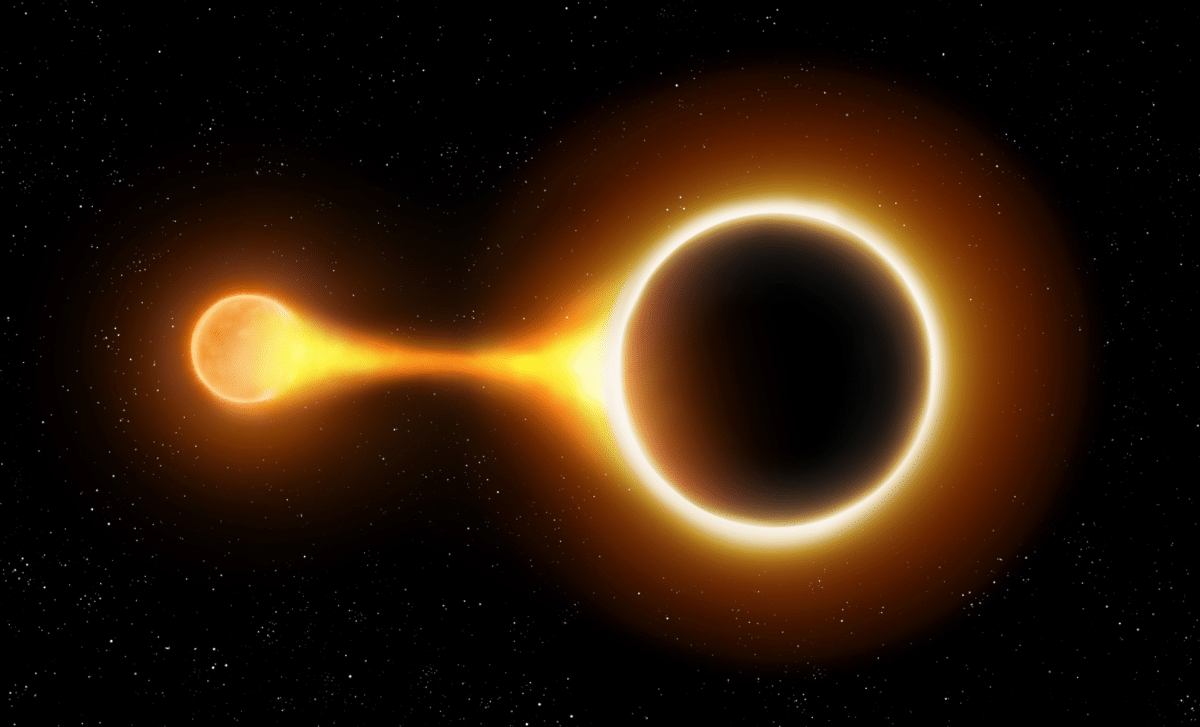
Astronomers have made the first direct observation of a spinning black hole twisting the very fabric of spacetime, a phenomenon known as Lense-Thirring precession. This rare detection, recently published in Science Advances, confirms a major aspect of Einstein’s theory of general relativity. The discovery occurred during the violent tidal disruption event (TDE) AT2020afhd, when a star strayed too close to a supermassive black hole, was torn apart, and formed a glowing, precessing disk and relativistic jets.
A Star Torn Apart Reveals A Hidden Force At Work
The cosmic event that unlocked this groundbreaking observation was not just dramatic, it was revealing. When the star AT2020afhd was gravitationally shredded, its debris spiraled into a tight accretion disk, launching jets of matter at nearly the speed of light. But what caught the researchers’ attention was the rhythmic wobbling of both the disk and jets. This coordinated motion, repeating every 20 days, served as the observable signature of spacetime itself being dragged by the black hole’s immense spin.
This twisting motion aligns with a prediction Einstein made in 1913 and later formalized mathematically by Josef Lense and Hans Thirring in 1918. The phenomenon, known as frame-dragging, suggests that a rotating mass can distort spacetime around it, akin to how a spoon stirs honey. Until now, observing such an effect directly had proven elusive.
Dr. Cosimo Inserra, co-author of the study, published in Science Advances, and astrophysicist at Cardiff University, emphasized the magnitude of the observation:
“Our study shows the most compelling evidence yet of Lense-Thirring precession – a black hole dragging space time along with it in much the same way that a spinning top might drag the water around it in a whirlpool.”
He added that this observation provides a new tool to investigate TDEs and the internal dynamics of black holes:
“This is a real gift for physicists as we confirm predictions made more than a century ago. Not only that, but these observations also tell us more about the nature of TDEs – when a star is shredded by the immense gravitational forces exerted by a black hole.”
Confirming Einstein Through X-Ray And Radio Telescopes
To detect the precession effect, researchers combined data from NASA’s Neil Gehrels Swift Observatory and the Karl G. Jansky Very Large Array. The key was in the patterns: X-ray and radio emissions from the event showed fluctuations that diverged from previously studied TDEs, which typically present steady signals. The variability in AT2020afhd’s emission hinted at something deeper than the usual energy outflows.
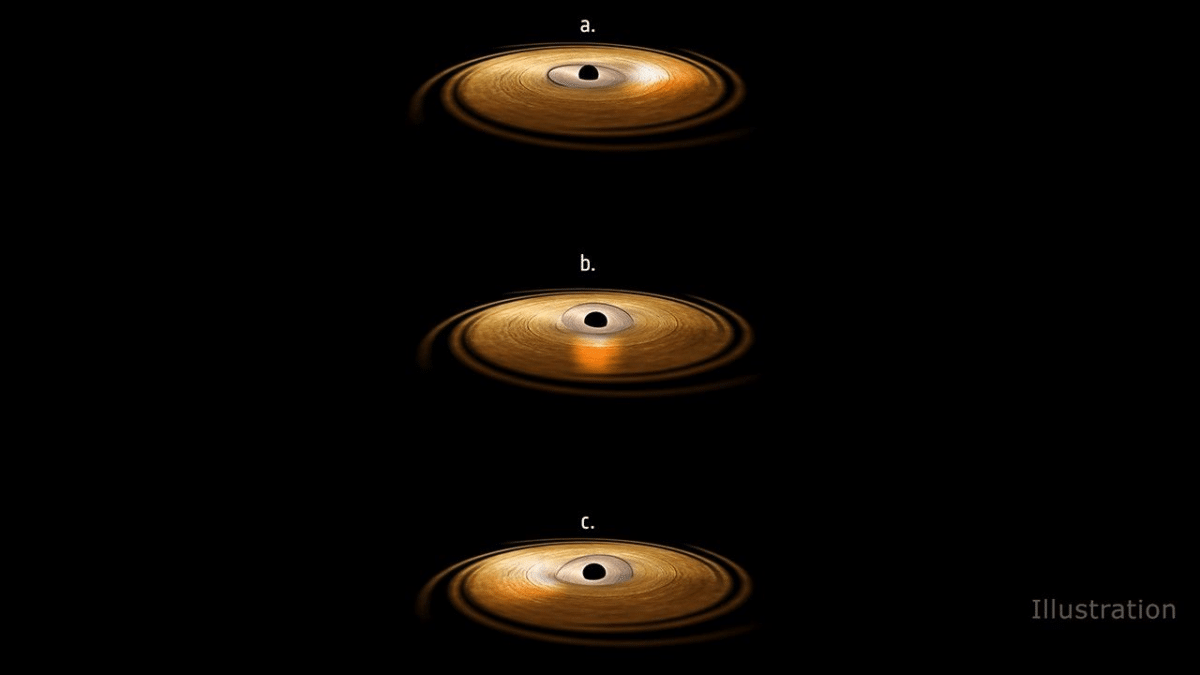 An artist’s impression depicts the accretion disc surrounding a black hole, in which the inner region of the disc wobbles. In this context, the wobble refers to the orbit of material surrounding the black hole changing orientation around the central object. Credit: NASA
The team used electromagnetic spectroscopy to analyze the material swirling around the black hole, confirming that both the disk and the jet were coprecessing, wobbling together in a synchronized way. These findings went beyond simply identifying energy shifts; they signaled the actual mechanics of frame-dragging in action.
As Dr. Inserra explained:
“Unlike previous TDEs studied, which have steady radio signals, the signal for AT2020afhd showed short-term changes, which we were unable to attribute to the energy release from the black hole and its surrounding components. This further confirmed the dragging effect in our minds and offers scientists a new method for probing black holes.”
The gravitomagnetic influence of the black hole, the curved path that matter takes when caught in warped spacetime, is now measurable in real-time. This extends our understanding of black hole spin, jet formation, and even the fate of matter consumed by gravity’s most extreme manifestation.
The Gravitomagnetic Field And The Nature Of Cosmic Rotation
At the heart of the frame-dragging effect is a physical analogy: rotation causes influence. Just as a spinning charge produces a magnetic field, a spinning mass, especially one as dense as a black hole, generates a gravitomagnetic field that distorts the spacetime fabric itself.
This concept has been theorized for over a century, but now, with instruments sensitive enough to detect subtle shifts in emissions across the electromagnetic spectrum, it has become a demonstrable reality.
Dr. Inserra offered a compelling metaphor:
“By showing that a black hole can drag space time and create this frame-dragging effect, we are also beginning to understand the mechanics of the process.
So, in the same way a charged object creates a magnetic field when it rotates, we’re seeing how a massive spinning object – in this case a black hole – generates a gravitomagnetic field that influences the motion of stars and other cosmic objects nearby.”
This deepens the astrophysical connection between mass, motion, and spacetime geometry, potentially influencing how we model galaxy evolution, jet dynamics, and the long-term behavior of accretion systems.
A Cosmic Reminder During A Season Of Reflection
While the technical details of the discovery are sophisticated, its significance touches on something deeply human, the wonder of cosmic exploration. These findings don’t just validate a scientific theory, they open new windows into the workings of the universe at its most extreme.
In Dr. Inserra’s words:
“It’s a reminder to us, especially during the festive season as we gaze up at the night sky in wonder, that we have within our grasp the opportunity to identify ever more extraordinary objects in all the variations and flavors that nature has produced.”
By pushing the limits of observation, this study shows that we are now able to detect not just matter and light, but the invisible contours of spacetime itself, bent and twisted by forces predicted over 100 years ago.