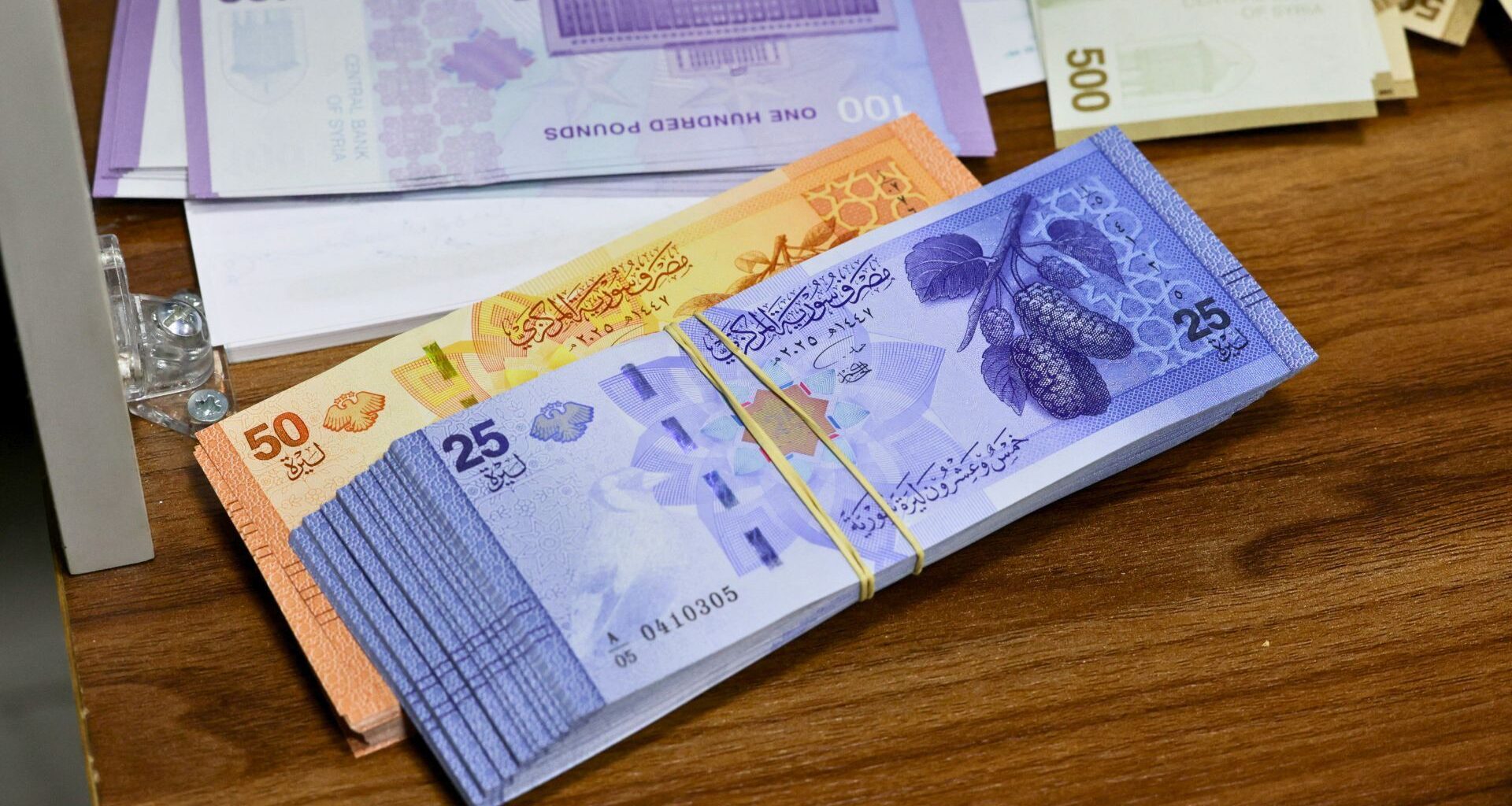
Authorities remove two zeros from the pound, hoping to simplify transactions and regain trust in the battered currency.
New banknotes have arrived at money exchanges across Syria, replacing those showing ousted longtime ruler Bashar al-Assad and his family, as the fledgling government hopes the Syrian pound can regain some of the value lost over more than a decade of war.
The redesigned notes have been months in the making and are part of a broader effort to stabilise and revitalise the economy and rebrand the state.
Recommended Stories list of 4 itemsend of list
The Syrian pound’s value has been drained, and inflation recently reached triple digits. Towards the end of 2025, an unnamed official told the Reuters news agency that the Central Bank of Syria had just $200m in foreign exchange reserves. At the end of 2010, it had $17bn.
Improving the standing of the Syrian pound is among the greatest challenges for Syria’s new authorities, alongside recurrent internal and external security challenges.
Two zeros have been removed from the old currencies in a process known as redenomination.
After unveiling the banknotes last week, Syrian leader Ahmed al-Sharaa said the new currencies mark “the end of a previous, unlamented phase and the beginning of a new phase that the Syrian people … aspire to”.
“The new currency design is an expression of the new national identity and a move away from the veneration of individuals.”
The new bills, which range from 10 to 500 Syrian pounds, entered circulation on January 1. They show images of roses, wheat, olives, oranges and other agricultural symbols for which Syria is famous.
![Syria economy [Screengrab/Al Jazeera]](https://www.europesays.com/us/wp-content/uploads/2026/01/Screenshot-2026-01-05-095125-1767596118.png) Syrians were forced to carry huge wads of old banknotes even for basic needs like grocery shopping [Screengrab/Al Jazeera]‘Ridiculous’ to see al-Assad on pound
Syrians were forced to carry huge wads of old banknotes even for basic needs like grocery shopping [Screengrab/Al Jazeera]‘Ridiculous’ to see al-Assad on pound
Muhammad Zaar, a Damascus resident, told Al Jazeera that he was happy with the change.
“At least we get rid of this previous president. It is ridiculous to see his picture on our money,” he said.
Al Jazeera’s Ayman Oghanna, reporting from Damascus, said the move was aimed at simplifying transactions, boosting economic recovery and rebranding the country.
“What a country prints on its currency says a lot about what it wants to be,” Oghanna said.
“These new denominations are designed to make a clean break from Syria’s past while legitimising its new government.”
The Syrian authorities have been striving to bring life back to a flatlining economy, including its payment systems, after nearly 14 years of ruinous civil war.
Since the start of the war in 2011, the pound, before it was denominated, had plunged from 50 to about 11,000 against dollars. Syrians had to carry huge wads of banknotes even for basic needs, such as grocery shopping.
The removal of the zeros does not impact the currency’s value.
The United States announced its permanent lifting of the so-called Caesar sanctions, paving the way for the return of investments to Syria after years of economic isolation.
Moreover, Gulf Arab states, including Qatar and Saudi Arabia, have made significant financial investments worth billions in the nation, creating an additional economic lifeline.
![Syria economy [Screengrab/Al Jazeera]](https://www.europesays.com/us/wp-content/uploads/2026/01/go-1767596341.png) Damascus residents say it will be easier to carry money around after the changes [Screengrab/Al Jazeera]
Damascus residents say it will be easier to carry money around after the changes [Screengrab/Al Jazeera]