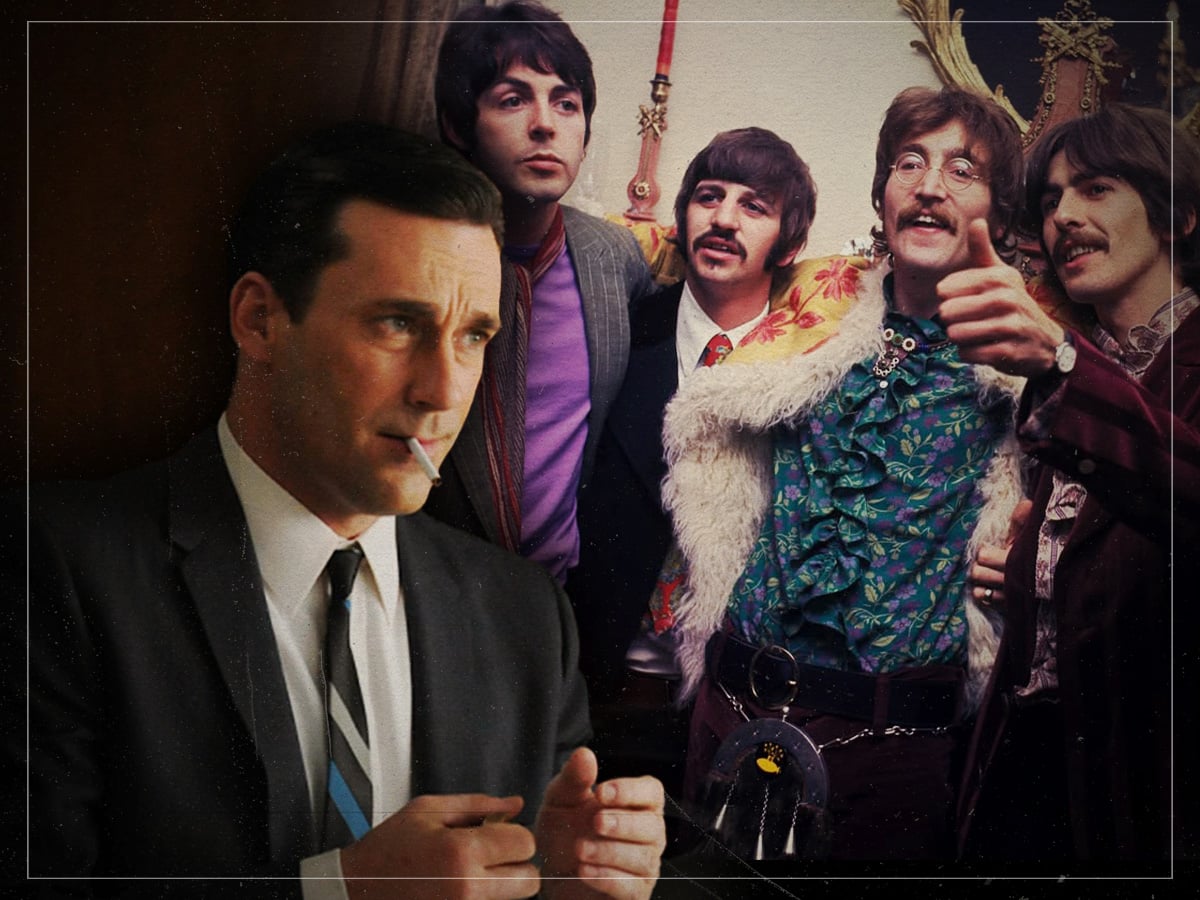
(Credits: Far Out / AMC / Apple Corps)
Mon 5 January 2026 7:00, UK
From the moment The Beatles’ catalogue was finally dumped onto all the streaming services a decade ago, the Fab Four have felt slightly more accessible – for better and worse – and certainly more active as a 21st-century commercial entity, with Disney Plus now serving as the band’s approved documentary factory.
That said, the protectors of the Beatles brand are still quite pernickety about licensing original songs out for use in film and television projects outside their own creative control. Demand for Beatles needle-drops, as you would imagine, has always been extremely high, but in most cases, the price has been even higher.
Cover versions of Beatle classics will pop up quite a lot on soundtracks, and you’ll get an occasional oddball like the film like Yesterday, in which the whole concept is essentially the Beatles’ greatest hits getting performed badly by the lead actor (Himesh Patel). Hearing the actual Beatles performing a Beatles song remains exceedingly rare in the film and TV landscape, however.
This helps explain why the final scene in a certain 2012 episode of the prestige TV series Mad Men wound up making headlines, not because of any major developments in the misadventures of advertising exec Don Draper, but for the surprise inclusion of at least one solid minute of ‘Tomorrow Never Knows’, direct from John Lennon’s mouth and the original 1966 Beatles recording.
In some ways, this needle drop should have felt perfectly natural, as the events of the fifth series of Mad Men are set across 1966 and 1967, when the Beatles were still ruling the pop world and logically should have been regularly heard in the background as the characters moved about their lives, from their apartments to department stores to office parties. But, because of the aforementioned tight lid on Beatle music licensing, no such moment had occurred before this one.
“It was always my feeling that the show lacked a certain authenticity because we never could have an actual master recording of the Beatles performing,” Mad Men showrunner Matthew Weiner told the New York Times after the episode, titled ‘Lady Lazarus’, had aired. “It always felt to me like a flaw. Because they are the band, probably, of the 20th century.”
To fix that flaw, it wasn’t just a matter of money. Thanks to Mad Men’s success as one of the most revered shows of its era, its producers at Lionsgate were willing to fork out the required $250,000 to license a Beatles’ tune, but Apple Corps still wanted to know the context in which the song would be used before officially giving its permission.
“I had to do a couple things that I don’t like doing,” Weiner said, “Which is share my story line and share my pages. . . . It was hard, because I had to, writing-wise, commit to the story that I thought was worthy of this incredible opportunity. The thing about that song in particular was, the Beatles are, throughout their intense existence, constantly pushing the envelope, and I really wanted to show how far ahead of the culture they were. [‘Tomorrow Never Knows’], to me, is revolutionary, as is [Revolver].”
Within the storyline of Mad Men, the heavy, futuristic psychedelia of ‘Tomorrow Never Knows’ was the ideal track to contrast with the latest plight of Don Draper, who is encouraged to listen to Revolver by his much younger girlfriend Megan as a way to better understand the youth culture he’s feeling out of touch with. Watching Draper absorb the music, we wonder if it might be an eye-opening moment for him, but instead, he swipes the needle off the record well before the song is over. He’s even more out of touch than he thought.
Interestingly, despite the substantial price paid, Matthew Weiner defended the Apple Corps folks and their high demands, believing their hearts were in the right place. “Whatever people think, this is not about money,” he said. “It never is. They are concerned about their legacy and their artistic impact.”
Related Topics