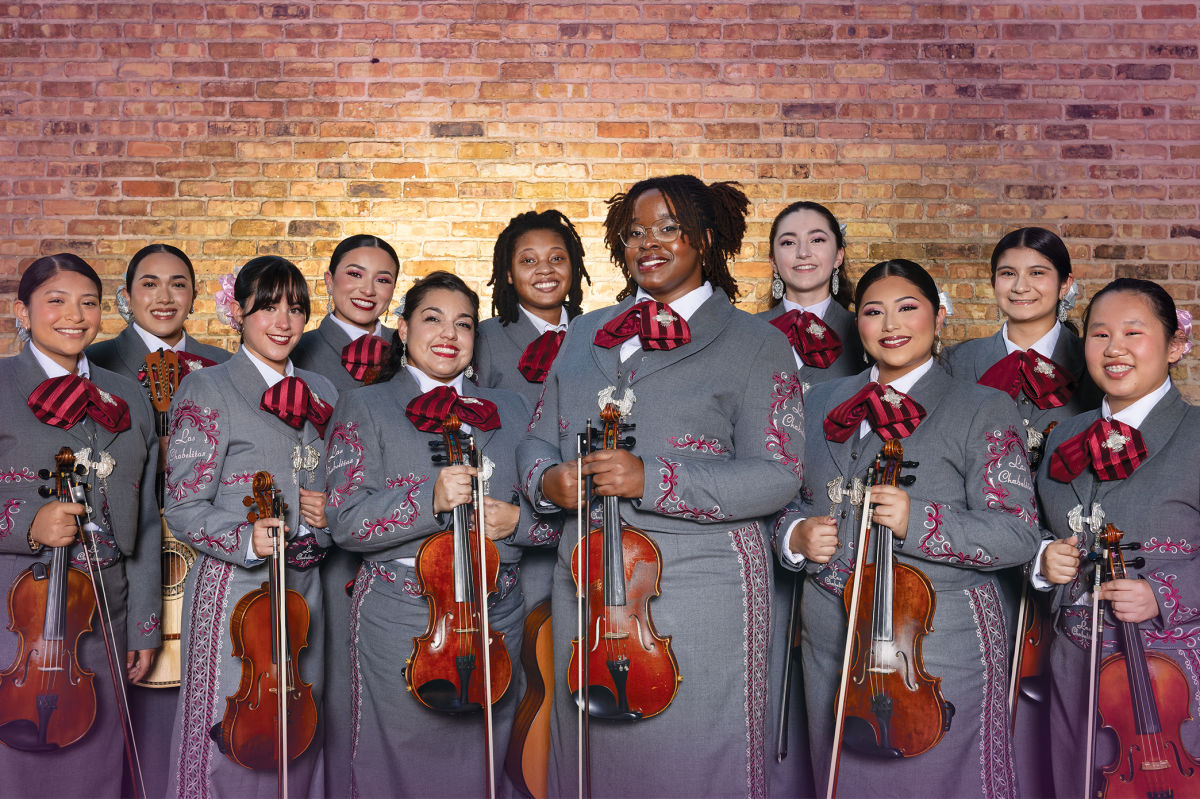
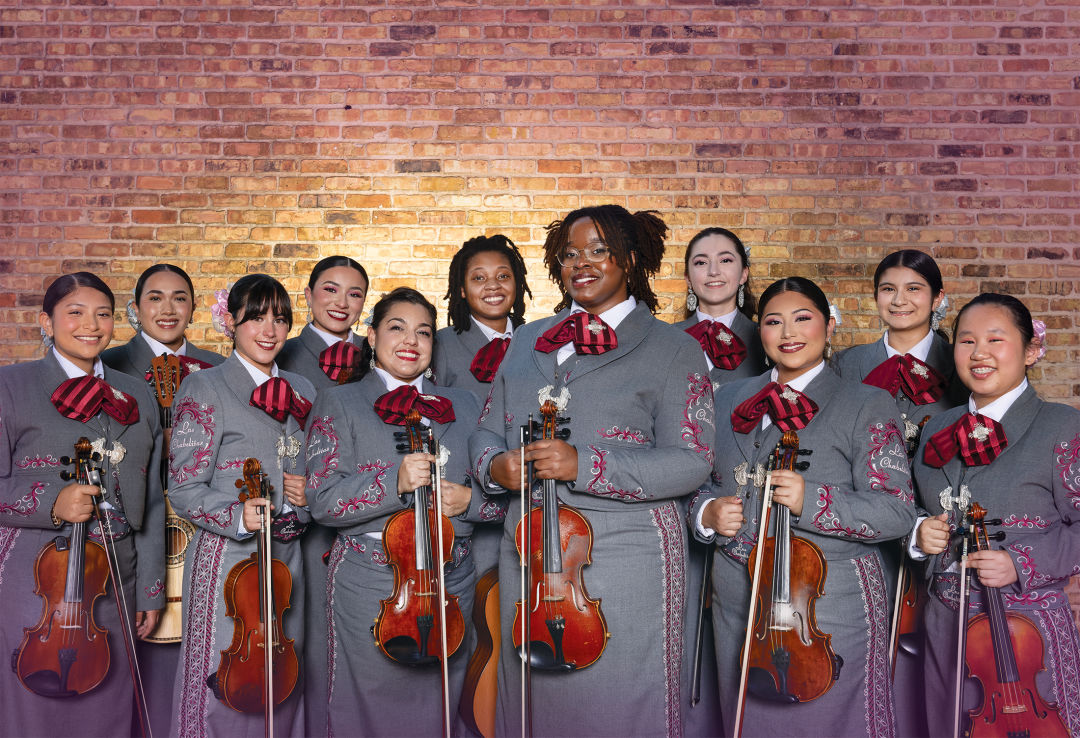
Members of Las Chabelitas (including Alysia García-Garza, fourth from right).
The air at Talento Bilingüe de Houston pulsates with the sounds of guitars, violins, and soaring voices as 14 women dressed in gray suits with burgundy embroidery take the stage. Shoulder to shoulder, they launch into a familiar, jaunty tune—but with a sound that is anything but traditional.
For centuries, mariachi music was defined by machismo—charro uniforms modeled after horsemen, songs steeped in bravado, stages dominated by men, and a world in which women were expected to sit in the audience. That’s changing. Across Houston, all-female bands like Las Chabelitas and Mariachi Amor a México are rewriting history and showing a new generation of girls that mariachi belongs to them, too.
“Being a part of an all-female mariachi group means not only carrying the tradition of it, but [also] the progress,” says Alysia García-Garza, a member of Las Chabelitas. In a city celebrated for its cultural intersections, the rise of women feels especially resonant. Houston’s mariachi scene reflects the city itself—diverse, evolving, and unafraid to challenge old boundaries. It’s about “honoring the roots of mariachi but showing that women do have this powerful place in this world and this music,” García-Garza says.
Mariachi traces back to nineteenth-century western Mexico, where rural ensembles laid the foundations for what became a national sound. The musical genre eventually made its way to Mexico City following the Mexican Revolution. “The ensemble got bigger, and more instruments were added, like the trumpet,” says Lauryn Salazar, an associate professor of music at Tarleton State University in Stephenville, Texas, and a member of the all-female band Mariachi Divas. By the early twentieth century, mariachi spread to Texas, beginning with Texas-Mexican conjunto performances at Haymarket Square in San Antonio. The genre gained even more popularity through the 1960s with the arrival of more Mexican immigrants, who brought their culture and traditions with them. Texas, with its ever-growing Hispanic population, had embraced mariachi on its radio waves and at community gatherings. “It’s an accessible type of music,” Salazar says. “Mariachi tends to be about celebratory music, and there’s a repertoire for any occasion you can think of.”
Female mariachis emerged early, but they remained on the margins of the scene. “In Mexico, women have always been involved in mariachi, but as with a lot of fields, their contributions have largely been invisible,” Salazar says. Even instruments were “highly gendered,” she adds. “In Latin America, harps and trumpets are considered very masculine, so if you’re a woman who plays one of these instruments, you used to get a lot of crap for it.”
While female band members face criticism from older or traditional audiences who cling to what they believe is the “authentic standard,” in Houston, that bias is slowly eroding. School programs have played a significant role, Salazar says. Texas served as a leader in mariachi music education, offering mariachi classes as early as the 1970s. Today, students can find programs in schools in Houston and around the country. “Now, you have a first generation of students who’ve learned mariachi through school systems and who’ve only ever played in a mixed gender group,” Salazar says. Such progression and inclusion around the country have made all-female ensembles seem possible.
At University of Houston, mariachi director José Longoria saw an opportunity. Inspired by the talented young women he coached at UH’s mariachi camp and by generations of mariachi players in his family, Longoria quietly assembled a roster and launched an all-female band. The name is a feminine play on his nickname ‘Chabelo,’ itself taken from his middle name, Isabel. The group comprises more than a dozen women and young girls, spanning ages 15 to 41. Donning bows in their hair and sparkling jewelry, Las Chabelitas made their debut in December. Today, they stand at the forefront of Houston’s mariachi scene, pushing the boundaries and expanding traditional music. “When they put on that mariachi uniform, there’s this certain confidence that that person creates inside of them, and as a team, that’s even stronger,” Longoria says.
Challenges, however, remain. Men still hold the reputation of playing instruments that are larger, heavier, and more challenging to maneuver, and Longoria says it’s still difficult to recruit women to play the guitarron and trumpet. That hasn’t stopped the Las Chabelitas.
García-Garza says she’s determined to be a “stepping stone” and to one day perform alongside the best professional female mariachi singers in the world. For Longoria, it’s about passing the torch. He realizes the future of mariachi is bright—shaped not just by the women performers in charro suits but also by the young girls in the audience, who could, for the first time, be imagining themselves in these roles. “They can inspire us through their experience in an all-female group, for when it’s time for the next person to do it,” Longoria says. “I want them to be inspirational and motivate other girls to join their group.”
That’s what drives García-Garza most. “To every girl, I would tell them to never be afraid to take up that space, to show that talent, to show that dream,” says García-Garza. “To show that you are there for a reason.”