As of Monday, the NBA trade deadline is one month away. All has been quiet so far, but with the Oklahoma City Thunder looking more vulnerable than they did at the beginning of the season and the Eastern Conference’s fourth through eighth seeds bunched together, it would be a surprise if things stayed that way.
The Athletic senior NBA writers Sam Amick, Josh Robbins and John Hollinger got together to talk about the stories, players and teams they are most closely monitoring.
What leaguewide story are you monitoring most closely as it relates to the trade deadline?
Amick: It pains me to be so predictable, but the only answer here is Giannis. Even if he doesn’t get traded before Feb. 5 — and I still think that’s the most likely outcome — the delicate dynamics in Milwaukee make it impossible to look away. Yet even beyond Antetokounmpo’s confusing response to the most recent report about his possible departure, it’s the continuation of the on-court issues that make you wonder if he might finally, and firmly, ask for a trade in these coming weeks.
They lost to the Wizards on Wednesday night, people. The Wizards.
That game alone served as a reminder that Antetokounmpo is miles away from the career goals that he has never been shy to share. At 31 and four years removed from the title that he desperately hopes isn’t his last, the harsh truth is that these Bucks are nowhere near contention. Longtime general manager Jon Horst is known to be on the lookout for an impact player who could change the mood in the second half of the season, but it’s hard to see how he digs the Bucks out of this mess.
Robbins: The large volume of star players, and even superstar players, who could be available at the deadline is fascinating.
Sam mentioned Giannis already. Then there’s Anthony Davis. Those are superstars who potentially could change teams. And then there are the stars: LaMelo Ball, Ja Morant and Trae Young.
Let’s not obsess over the “superstar” and “star” labels. My overall point is that these are five big-name players who have oversized on-court impacts, and they all could be available. The trade deadline almost always yields surprises. But in this cycle, smoke already hovers over Giannis, A.D., Ball, Morant and Young.
Hollinger: As much as I want to be an ATL homer and talk about Young or potential Davis trades, Giannis is the one guy possibly in play at this trade deadline who can alter the balance of power in the league. It makes all kinds of sense for both parties to move on, and yet it’s in this odd situation reminiscent of Damian Lillard’s endgame in Portland, where neither side wants to be the bad guy and push the eject button.
If we’re looking for a deeper trend, let me throw this one out there: Will teams continue to be as profligate with unprotected picks in trades for elite players as they’ve been in recent years, or will they be chastened by examples of teams like the Clippers and Pelicans seeing it potentially blow up in their faces this June?
Giannis Antetokounmpo and Anthony Davis are the two superstars potentially on the trade market. Which teams will they be on after the deadline, and why?
Amick: I … think … Giannis will be on the Bucks? Even if he decided to bring the hammer and ask out forcefully, it takes two to tango. And considering Horst is going to be looking for a major return if he’s trading one of the best players of all time, it’s hard to imagine that even the most serious suitors could satisfy those demands midseason.
As for Davis, my spidey sense tells me that he’ll also be staying put. Midseason trades are inherently more complicated than the summertime variety, and the Mavericks are in the midst of an organizational transition that makes this kind of deal difficult to navigate. After firing general manager Nico Harrison in November, then handing the front office reins to incumbent executives Matt Riccardi and Michael Finley, it remains unclear who will be in charge of the roster after this season. When it comes to the PR battle, the fact that Davis was the centerpiece of the ill-fated Luka Dončić trade with the Lakers makes it that much harder to find a deal that might satiate these frustrated fans.
Robbins: There’s not much I can add about Giannis that Sam hasn’t already said. But I would like to emphasize that there’s a lot that we don’t know yet about his situation. Just how much does he want a change of scenery? A little or a lot?
As for A.D., he has dealt with enough injuries in recent years that it seems implausible to me that a contending team would be willing at midseason to offer the haul that the Mavericks would want for him. How can a contender count on Davis to be available at playoff time — or count on his availability enough to warrant trading significant draft capital? Any trade involving Davis might require the participation of multiple additional teams, and a large multi-team deal could be so complicated that it would be easier to accomplish during the offseason.
Hollinger: Giannis is the easier for me: I think he’ll be on the Bucks, because I don’t think either side in that marriage has it in them to be the ones to show up to the dinner table with a divorce lawyer. Summer? That might be a different story.
One counterpoint I’ll offer to my own prediction: The Bucks could still tank this season and get a high draft pick even though they owe a pick swap to the Pelicans, because the Pels are so bad that the “second best” of the Bucks’ and Pels’ picks still might be very high. There’s a chance both could luck into top-four lottery slots.
That’s why I think it’s sensible for the Bucks to trade Giannis. But I also don’t think they’ll do it.
As for Davis, I’ll go with “Not Dallas” by a hair over “Dallas.” I don’t have a perfect trade partner for him, but I think Dallas’s price for him will be reasonable enough that some center-deprived team will talk themselves into taking the plunge for him at the trade deadline. The tricky part for any acquiring team will be managing expectations on Davis’ potential extension number in the offseason. At this point in his career, giving him the full-boat deal he’s eligible for (four years, $275 million) would be reckless.
If you were running a team, accounting for salary and acquisition cost, which guard would you be most interested in: Ja Morant, LaMelo Ball or Trae Young?
Amick: I’m definitely guilty of recency bias here, but the answer — given what happened on Tuesday night — is Morant. If you didn’t watch him drop 40 on the Sixers in that overtime loss in Memphis, then you’re forgiven for forgetting how electric his game can be. Beyond the stat line — 16 of 22 from the field(!) — it was his nonstop motor and sheer will to win that made me do a double-take while watching the game in my home office.
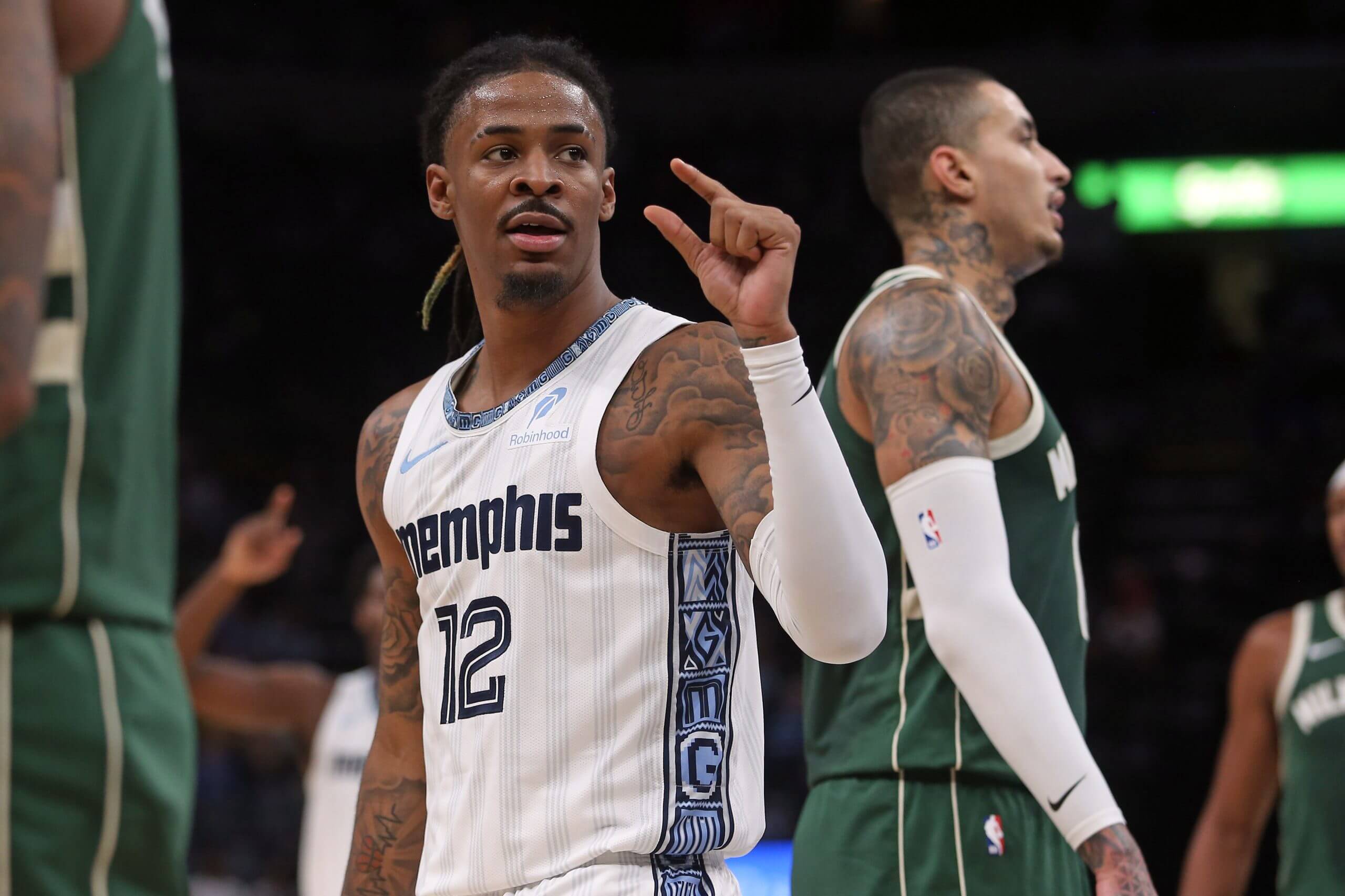
Despite lack of availability, Ja Morant’s flashes of brilliance still make him an attractive trade target. (Petre Thomas / USA Today Network via Imagn Images)
It had been a while since we saw that guy showing out like that. And even with all the off-court concerns that come with Morant, he still shows flashes of being able to carry a franchise. After all, that was his developmental arc not too long ago. He’s still just 26 years old, with two guaranteed seasons on his deal after this one ($87 million combined), meaning any team that trades for him gets a good, long look with him before finding out if he’s worthy of being someone else’s franchise player. He went back to his struggling ways three nights later in a loss to the Lakers, but you wonder if that special something is still in there somewhere.
Robbins: This question speaks to the risks inherent with Ball, Morant and Young, which explain why they might be available in the first place.
Morant is the best all-around player of the three. On that, Sam and I agree.
Still, I would go with Young. For all his struggles on defense, Young led the Hawks to the Eastern Conference finals in 2021, when they lost to the Milwaukee Bucks, the eventual champions. I have two important caveats here. First, a team that would trade for Young would have to have more than enough defense already on its roster to compensate for his deficiencies on that end. Second, because Young has a player option for the 2026-27 season, any team that would trade for him would need to have a strong sense ahead of time of what it would take to re-sign him, and then must be comfortable with that cost, or the eventual cost after negotiating.
Hollinger: Young, because you know what you’re getting so it’s much easier to value him properly in a trade. He doesn’t have the reliability issues that the other two have, which should make a team much more comfortable making him a core piece of whatever they’re doing.
Here’s how stark that difference is: Young has four different seasons that would be a career high in games for Morant, and three for Ball. Over the last five years before this one, he’s played an average of 68.4 games a year, while Morant is at just 48.0 and Ball 46.2.
That doesn’t mean Trae becomes a team’s A-1 star; I think realistically he’s no better than the second-best player on a true contender. But he’s more reliable in that role than Ja or LaMelo.
Which role player on a team projected as a seller do you believe a contender should be most aggressive in acquiring?
Amick: Is Michael Porter Jr. a role player? His numbers might say no, as he’s averaging 25.9 points, 7.6 rebounds and 3.4 assists for the Nets. Per NBA.com, only three other players are hitting those marks (Nikola Jokić, Dončić and Antetokounmpo).
Still, his six seasons with the Nuggets, especially the 2023 title run, showed that he is more than good enough to be a difference-maker on a title contender as a third and sometimes fourth option — so long as he is healthy. That doesn’t mean he can’t be a go-to star himself, and he may very well become an All-Star this year as Brooklyn’s Alpha. But the combination of his shooting (40.8 percent on 9.1 three-point attempts per game) and contract (a hefty $38.3 million owed this season and $40.8 million next season) make him an interesting name to watch. There’s real impact here, and a relatively short runway financially so long as the money makes sense for your payroll.
As I reported on Wednesday, the Bucks are looking at Porter. For them and any other suitor that emerges in these coming weeks, he’s a tempting possibility, even if there are some red flags surrounding his situation.
Robbins: Contenders can never have enough high-level 3-and-D players, especially at playoff time. That’s one of the lessons that last season’s two NBA Finals teams, the Oklahoma City Thunder and Indiana Pacers, reinforced to the rest of the league.
If we look at teams that could be sellers, I would inquire about Phoenix’s Royce O’Neale and New Orleans’ Trey Murphy III.
The surprising Suns are in the playoff hunt in the West, but it seems reasonable that they at least would have to listen if a potential trade suitor is willing to help replenish their cupboard of future draft picks. O’Neale also owns a reasonably priced contract; he’s in the second year of a four-year, $42 million contract.
Murphy is the kind of player whom players on other teams regard as underrated. At 25, he’s young enough to expect more seasons of improvement from him, especially if he’s playing alongside a contending core. The Pelicans’ asking price in a trade almost certainly would be significant.
Hollinger: I don’t see Brooklyn trading Porter when they have a strong incentive to be good next year (pick swap with Houston), nor do I see the Pelicans being in any hurry to move on from Murphy (or the low-key productive Saddiq Bey, for that matter) when both have years left on their deals. Yes, teams absolutely should be asking about Murphy, but I’m not sure asking nicely is going to get them very far. Myles Turner is another interesting name, but obviously he’d only be available if the Bucks also decided to move on from Giannis.
So let me instead throw another name out there: Justin Champagnie of the Wizards. While many are familiar with his brother Julian after his Champagnie Supernova against the Knicks on New Year’s Eve, it is Justin who is stuck on a Wizards team that has other priorities for wing minutes, despite that this Champagnie has also proven to be a useful 3-and-D piece. He is also on an amazing contract that has him at near-minimum salary for two seasons beyond this one, allowing him to fit into any cap structure.
Which team that is neither at the top nor the bottom of the standings would you most like to see make a definitive move, whether it is to improve or trade its best players?
Amick: Antman needs another superhero on his squad.
While Anthony Edwards’ Timberwolves still have plenty of time to right their ship, this 23-13 start has been so concerning to the people responsible for it that they’re routinely sounding the alarms these days. Edwards left the bench and headed for the weight room with nearly eight minutes left in a loss against Atlanta on Wednesday night — as clear a sign as any that he’s fed up. Head coach Chris Finch has had multiple postgame press conferences that indicate the same.
After two consecutive trips to the West finals, the sense of urgency to make that next step is understandably strong. And with team president Tim Connelly widely known to be among the most aggressive executives in the entire league, it wouldn’t surprise me in the slightest if he found a way to land a high-profile player before Feb. 5 arrives.
Robbins: Orlando already made its all-in move when it traded for Desmond Bane over the summer, and Bane has made a strong impact that’s increased month to month as he’s grown more comfortable with his new team. But the Magic still need more shooting for the playoffs, when the pace will slow down to more of a half-court game. Ideally, any addition in shooting would not hamper the defense much. Someone like O’Neale would be ideal for them because he would provide defense and would be a threat to shoot from the corners when Paolo Banchero or Franz Wagner attempt to create.
Hollinger: How about a team at the bottom making a move to improve? The Indiana Pacers need to start building next year’s team now by getting a center on the trade market rather than waiting until free agency in July. Indy will be constrained by the non-taxpayer midlevel exception in the best-case scenario in the summer, but has a window where it could acquire a more expensive player in a trade by sending out contracts, including the expiring deal of likely restricted free agent Bennedict Mathurin.
Bringing back Tyrese Haliburton plus three of the other four starters from their Eastern Conference title run in 2025 and key subs T.J. McConnell and Obi Toppin, plus adding a high lottery pick, should make Indy strong again. But they haven’t replaced the departed Myles Turner, and they can’t realistically contend in 2026-27 as an exclusively small-ball team.