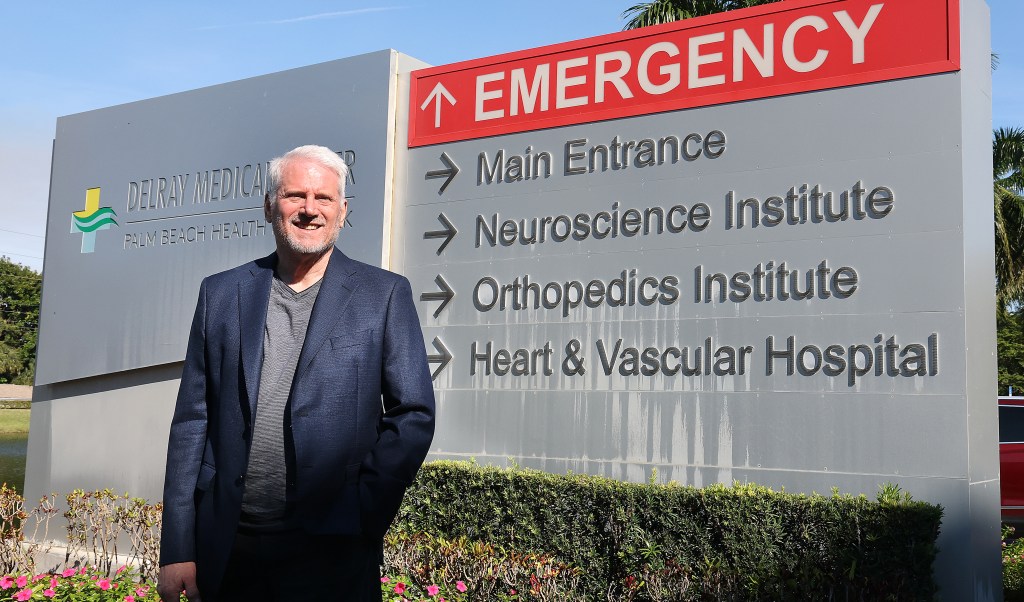
By all measures, Dr. Tim Williams should not be alive.
Williams, 69, has survived a fall while home alone, a brain bleed, a coma for nine days, and in-bed surgery to drain fluid buildup in his brain — and a major recovery effort.
“There’s at least three times I could have easily died,” Williams said.
Williams had previously spent his days overseeing the delivery of radiation therapy to patients as the director of The South Florida Proton Therapy Institute at Delray Medical Center. But on the first Saturday in March, he was at his Lake Worth Beach home, alone.
Sara, his wife of only a few months, was hundreds of miles away in Washington, D.C., and felt something was wrong when her husband didn’t respond to her morning calls and texts. She asked a neighbor to check on him. The neighbor found Williams semi-conscious on the floor with a bruise on his head and called for an ambulance.
Williams said when the emergency crew arrived, his brain was in an “active bleed.”
It’s unclear if the otherwise healthy doctor fell and hit his head, causing the brain bleed, or if an aneurysm caused the bleed and fall. Regardless, his medical condition became precarious.
“It is as if your body is an hourglass, and every second that passes places you in more peril as your life force is leaking out through the bottom,” he said. “If appropriate care isn’t delivered within time, the sand runs out, and your next stop is the funeral home. No one on earth knows the exact amount of time you have left. One thing is clear, though, is that there isn’t much. It is measured in minutes, not hours.”
Inside the ambulance, his condition deteriorated quickly. Emergency crews typically take patients to the nearest hospital, but they suspected a stroke and took Williams to Delray Medical Center, a recognized Comprehensive Stroke Center.
“If there is one thing I am sure of, it is that if it weren’t for the quality and professionalism of the physicians and staff at Delray Medical Center, I would have died. I’m a very lucky guy. My journey has taken me from being perhaps 15 minutes from death to an almost complete recovery.” — Dr. Tim Williams
Later, Williams wrote a thank-you letter to the hospital staff describing the events.
“I’ve been on the staff at Delray Medical Center since 1989 and served four years as a member of the senior governing board. None of this was known to anyone involved on the morning of March 1, 2025, when the ambulance picked me up, near death, on the floor at the foot of my bed,” Williams wrote. “My neurologist would later tell me that, at the time, I only had perhaps another 20 to 30 minutes to live.”
Hospital staff immediately took a scan that showed a severe brain bleed.
“They couldn’t tell if it was a full-blown stroke or aneurysm or any of that, but they did see blood,” Sara Williams said. “So it was just kind of a waiting game to see if the blood would drain the normal way, but it didn’t. He just got worse and worse and worse.”
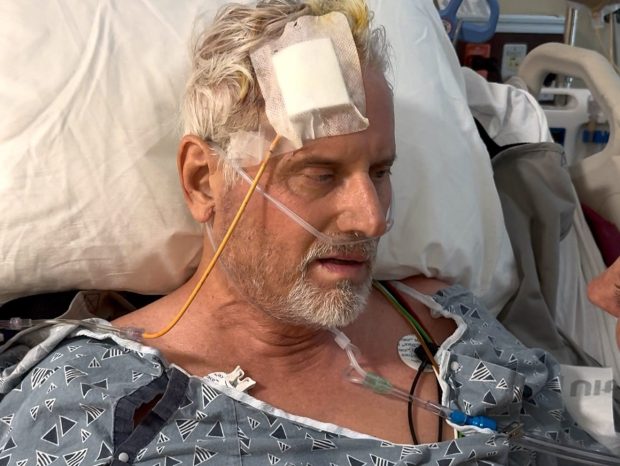 Stroke survivor Dr. Tim Williams during his time in the Delray Medical Center. (Sara Williams/Courtesy)
For three days, Williams drifted in and out of consciousness, only to suffer a huge setback. He became completely confused, an indication of fluid buildup in his brain. The staff did another MRI.
“Completely unconscious, blood pressure dropping, I was hauled immediately back to radiology for an emergency MRI scan of my brain,” Williams said. “The images were bleak. Blood was everywhere. … This prompted a spinal tap, which showed blood around my spinal cord. And, as if that wasn’t enough, my brain was swollen.
“I was dying, again,” he said.
Neurosurgeon Dr. Ron Young arrived to see his friend in trouble. “When I got there, he was barely responding at all,” Young said.
With no time to secure an operating room, Young called for a craniotomy tray and, at the bedside, drilled a hole in Williams’ scalp. He stuck a small drainage tube into the middle of Williams’ brain.
“Within a few minutes, he was more responsive and started talking,” Young said. “Bleeds are relatively common. We see this fairly often. Not finding the cause is quite uncommon.”
Young said it’s a true miracle that Williams survived all he endured: “If appropriate treatment isn’t delivered, outcomes are poor,” he said.
Soon after Young drained the fluid, Williams slipped into a coma, where he remained for nine days. During that time, he battled aspiration pneumonia, yet he doesn’t remember anything.
When he finally awoke, he had a long, hard recovery ahead.
“He was not mobile whatsoever,” Sara Williams said. “The physical therapy staff came for the first time to stand him up and get him out of the bed, and that’s when we found out that he wasn’t able to walk.”
At rehab, Williams underwent physical therapy, occupational therapy, and speech therapy.
After 43 days at Delray Medical Center and then its rehabilitation facility, Williams finally went home — still unable to fully walk or use his hands and struggling with short-term memory.
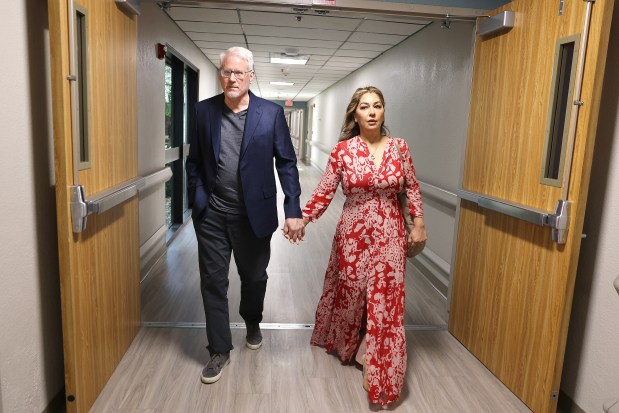 Dr. Tim Williams and his wife, Sara Williams, visit Delray Medical Center on Friday. Williams, the director of the hospital’s proton therapy center, became a patient there after collapsing at home. He survived a stroke, nine days in a coma, an in-bed surgery and a long recovery. (Carline Jean/South Florida Sun Sentinel)
“When we came home, it was actually the scariest part of the whole ordeal,” his wife said. “He was tired a lot. He could not tolerate a lot of motion or activity around him.”
“It wasn’t summer camp, but I did everything I was told, worked hard, and did as much as possible to assist with my own recovery,” Williams said.
As a patient, rather than a doctor, Williams says he has seen health care from a different perspective: “If there is one thing I am sure of, it is that if it weren’t for the quality and professionalism of the physicians and staff at Delray Medical Center, I would have died. I’m a very lucky guy. My journey has taken me from being perhaps 15 minutes from death to an almost complete recovery.”
Nine months after his ordeal started, Williams says he still tires easily and describes himself as 80% back to normal. “I don’t think I’ll ever get back to 100,” he said.
He doesn’t plan to return to work in the same capacity.
“My clinical days are pretty much done. It’s too stressful. There’s too medical decision-making,” he said. Instead, he plans to conduct research in radiation oncology.
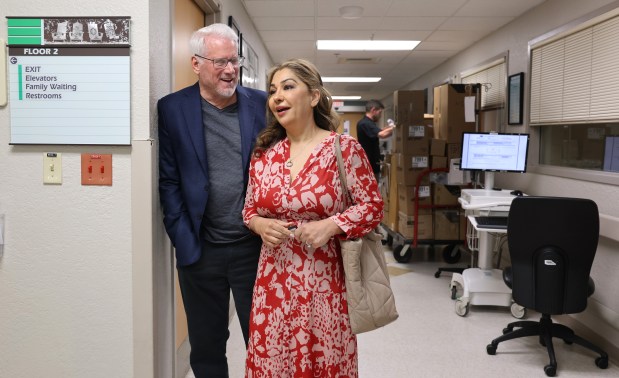 Tim Williams and his wife, Sara Williams, visit Delray Medical Center on Friday. Williams, the director of the hospital’s proton therapy center, became a patient there after collapsing at home. He survived a stroke, nine days in a coma, an in-bed surgery and a long recovery. (Carline Jean/South Florida Sun Sentinel)
Williams wants others to learn from his experience. He says the medical staff’s knowledge of strokes and brain bleeds in the neurology ICU made all the difference in his survival. The message he wants to get out is that anyone with stroke symptoms needs to go to a stroke center.
“I was in the right place at the right time,” he said. “I was lucky.”
South Florida Sun Sentinel health reporter Cindy Goodman can be reached at cgoodman@sunsentinel.com.