As the communities of Altadena and the Palisades continue to recover and rebuild one year after the deadly January 2025 wildfires, NBCLA is looking back at the disaster that forever changed lives, how the tragedies altered the landscape of Southern California and what’s next in the process of recovery and rebuilding.
We also spoke with some of the people who shared their stories of survival with us on Jan. 7, 2025 and the following days, when the fires were still burning in the San Gabriel Valley community and neighborhoods tucked between the Santa Monica Mountains and the Los Angeles County coast. Their stories of resilience will be featured this week in docuseries episodes on NBC4 and our streaming platforms during special coverage devoted to how the wildfires impacted Southern California.
Following each broadcast, the docuseries episodes will be published below.
Coming up — Episode 1, Monday at 5:30 p.m.: The first episode of “Palisades and Eaton fires: Devastation to determination,” airing Monday night, will focus on the first day of the fires from the intimate perspective of community members who lived through it and the NBCLA staff members who covered those first hours of the fires.
Jan. 7 marks one year since the deadly Palisades and Eaton fires, two destructive wildfires that would change the Southern California landscape forever. Jonathan Gonzalez reports for the NBC4 News at 11 p.m. on Jan. 4, 2026.
What happened on Jan. 7, 2025
On the morning of Jan. 7, the Palisades Fire erupted in the Pacific Palisades and quickly spread to thousands of acres. Fanned by powerful Santa Ana winds that had been in the weather forecast for days, the 23,700-acre fire became the ninth-deadliest and third-most destructive wildfire on record in California. Twelve deaths were reported in connection with the Palisades Fire, which destroyed more than 6,800 structures.
Hours later, as darkness fell and fearsome winds continued to plague firefighting efforts, another wildfire broke out in the hills above Altadena. The Eaton Fire grew to 14,000 acres, leaving 19 people dead and destroying 9,400 structures. It is the fifth-deadliest and second-most destructive wildfire in California history.
The first hours, the fires brought harrowing scenes of desperation and courage:
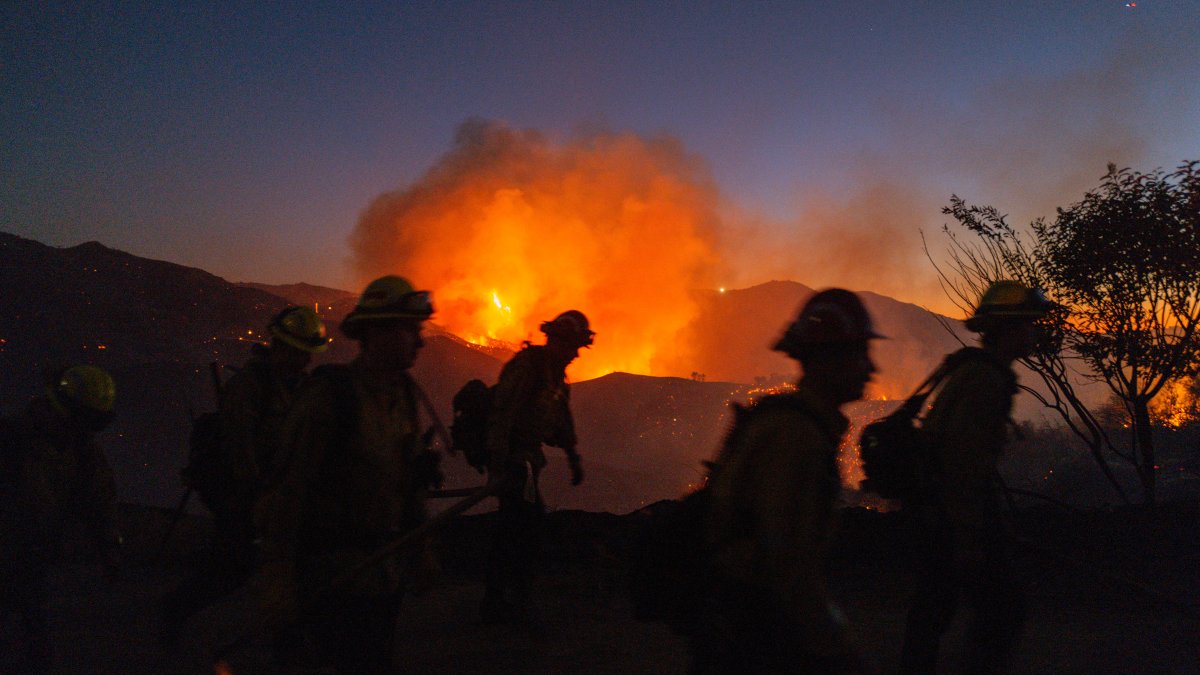
The first towering plume of dark smoke rising above the Los Angeles County coast, an image that confirmed what had been feared for days as fire weather conditions reached extreme levels was now happening. That night, an eerie orange glow in a dark canyon above Altadena, signaling the start of the Eaton Fire.
Scenes of gridlock on Sunset Boulevard and other streets out of the Palisades Fire zone coupled with a spine-chilling plea from law enforcement officers: “Get out of your car if you want to live.”
Residents of a senior center in Altadena, many in gowns and wheelchairs, evacuating as chaotic winds fanned smoke and glowing embers.
A man laden with bags packed with belongings and carrying paintings as he escaped his Pacific Palisades home on a bicycle in a storm of flames and embers.
Firefighting aircraft were grounded because of the ferocious winds that continued into the night. Hours later, the first daylight on the morning after the start of the fires revealed destruction on a massive scale. Homes and businesses representing hopes and dreams — in some cases, of several generations — had been reduced to rubbles and ashes in a heartbreaking scene.
Several smaller fires broke out during early January, a month that included more than a dozen days of red flag warnings, forcing fire crews to scramble in a desperate extended battle to protect lives and property.
The Palisades and Eaton fires were contained by the end of what had been a month of uncertainty and grief.
Mapping the spread of the Palisades and Eaton fires
The Jan. 7 fires sparked in exceptionally high-risk weather conditions that forecasters had been warning of for days. Dry and extremely windy conditions fanned flames, casting red-hot embers into the air that landed on trees, brush and buildings in a nightmare scenario for firefighters.
Several fires broke out that month, but the Eaton Fire in Altadena and the Palisades Fire in the Palisades area spread into densely populated neighborhoods.
The maps below show how the fires spread day-by-day. The progressions were determined by data tracking captured by Cal Fire. The perimeters were determined with satellite imagery, aerial surveillance, and on-the-ground reports.
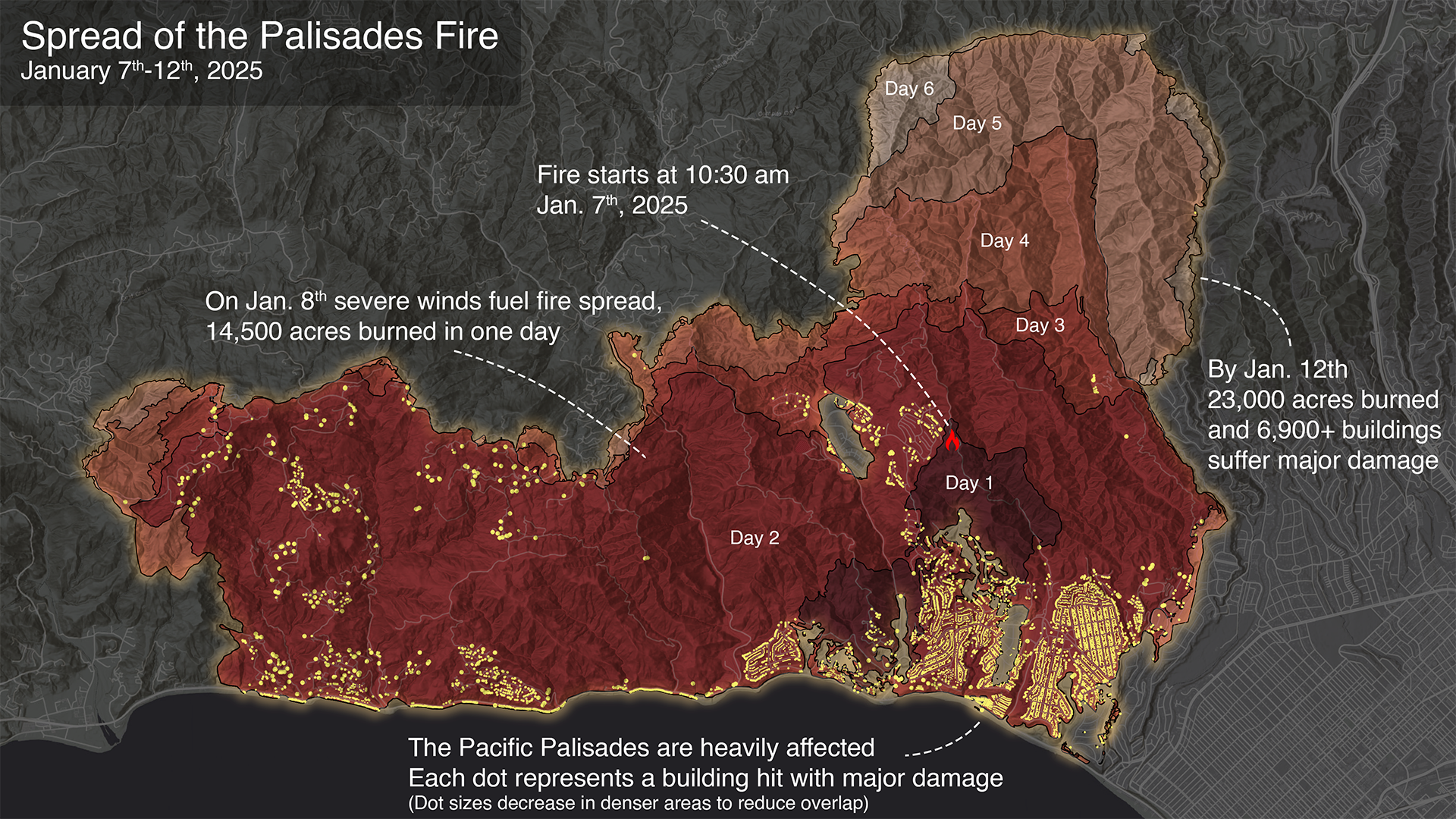
Overview showing a timeline of the Palisades Fire spread, the areas affected, and some information about the event.
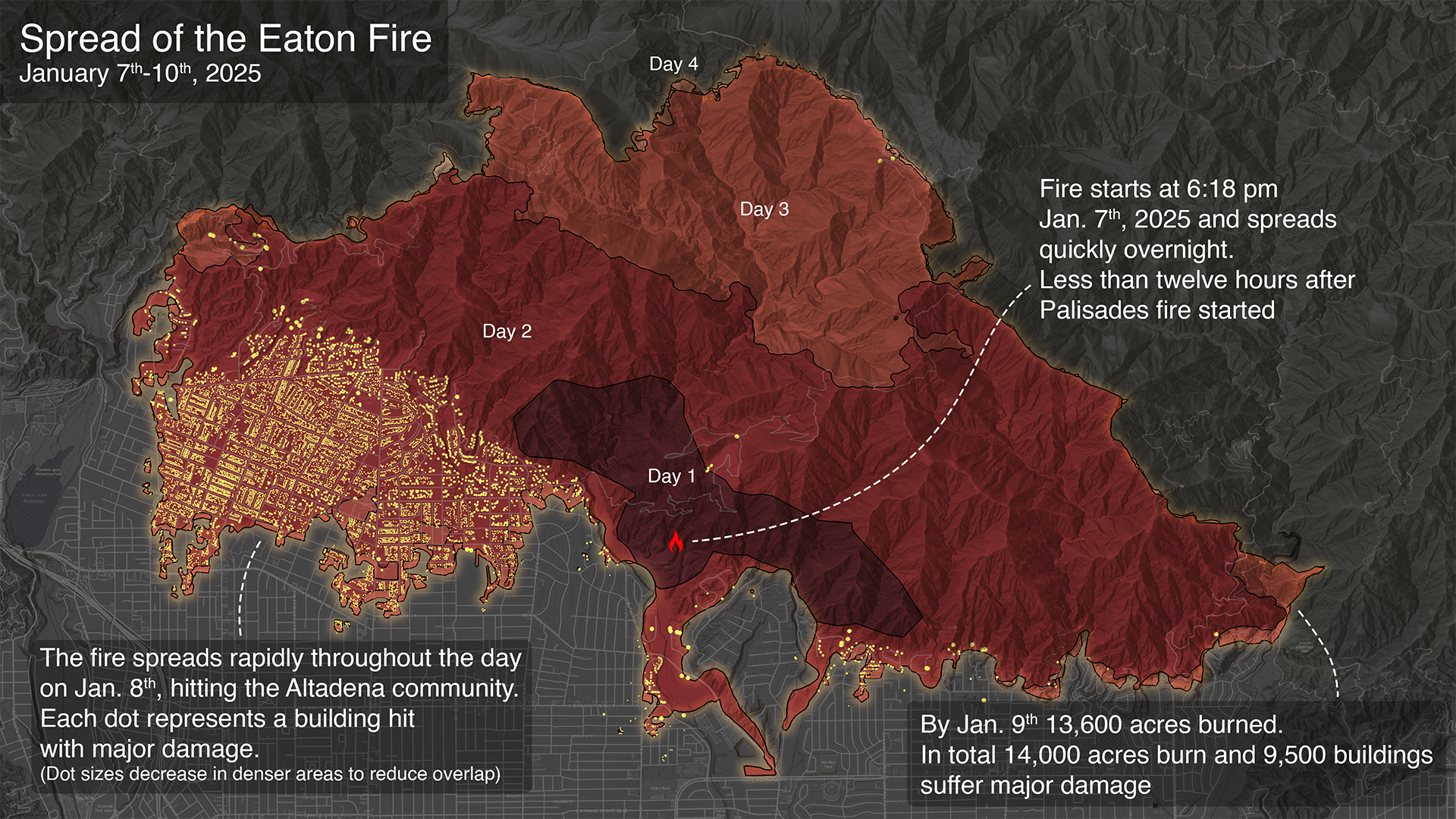
Overview showing a timeline of the Eaton Fire spread, the areas affected, and some information about the event. Credit: NASA
What caused the January 2025 Los Angeles wildfires?
In October, federal authorities announced the arrest of a Florida man in connection with the Palisades Fire, which was determined to be a holdover fire — a fire that started from an earlier fire that smoldered for days in the dense root structure in the LA County coastal community before it was re-ignited and fanned by powerful winds on the morning of Jan. 7.
No official cause has been determined for the Eaton Fire, but SoCal Edison has said there is a possible connection to the utility’s equipment.
The causes for several smaller fires remain under investigation.
A year of recovery and rebuilding
As the flames were contained weeks after the fires began and evacuation orders gradually were lifted, homeowners returned to communities forever changed by two of the most destructive wildfires on record in California.
First came the two-phase cleanup process, which involved the clearing of household hazardous waste by the U.S. Environmental Protection Agency and the removal of structural debris, a task handled by the U.S. Army Corps of Engineers or through a contractor chosen by homeowners.
According to the county, more than 10,000 properties opted in to the Corps of Engineers’ debris clearance program.
Once debris was cleared, property owners who sought to rebuild entered a permitting process handled by various local governments, including Los Angeles County, the city of Los Angeles, and the cities of Malibu and Pasadena.
The city of Los Angeles alone received more than 3,000 permit applications, 1,400 of which have been issued at the start of January, according to the city. Nearly 2,900 applications for rebuilding permits were received by Los Angeles County, 1,153 of which have been issued as of Jan. 2, 2026.
Thousands of applications remain in review.