When scientists look deep into space, the light reaching telescopes comes from a very distant past. This allows astronomers to study how the universe looked billions of years ago.
Most discoveries match what existing theories predict, but sometimes the universe does something entirely unexpected.

A recent study led by Canadian researchers revealed one such surprise. Astronomers found a galaxy cluster filled with extremely hot gas at a time when the universe was still very young.
According to current ideas, this level of heat should not exist so early. This discovery suggests that large cosmic structures may have formed faster and more violently than scientists once believed.
The research focuses on a galaxy cluster seen just 1.4 billion years after the Big Bang. At this stage, clusters were expected to remain cooler and less organized.
Instead, this cluster shows intense energy, forcing scientists to question long-standing models of how galaxy clusters grow.
A galaxy cluster in its infancy
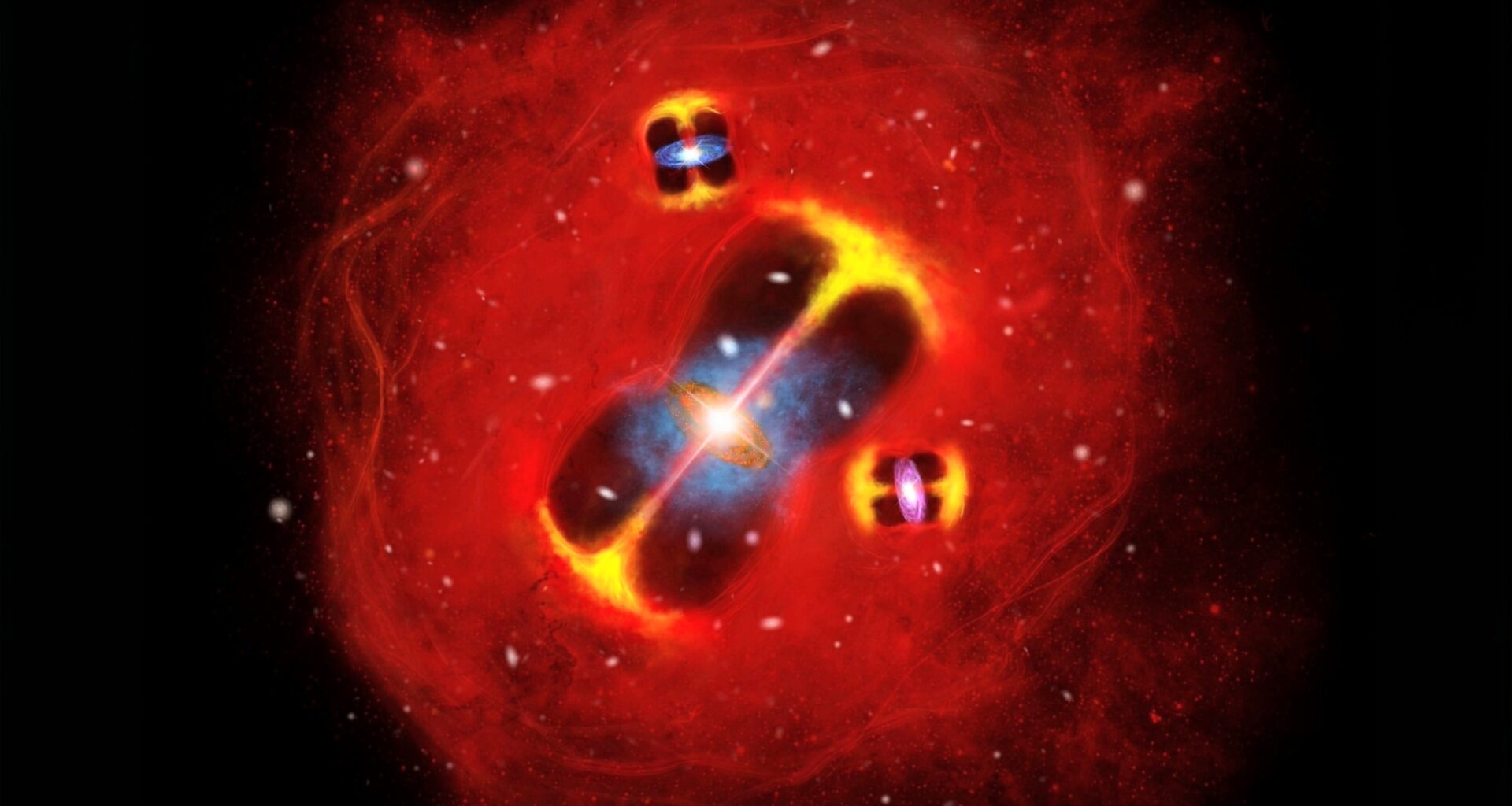
The research team studied a young galaxy cluster known as SPT2349-56. Light from this cluster has traveled for nearly 12 billion years, allowing astronomers to see it during its early life.
Even at this young age, the cluster already appears massive and highly active. SPT2349-56 contains more than 30 active galaxies packed tightly into a small region of space.
The cluster core stretches across about 500,000 light-years, which is similar to the size of the halo surrounding the Milky Way.
Star formation inside this region happens at an astonishing pace. New stars form more than 5,000 times faster than in our own galaxy.
Such extreme growth usually appears much later in cosmic history, which makes this early activity especially surprising.
To observe this distant cluster, the team used the Atacama Large Millimeter/submillimeter Array, known as ALMA. This group of powerful radio telescopes sits in Chile and includes instruments designed, built, and tested by the National Research Council of Canada.
Measuring hidden cluster heat
The researchers focused on a method called the Sunyaev-Zeldovich effect. This tool helps scientists measure the heat energy of gas that fills the space between galaxies inside a cluster.
This gas is known as the intracluster medium and plays a major role in shaping how galaxies evolve over time.
The team detected gas temperatures far higher than expected for such a young system. The signal was so strong that it initially raised doubts.
“We didn’t expect to see such a hot cluster atmosphere so early in cosmic history,” said study lead author Dazhi Zhou, a Ph.D. candidate in the UBC Department of Physics and Astronomy.
“In fact, at first I was skeptical about the signal as it was too strong to be real. But after months of verification, we’ve confirmed this gas is at least five times hotter than predicted, and even hotter and more energetic than what we find in many present-day clusters.”
Black holes heat the cluster
The intense heat likely comes from supermassive black holes inside the cluster. Astronomers recently identified three such black holes within SPT2349-56.
These objects release enormous amounts of energy as material falls into them. This energy can heat nearby gas and change the structure of the surrounding environment.
“This tells us that something in the early universe were already pumping huge amounts of energy into the surroundings and shaping the young cluster, much earlier and more strongly than we thought,” said study co-author Dr. Scott Chapman, a professor at Dalhousie University.
Older models suggest that gas inside a cluster slowly heats up as gravity pulls galaxies together over time. The new findings point to a faster and more explosive process, driven by black hole activity and intense star formation.
Why galaxy clusters matter
Galaxy clusters host some of the largest galaxies in the universe. Understanding how these clusters form helps scientists explain how massive galaxies grow and change.
“Understanding galaxy clusters is the key to understanding the biggest galaxies in the universe,” said Dr. Chapman, who is also a UBC professor.
“These massive galaxies mostly reside in clusters, and their evolution is heavily shaped by the very strong environment of the clusters as they form, including the intracluster medium.”
Future research directions
This discovery shows that several powerful processes can occur together very early in cosmic history. Star formation, black hole activity, and overheated gas all appear inside a compact and youthful system.
Looking ahead, the research team plans to explore how these processes connect.
“We want to figure out how the intense star formation, the active black holes and this overheated atmosphere interact, and what it tells us about how present galaxy clusters were built,” said Zhou.
“How can all of this be happening at once in such a young, compact system?”
As astronomers continue to study the early universe, discoveries like this reveal how much remains unknown and how quickly the universe learned to build its largest structures.
The study is published in the journal Nature.
Image credit: Lingxiao Yuan
—–
Like what you read? Subscribe to our newsletter for engaging articles, exclusive content, and the latest updates.
Check us out on EarthSnap, a free app brought to you by Eric Ralls and Earth.com.
—–