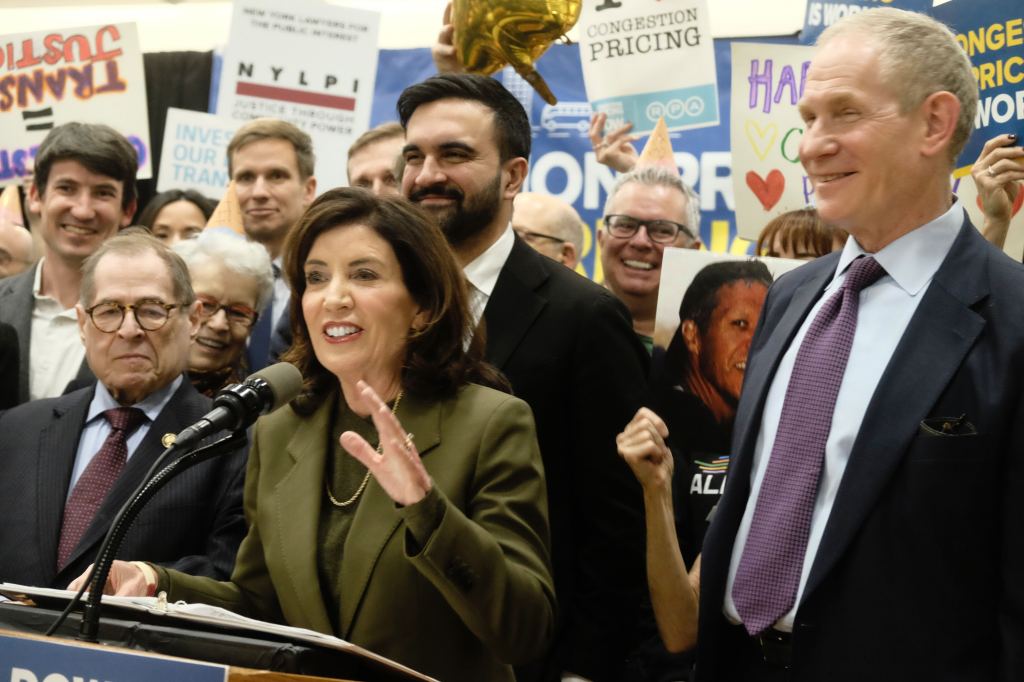
One year after New York’s much-delayed and hotly debated congestion toll went into effect, Gov. Hochul, Mayor Mamdani and MTA Chairman Janno Lieber Monday released numbers they argue point to the success of the program, which charges drivers a base toll of $9 to enter Midtown and lower Manhattan.
According to state data, vehicular traffic into the congestion zone is down 11% compared with last year, with 27 million fewer vehicles traveling the streets, an average of 73,000 fewer per day.
“The results are extraordinary, beyond what we could have expected,” Hochul told reporters Monday.
“People with asthma are breathing better,” Hochul said, “and our streets are safer.”
Congestion pricing, which was written into state law in order to back a $15 billion bond issuance toward projects from the MTA’s 2020-2024 capital budget, is also making more money than initially projected.
Though the toll was initially set at a $15 base rate, Hochul made a controversial eleventh-hour decision to phase that figure in, starting the toll at the current $9 base rate. The zone covers all of Manhattan south of 60th St.
Initial projections by the state estimated that would bring in some $500 million a year in gross revenue. But current projections estimate the toll will end up bringing in $550 million by the time the first 12 months in revenue are counted.
“For a long time we have asked the MTA to do the impossible without providing them with the funding that would even make it something they could consider,” Mamdani said Monday. “What this program has done is commit funding to the very capital needs that have been put off for years if not decades.”
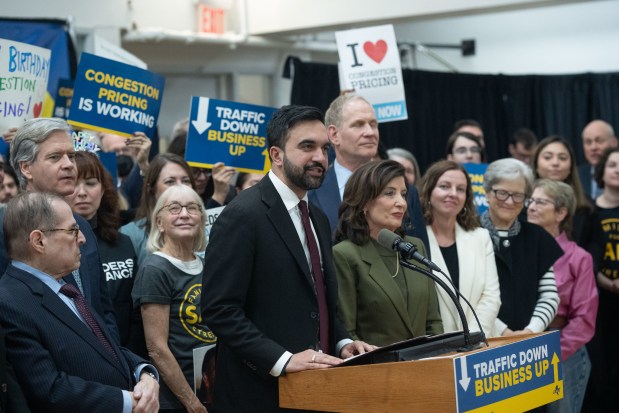 New York City Mayor Zohran Mamdani joins New York Governor Kathy Hochul and Metropolitan Transportation Authority (MTA) is Chair and CEO Janno Lieber in Manhattan to celebrate the successes of one year of congestion pricing in Manhattan on Monday, January 5, 2026. (Michael Appleton/Mayoral Photography Office)
“Those are investments that can transform the day-to-day realities of a New Yorker,” the mayor added.
The toll is set to go up to $12 in 2028, and then to $15 in 2031.
The toll, which faced years of legal opposition in its planning stages, was almost immediately assailed by the Trump administration after it began last January, with the president claiming to have shut the program down by fiat last February.
“We stood up here in New York, we showed who we are, and yes, the cameras are staying on,” she said.
Trump’s efforts to kill the toll are still working their way through federal court in Manhattan. The federal government has sought to characterize the toll as an attack on New York’s working class and small-business community, while simultaneously claiming it does not reduce congestion enough and focuses too much on revenue generation.
But Hochul said Monday that the toll has been a boon for the minority of area residents who commute by car.
“How does 25% faster coming through the Lincoln Tunnel sound?” she said. “Let me top that, how about 51% faster coming through the Holland Tunnel? About 25% faster going across our bridges into Brooklyn or Queens? That’s time in your life that’s precious.”
Hochul projected confidence that the latest legal challenge would end with congestion pricing intact.
“Every time it’s gone before a judge, the judge says, ‘No, no, the state is right,’” she said.
“Later this month, guess where we’ll be? We’ll be back in court,” she said.
“But we’ll just keep on winning,” she said, mimicking President Trump, “We’ll be winning so much we’ll be tired of winning.