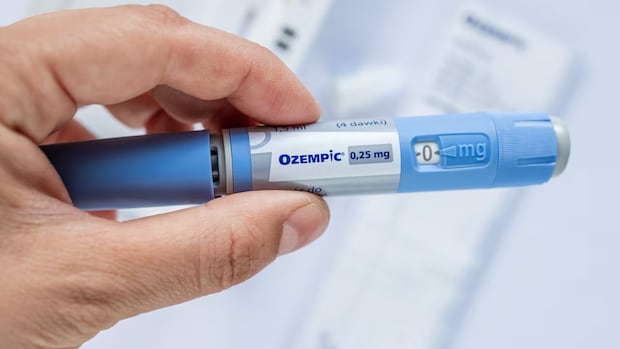
Health Canada says it is reviewing nine submissions for generic versions of popular weight loss medications that pharmaceutical experts say could bring down the price.
The submissions in Canada are for generic forms of semaglutide, the active ingredient in Novo Nordisk’s injectable prescription drugs Ozempic and Wegovy, which have been approved by Health Canada for diabetes and weight loss respectively.
The medications are in a class called glucagon-like peptide-1 (GLP-1) therapies that mimic a natural gut hormone to help control blood sugar levels, slow digestion and increase feelings of fullness. Common side effects of semaglutide can include nausea, vomiting, diarrhea and stomach pain. Fatigue, constipation and headaches are also possible.
Canada is the only country where Novo Nordisk allowed the patent for its semaglutide drugs to expire, paving the way for “regulatory exclusivity” to end on Jan. 4. That’s why Canada could become the first country to offer a cheaper version of Ozempic and Wegovy to people with prescriptions, but pharmaceutical experts say it is unlikely to happen immediately.
Here’s what we know about the drugs, their approvals and pricing.
WATCH | U.S. approves Wegovy pill for weight loss: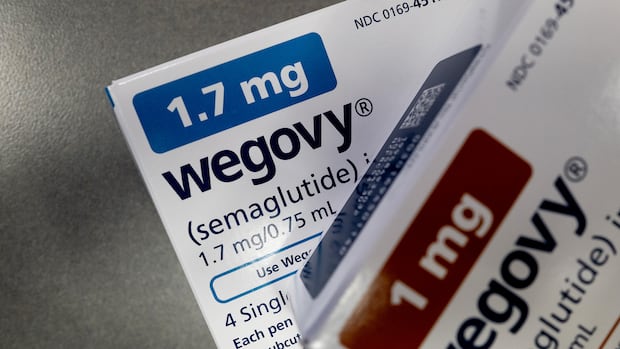
Wegovy pill version gets U.S. approval for weight loss
The U.S. Food and Drug Administration has approved a pill version of Wegovy, Novo Nordisk’s blockbuster weight loss drug, with the company claiming it offers a more convenient option than the previous injectable version.Wegovy pill approved in U.S.
On Monday, Novo Nordisk announced that a pill form of Wegovy is now available in the U.S. as a starter dose. Higher doses will be available by the end of the week in the U.S., the company said.
When asked about the availability of a Wegovy pill in Canada, Novo Nordisk directed CBC News to its U.S. media release.
CBC News has also asked Health Canada if it has received an application for a pill form of Wegovy from Novo Nordisk, or a generic version of the medication in pill form. The regulator did not immediately respond.
Novo Nordisk also offers a pill approved by Health Canada to treat Type 2 diabetes that contains semaglutide and is sold under the name Rybelsus.
What are generic versions?
Generics are pharmaceutically equivalent to brand name drugs, according to Health Canada, which says it examines data provided by companies to ensure that the submission meets its criteria for safety, quality and effectiveness before authorizing any drug, whether it’s a brand name or generic version.
Evaluating generic semaglutide drugs is more complex than many other medication approvals, according to Mark Johnson, a Health Canada spokesperson.
That’s because semaglutide was originally developed using biological processes, but the generic versions can be made using more simple chemical means.
LISTEN | Taking medications for excess weight:
Cross Country Checkup38:16Ozempic Goes Generic: Canada’s Weight Loss Revolution?
The World Health Organization conditionally recommended glucagon-like peptide-1 (GLP-1) therapies for obesity treatment in December 2025. Canada could soon become the first country in the world to offer a cheaper version of Ozempic and Wegovy to people with prescriptions.
Our question: Would you take a drug to lose weight…or have you already?
When a patent expires, other companies are allowed to make copies of the drug. These companies don’t have to spend as much money studying the medication, which lowers the price, according to Canada’s Drug Agency.
“Generic semaglutide products are complex synthetic products that are pharmaceutically equivalent to the brand name drug, but with possible differences that could impact safety and efficacy,” Johnson said.
“The manufacturer must show that these differences do not affect the safety, efficacy or quality of the drug compared to the brand name drug.”
Pricing depends on a few factors, said Mina Tadrous, an associate professor at the Leslie Dan Faculty of Pharmacy at the University of Toronto. These include whether a prescription medication is available in a branded formulation, how many cheaper generic versions are available on the market, the formation of the drug — oral or injectable — as well as the dosing.
Given those challenges, Tadrous says he doesn’t expect the cheaper versions will be immediately available.
“I don’t think that anyone is anticipating we’ll see any products being approved in January or February,” Tadrous said in an interview on Monday, suggesting summer would be more likely.
WATCH | What WHO’s move to back obesity drugs means: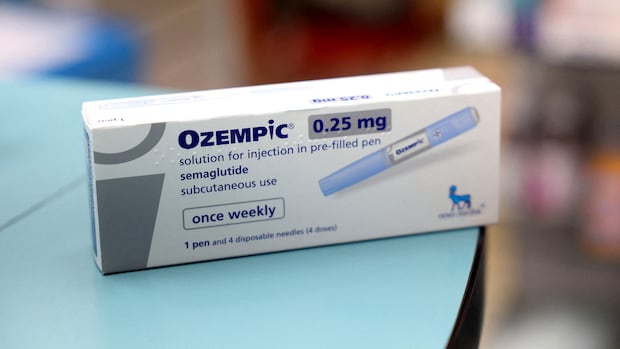
The WHO just backed Ozempic-like drugs. So what?
The World Health Organization has issued its first guidelines for the use of GLP-1s, such as Ozempic, to treat obesity. The National’s Erica Johnson asks Dr. Daniel Drucker — whose research helped lead to the development of these drugs — to break down the significance of the announcement and key things to consider when using GLP-1s for weight loss.What could approval mean for patients
Canadians taking GLP-1 medicatiosn for weight loss pay anywhere from $200 to $400 a month, usually out of pocket as many Canadian insurance companies don’t cover the medications for obesity.
“We’re looking at probably about $100 to $125, $150 a month, which is way lower than what it is right now,” Tadrous said of three or more cheaper alternatives expected to come on the market in Canada.
Dr. Sanjeev Sockalingam, scientific director of Obesity Canada, says accessibility is another consideration.
“I know in my clinics, there are many patients who don’t have insurance coverage for it [and] cannot afford these medications, which limits one tool in our toolbox for obesity management,” Sockalingam said.
Having generics that might significantly reduce the price is welcome, he said, given that obesity affects one in three Canadians.
Which companies are applying?
The list of companies applying to have generic submissions reviewed by Health Canada include Sandoz Canada, Apotex, Teva Canada, Taro Pharmaceuticals and Aspen Pharmacare Canada.
The remaining companies aren’t named because their submissions were received before April 1, 2023, when Health Canada’s policy changed to require sponsors be named, Johnson said.