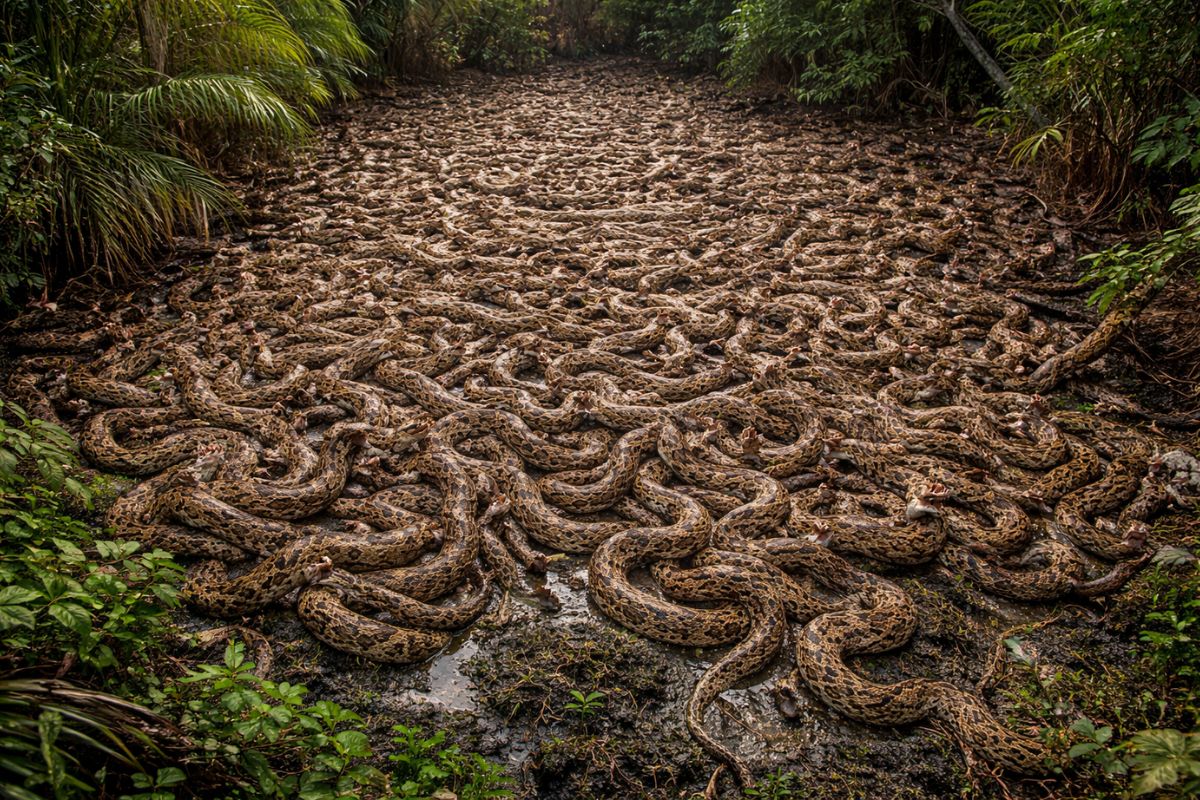
To control Burmese pythons, Florida has turned to native giant snakes, the eastern indigo snake, and is already seeing concrete signs of a return to balance with the hunting of python hatchlings and reproduction in the wild.
Florida tried to save the Everglades with giant snakes And for a time, the world treated this as environmental madness. The idea seemed absurd: fighting invasive snakes by bringing more snakes to a place already overrun by them.
But the plan wasn’t to “throw snakes into the swamp.” It was to reintroduce a native predator that had disappeared from the landscape and that, historically, had kept other snakes under control. What seemed like desperation began to turn into a restoration strategy.
The silent invasion that transformed the swamp into an empty place.
At the end of the 20th century, Burmese pythons, brought from Southeast Asia as exotic animals, escaped or were abandoned and found a perfect refuge in the Everglades. With a favorable climate, endless wetlands, and abundant prey, the invasion grew silently.
— ARTICLE CONTINUES BELOW —
See also other features
-
Goodbye to the gas cylinder: new technology eliminates the risk of explosions, heats pans in seconds, and reduces your electricity bill.

-
Released as pets, pythons have already decimated some native mammal populations by up to 90% and altered the balance of one of the most important ecosystems in the Americas, requiring high-precision containment, with telemetry, eDNA, and robotic testing by 2025.
-
Your car changes the electricity in the air: study finds that pollution from heavy traffic affects invisible charges in the atmosphere and serves as a warning about pollution in cities.
-
Foldable phones in three parts, the most powerful Xiaomi phone ever, the possible iPhone Fold, and gadgets with full AI: see the complete list of releases that promise to transform the technology sector in 2026.


Are you in favor of US military intervention in Venezuela and the arrest of Nicolas Maduro?
— Click Oil and Gas (@clickpetroleoeg) January 3, 2026
The impact turned into ecological collapse. Studies between 2003 and 2011 indicated extreme declines in mammal populations in areas dominated by pythons: raccoons with a reduction of over 99%, opossums practically extinct, lynxes with a decline close to 90%, in addition to the disappearance of swamp rabbits and foxes. The python didn’t just devour animals, it devoured balance.
When “eliminating snakes” doesn’t work, Florida looks for another solution.
Traps, trackers, bounties, and even thermal drones have been among the attempts made. The problem is that the python can remain motionless for days and hide where almost no one can find it.
That’s when the state’s most unpopular strategy emerged. Instead of trying to defeat the invader through brute force alone, Florida began working with ecosystem logic and bet on… giant snakes native species as a biological counterweight.
When conservation organizations announced the reintroduction of the eastern indigo snake, the world laughed. Headlines and news anchors repeated the same phrase: “Florida fights snakes with snakes.” It seemed like just another bizarre experiment destined to fail.
But there was one point that almost no one took into account. The eastern indigo snake was no longer an invasive species. She was the forgotten guardian of Florida., a large, strong native species known for hunting other snakes, including venomous ones.
Who are the chosen giant snakes: the eastern indigo snake
The eastern indigo snake can grow to over 2,5 meters in length, with a dark blue appearance and striking sheen. It does not rely on venom: it hunts by strength, is immune to toxins, and can prey on rattlesnakes, moccasins, and coral snakes.
And there is a crucial detail for public acceptance: despite being one of the giant snakes One of the most impressive in the region, it is not described as a threat to humans.
Shy and reserved, she avoids conflict and acts as a silent regulator of the environment.
Why had this species disappeared, and why did its return take so long?
The decline of indigo was not sudden. Deforestation eliminated much of the habitat of longleaf pines, highways fragmented the remaining areas, and capture for trade and collectors accelerated the decline.
In the late 1970s, the species was declared endangered. Without its native predator, the ecosystem became more vulnerable. And the python invasion encountered a scenario with no natural defenses.
The real plan behind the giant snakes: breeding, release, and monitoring.
The return was planned years in advance. Organizations and biologists They began breeding indigo snakes in captivity, not for display, but for release, monitoring their health, strength, and hunting behavior.
In 2017, the project took shape with releases in the Apalachicola Bluffs and Ravines Preserve, a rare and protected area.
The snakes were raised for about two years before being returned to the wild, with documentation and monitoring to increase their chances of survival. It wasn’t a spectacle, it was precision and patience.
What changed after the release: hunting, monitoring, and signs of recovery.
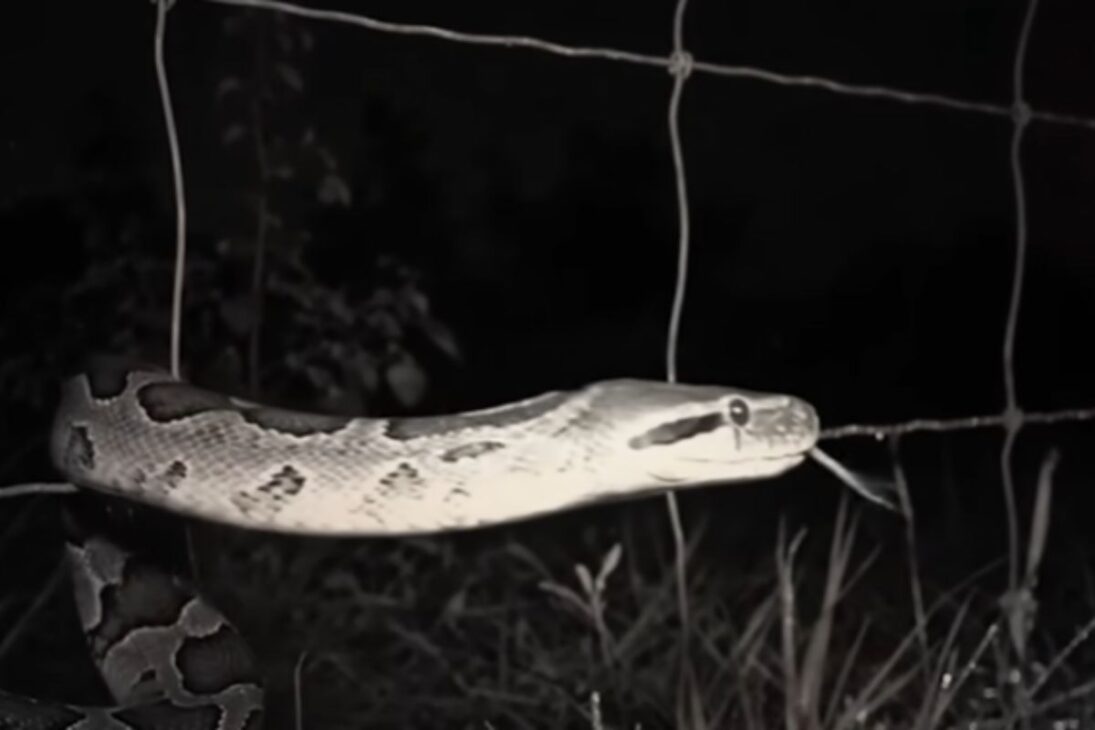
When the giant snakes As indigo birds returned to the wild, they began hunting venomous snakes and rodents, such as the cotton rat, which is associated with damage to crops and the spread of diseases in overpopulation scenarios.
But the biggest turning point came with a discovery that surprised researchers: the Indigo girls began hunting Burmese python hatchlings.
Small and vulnerable pups, which previously faced no natural predators in Florida, have become prey. It was as if nature had put the brakes on where humanity had failed.
Local reports also began to change. Farmers noticed fewer venomous snakes in field areas, and hikers and rangers observed the return of small mammals to places previously considered deserted.
The proof that every reintroduction project needs: being born in the wild.
In projects like this, simply surviving isn’t enough. The goal is to replicate the results in nature.
This evidence emerged in 2023, when researchers found two wild-born offspring of the reintroduced snakes.
It was the first confirmed natural birth in over 40 years, a sign that… giant snakes Indigo plants not only returned, but they also returned to occupy their ecological role.
In 2024, the program recorded the release of 41 indigo snakes, 22 females and 19 males, with expectations of more than 200 to follow. And the effect began to inspire other areas: in Alabama, releases also progressed, and in 2019 a hatchling was found in the state for the first time in 60 years.
Why the “unlikely plan” can restore balance, and where does the risk lie?
The logic is powerful: reintroduce a native predator to reduce pressures that were destroying the food chain. It’s about ecological restoration, not improvisation.
Still, it’s not an automatic miracle. Reintroduction requires suitable habitat, monitoring, a continuous supply of resources, and time. And the impact on the pythons needs to be carefully monitored, because the challenge is enormous and the ecosystem is complex.
In the end, Florida didn’t “release snakes out of desperation.” It bet on… giant snakes Native people are returning to the swamp a piece that had been ripped from the equation, and now they are beginning to see the kind of response that only appears when nature finally gets a second chance.
Do you think using giant snakes Using native species to control invasive species is a model that should be replicated elsewhere, or is it too risky to become an official strategy?