
The sanctuary was full Sunday morning, its pews packed with a congregation that likely looks more like Dallas than any other. Christmas trees still bracketed the pulpit; wreaths, too, as garlands wrapped the rafters on this cool morning preceding Epiphany. Children dressed like wise men wandered the sanctuary, as did a little girl dressed in white, carrying a giant star wrapped in tin foil.
And for an hour, on this Sunday before Epiphany, inside the warm, welcoming confines of the 110-year-old Oak Lawn United Methodist Church, it still felt like the holiday season four days into an already lousy new year.
Only 24 hours later, the sacred collided with the decidedly profane, by which I mean the nonsense that so often spills out of Dallas City Hall.
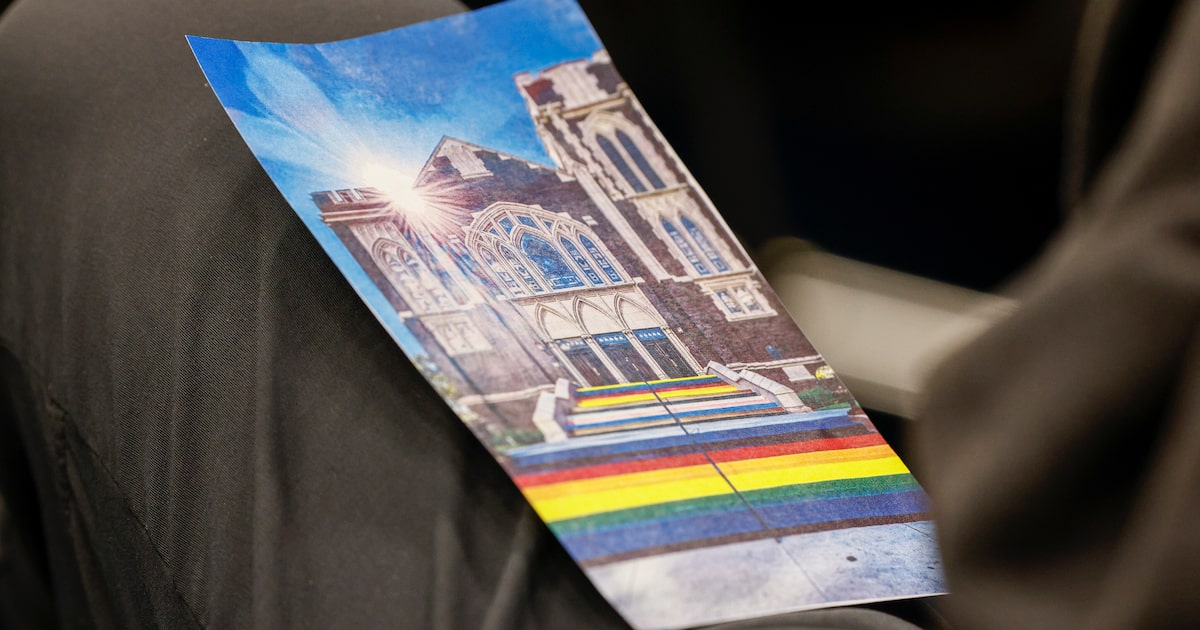
Church leaders had been summoned there to defend the decision in October to paint the church’s front steps every shade of the rainbow, a life-sized recreation of the Pride Progress Flag that serves as a symbol of the LGBTQ community. This was the church’s response to Gov. Greg Abbott’s demand that cities across Texas paint over roadway crosswalks and art displays that “advance political agendas” and “ideologies.”
For safety reasons, he said. WINK WINK. City officials continue to seek guidance from the Texas Department of Transportation. The Rev. Rachel Griffin-Allison, Oak Lawn UMC’s senior pastor for a decade, went to a much higher authority.
Opinion
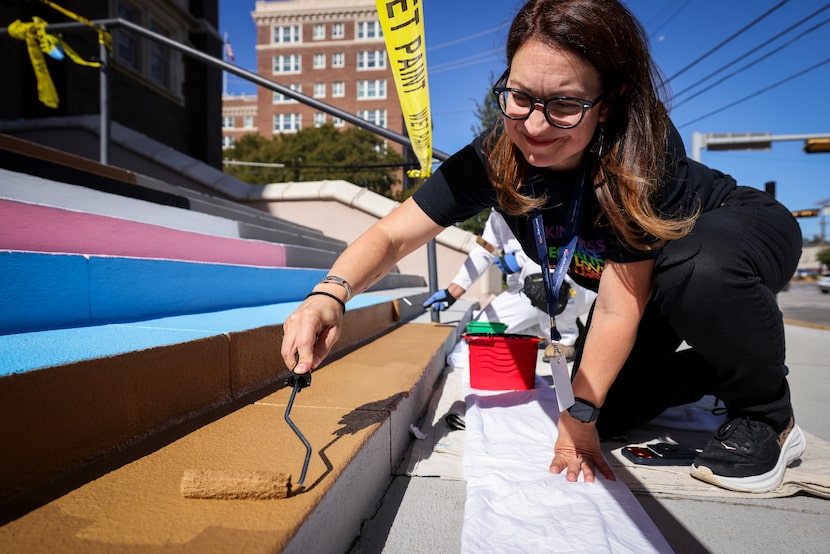
Senior pastor Rachel Griffin-Allison helps paint the stairs of Oak Lawn United Methodist Church in Pride and trans colors Wednesday, Oct. 22, 2025, in Dallas. The church made the move in response to Gov. Greg Abbott’s order to remove symbols from crosswalks in Texas cities.
Yfat Yossifor
“It’s a message that needed to be sent for those who desperately need to know they are beloved,” she told me on New Year’s Eve. “It’s a beautiful sign of God’s love we need at a time when, as a culture, we desperately need it. And it’s a spiritual statement that goes far beyond our neighborhood.”
The steps painted at Oak Lawn Avenue and Cedar Springs Road, in front of the church that’s the beating heart of The Gayborhood, became big news. Here. There. Everywhere. Andy Cohen gave them a hearty mazel-mazel on Bravo.
Griffin-Allison said she still gets emails from all over the world, from people “who see this as an affirmation of who they are. That’s the best of all possibilities, in my opinion. This has ended up having such a positive effect.”
All that good news doesn’t come without consequences, turns out.
In December, some two months after the paint had dried, someone at City Hall told her the church needed to get a certificate of appropriateness. That’s the permission slip for which Oak Lawn UMC had not applied before putting a paintbrush to steps that have been painted and repainted God knows how many times since the church opened in 1916. The Landmark Commission first needed to bless Oak Lawn UMC’s work — what Griffin-Allison called a “visual sermon” when we spoke last week — before it could be allowed to remain.
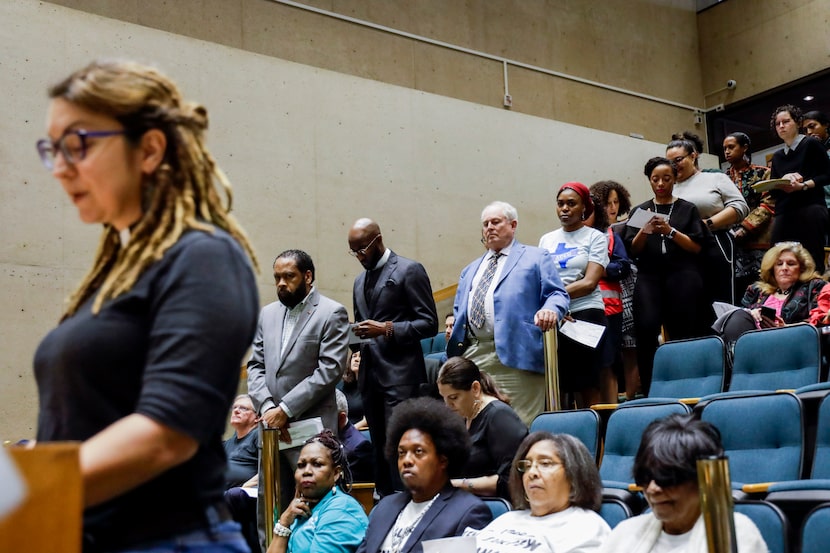
The Rev. Rachel Griffin-Allison, seen here speaking to the City Council in February 2019, is no stranger to Dallas City Hall, as she spent three years sheltering the homeless during frigid nights in defiance of city code. The city finally changed its rules a the end of 2020.
Shaban Athuman / Staff Photographer
And, spoiler alert: That is just what happened Monday afternoon, when it only took a few minutes for the commissioners to unanimously give Oak Lawn UMC a three-year permission slip for what Landmark is designating a temporary art installation.
Griffin-Allison has some experience with circumventing city code, dating back to those frigid-weather days a decade ago when she began sheltering the homeless against City Hall’s archaic rules that didn’t allow churches to serve as shelters. She did it for years without asking permission or seeking forgiveness, until City Hall finally came to its senses at the end of 2020.
To the rational and the reasonable, all of this might give the appearance of lunacy — of Dallas being Dallas, distracted by the sideshow until it turns into the … you know, rhymes with sideshow. Especially on the very day the mayor and city manager shrugged their farewells to AT&T, downtown Dallas’ biggest employer. Surely, you’d think, there are more important things than debating whether some paint on some steps constitutes a violation of city code.
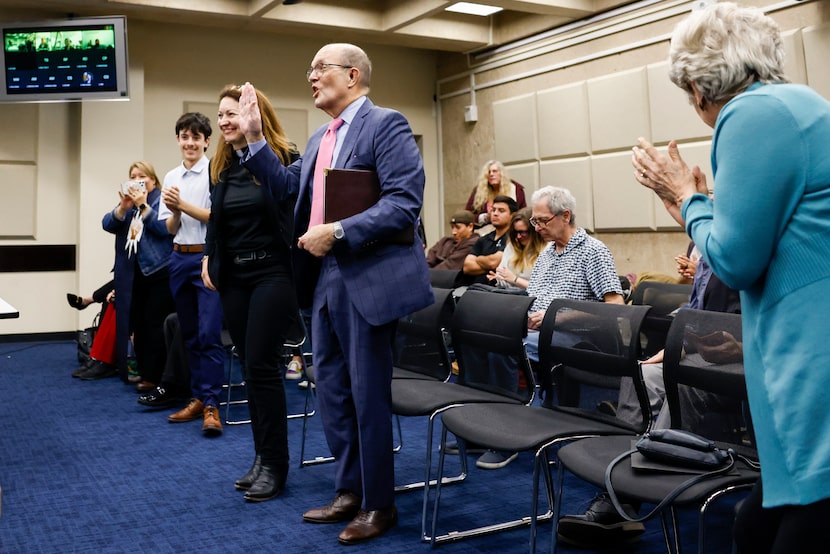
The Rev. Rachel Griffin-Allison of Oak Lawn United Methodist Church (center left) and John Horany (center) stand and thank the City of Dallas Landmark Commission after voting to approve a certificate of appropriateness for the rainbow colored stairs at Oak Lawn United Methodist Church during a meeting at Dallas City Hall, Monday, Jan. 5, 2026.
Elías Valverde II / Staff Photographer
Or so I thought until shortly before 1 p.m. Monday, when I saw Rabbi Andrew Paley of Temple Shalom and the Rev. Neil G. Thomas, senior pastor of Cathedral of Hope, among the throng waiting to get into the undersized, overfilled briefing room at City Hall. Both men have delivered their share of invocations at City Council meetings.
I asked if they were there to speak. “To support,” said Paley, as he and Thomas found seats behind Griffin-Allison.
There were plenty of speakers already, enough to fill more than an hour. Dozens of Dallas residents, and a couple from Richardson and Denton, came to City Hall and dealt with all of its nonsense, including a 45-minute delay due to sound issues, to preach their love for Oak Lawn United Methodist and those blessed steps.
There was John Horany, a former Oak Lawn UMC trustee, who told the commission that he was married on those steps in 2017, seven years before the United Methodist Church lifted its ban on same-sex marriage and LGBTQ clergy. Horany said that the steps are “an extension of our mission, a way to demonstrate that God’s love reaches everyone in our neighborhood.”
A woman spoke of moving to Dallas with her husband in 2010, and of finding at Oak Lawn UMC “the best of what a faith community should be.” Another speaker said those rainbow-colored steps are now “a tangential piece of what makes the church historic.”
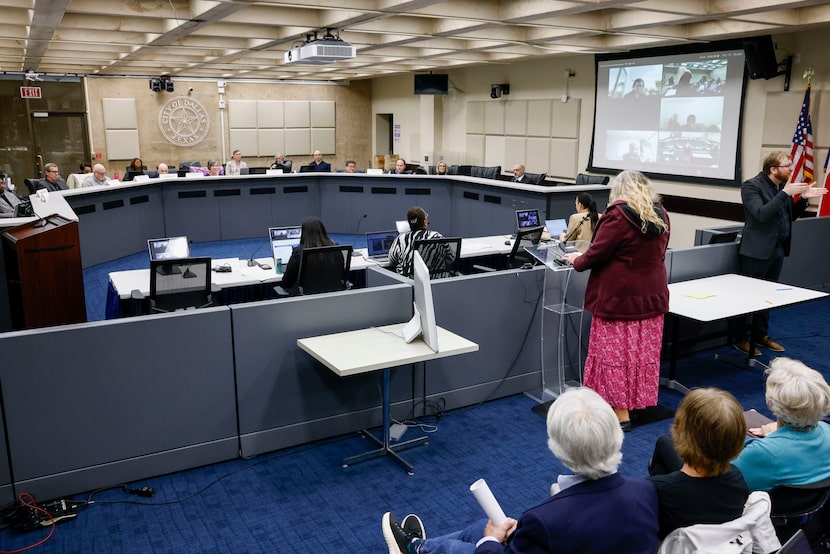
Amanda McLaughlin speaks in favor of the rainbow stairs in front of Oak Lawn United Methodist Church during a City of Dallas Landmark Commission meeting at Dallas City Hall, Monday, Jan. 5, 2026.
Elías Valverde II / Staff Photographer
One young man got a chuckle out of Griffin-Allison, when he said, “If you don’t like rainbow crosswalks, then you’re probably on the wrong street.”
Amanda McLaughlin, a trans woman from Garland who spent last spring imploring elected officials not to restrict her freedom to live as a woman, told Landmark commissioners that this has been a painful year for her. She said she often had trouble getting out of bed.
“But when I saw the stairs, it brought me hope,” she said. “It brought me comfort. It brought joy to me.” She begged the commission: “Please don’t take away our comfort and hope.”
And it didn’t.
Griffin-Allison told me the church had long considered making a statement in the wake of state and federal legislation hell-bent on rolling back LGBTQ freedoms. They thought about something with lights, maybe, or signs. Abbott’s demand simply expedited that which they’d already imagined.
On Sunday, in the hours before Epiphany, Griffin-Allison told her congregation that the painted steps “were not just an act of resistance, but an act of faith. Would we be silent, or would we make our love visible. Silence is not neutral.”
The congregation responded with a loud, “Amen.”
“We chose to let our building preach,” she said. “Light does not need permission to shine.”
Turns out, it does. Thank God it got it.