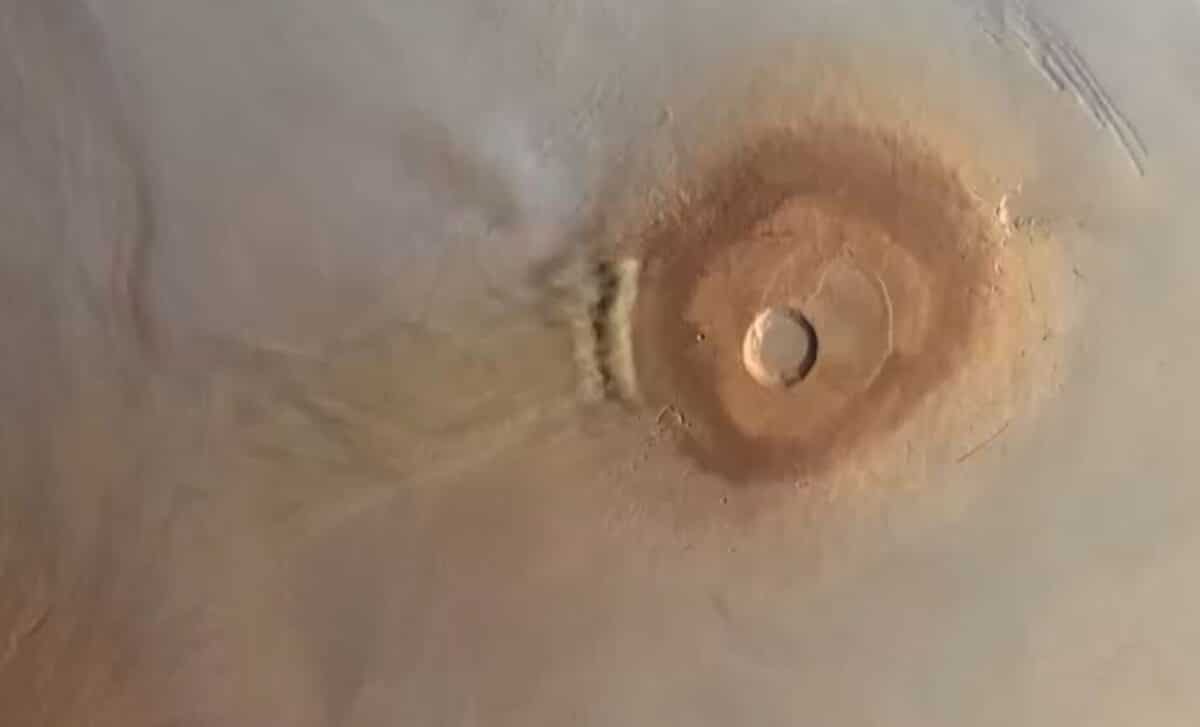
Phobos, the oddly-shaped moon of Mars, has been captured in a series of stunning images gliding above the planet’s volcanic terrain and a dust storm in full rage. Taken by the European Space Agency’s Mars Express orbiter and later processed by a skilled astronomy enthusiast, the visuals show the moon against one of the most geologically dramatic regions on the planet.
The images were originally taken in June and released to the public in December 2025, according to EarthSky. While raw satellite data provided the foundation, it was the work of image processor Andrea Luck that transformed them into high-resolution photographs now circulating widely.
A Close Encounter With Mars’ Volcanic Giants
Phobos is of particular interest to astronomers not only because of its irregular shape and proximity to Mars but also because of the speed at which it orbits, a mere 7 hours and 39 minutes.
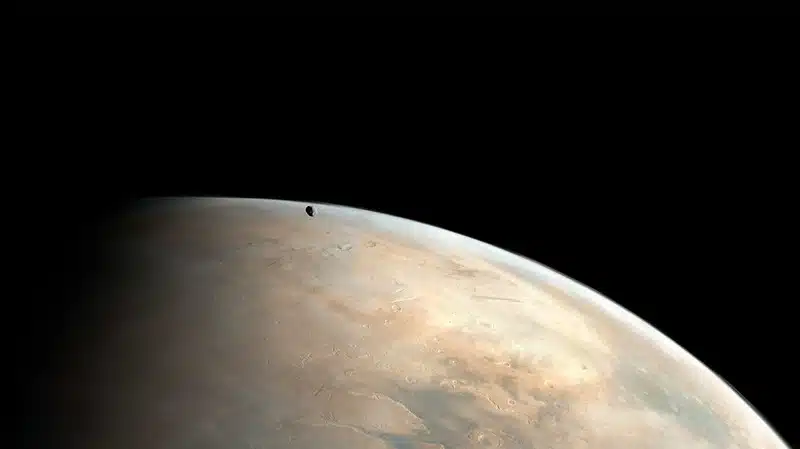 Phobos drifts above Mars as a dust storm stirs across the Tharsis region, seen from Mars Express. Credit: ESA/ DLR/ FUBerlin/ Andrea Luck
As reported by EarthSky.com, in the images it appears just above the Tharsis plateau, a vast volcanic region that dominates Mars’s western hemisphere. Clearly visible beneath the moon are the peaks of Ascraeus Mons, Pavonis Mons, and Arsia Mons, three massive volcanoes arranged in a near-linear formation. These giants, remnants of Mars’s ancient volcanic activity, are among the tallest in the solar system.
The visuals also show the lower edge of Valles Marineris, a canyon so large it stretches for roughly 2,000 miles, measuring up to 300 miles wide and five miles deep in places. The lower right corner of the image frames part of this vast trench, sometimes referred to as the “Grand Canyon of Mars,” though it is significantly larger in scale.
Orbiting Faster than Mars Rotates
Phobos’ proximity to Mars allows it to complete more than three full orbits for every Martian day. At just 3,700 miles above the planet, it appears to skim the surface in these photographs, and from the planet below, it rises in the west and sets in the east. This rapid movement contrasts with the slower rotation of Mars itself.
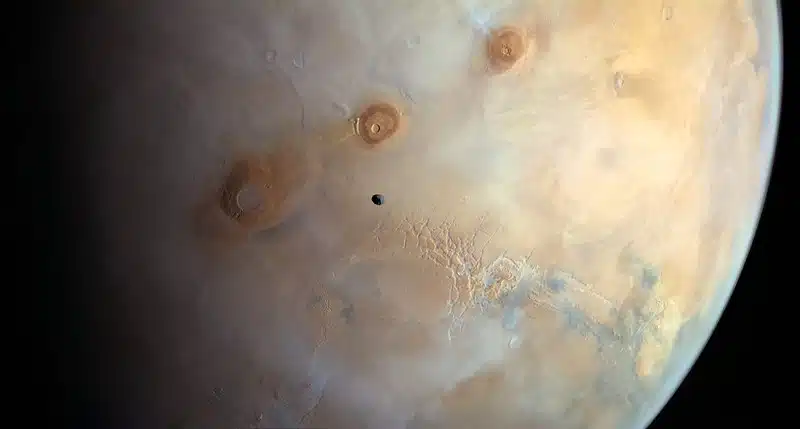 Phobos crosses above Mars’ volcanoes on the Tharsis plateau. Credit: ESA/ DLR/ FUBerlin/ Andrea Luck
As detailed in EarthSky, Phobos’ orbital speed and altitude are exceptional. The moon’s flight path offers a unique observational advantage, especially for orbiters like Mars Express. Its quick orbit also means opportunities for imaging alignments with specific surface features, such as volcanoes or storms, are brief and must be carefully timed.
A Citizen Astronomer’s Digital Craftsmanship
Though the photos originate from Mars Express, the polished versions were created by Andrea Luck, a figure well regarded in the astronomy imaging community. His processing work brought out colors, textures, and contrast levels that raw satellite data typically conceals.
Luck also released a video capturing the same scene. Shared on his Flickr page, the visuals provide a striking view of Phobos seemingly suspended above three Martian volcanoes and the rim of a vast canyon. The video shows the moon gliding over Pavonis Mons as a dust storm forms along its slopes, an otherworldly perspective more often associated with science fiction than with real planetary observation.