Protesters in Iran defied authorities Tuesday, hitting the streets in the capital, Tehran, and smaller cities to chant anti-government slogans amid an ongoing violent crackdown that one human rights group says has left at least 36 dead.
The protests began last week with economic grievances as the Iranian currency, the rial, tanked. They quickly turned political, with demonstrators chanting slogans against the ruling clergy.
The rial dropped to a record low of 1.46 million against the dollar Tuesday. If it continues to drop, it is unlikely that the protests will stop anytime soon, analysts say.
HRANA, a network of rights activists, noted in a report Tuesday that 36 people have been killed since the demonstrations began 10 days ago — including 34 protesters and two members of the security forces — and more than 2,000 people have been arrested.
Dramatic videos posted on social media and verified by NBC News show security forces firing tear gas at Tehran’s main bazaar on Tuesday as protesters scramble for cover into passageways and narrow streets. Gunshots can be heard in some videos, and protesters can also be heard chanting slogans directly against Supreme Leader Ayatollah Ali Khamenei, the highest authority in the Islamic Republic.
Unrest at the Tehran bazaar is particularly unsettling for officials because the shuttering of shops at the ancient marketplace and protests from the merchant class were key elements that led to the overthrow of the monarchy in 1979.
President Masoud Pezeshkian, who is seen as a relative moderate, in the past week called for the demands of protesters to be heard and said he was asking the interior minister to meet with the leaders of the protest movement.
But the demonstrations are diffuse and largely leaderless, and Pezeshkian’s efforts at mediation — and the killings and arrests by security forces — have not convinced the protesters to stay off the streets.
“The system has responded to these protests with a combination of conciliatory rhetoric and brute force,” Ali Vaez, Iran project director at the International Crisis Group, said in a text message response to questions. “The fact that neither has worked indicates that the former falls well short of what the protesters want, and the latter has failed to deter them from expressing it.”
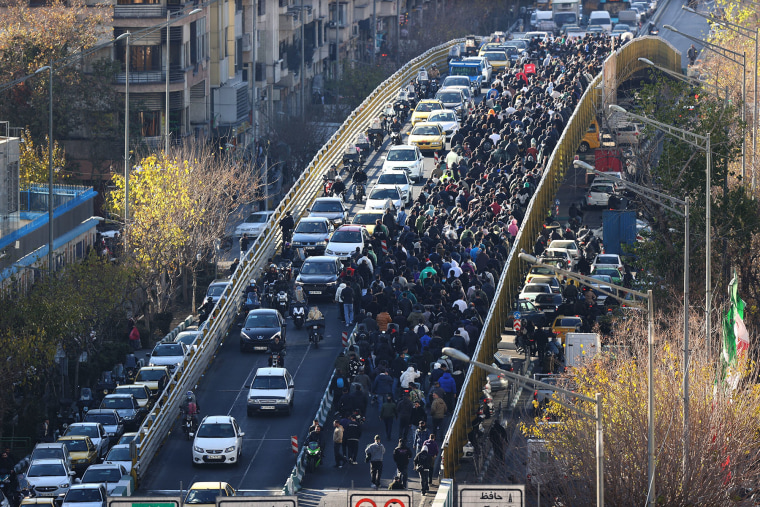 Shopkeepers and traders walk over a bridge during a protest against the economic conditions and Iran’s embattled currency in Tehran in 2025. FARS News via AFP-Getty Images
Protesters got an unexpected offer of support last week when President Donald Trump warned that the U.S. would intervene if violence against protesters continued, though he did not specify what actions the U.S. might take.
Iranian Parliament Speaker Mohammad Bagher Qalibaf said Friday in a post on X that Trump’s threat of intervention makes U.S. bases in the region “legitimate targets.”
Analysts say Trump’s message fed into the conspiracy theories of the most hardline elements of the government, who were already on high alert for any foreign interference after a devastating 12-day war with Israel last summer, partly joined by the U.S. military, which left the country reeling.
The detention of Venezuelan leader Nicolás Maduro, a staunch Tehran ally, over the weekend only highlighted the issue for Iranian officials.
Iranian Foreign Minister Abbas Araghchi called the operation to detain Maduro “a clear example of state terrorism” in a telephone call with his Venezuelan counterpart on Saturday, according to the Iranian foreign ministry official website.
“What the threshold for U.S. intervention would be, or what it might look like, is not entirely clear but the leadership in Tehran is likely worried about the prospect of dealing with not just instability from below but military action from abroad,” Vaez said.
On Monday, the head of the judiciary, Gholam Hossein Mohseni-Ejei, issued a clear warning: Legitimate protesters’ demands would be heard, but those creating unrest would be dealt with harshly.
“The main enemies of our people, meaning the American and Zionist regimes, in the current situation have officially and publicly supported chaos in our country,” Mohseni-Ejei said, according to state media.
He added: “Now, there is no room for leniency for rioters and agitators.”
Some of the worst violence in recent days took place in the small town of Malekshahi and nearby Ilam in western Iran. The Hengaw Organization for Human Rights, a Norwegian-registered Kurdish watchdog that monitors rights violations across Iran, reported that security forces opened fire on a crowd on Saturday, killing five people and wounding more than 40 others.
In one video posted on the organization’s site, which was verified by NBC News, a crowd disperses quickly as multiple gunshots ring out and a handful of men return to pick up a man bleeding from a head wound.
The wounded and dead from Saturday’s violence in Malekshahi were taken to the Imam Khomeini hospital in Ilam, where security forces stormed the compound and used batons, tear gas and live fire, according to Hengaw. One video posted on the organization’s site, which was verified by NBC News, shows a member of the security forces shooting into the hospital courtyard where people were gathered behind a gate.
The U.S. State Department’s Farsi language account on X posted a video of the security forces rushing into the Ilam hospital compound below text that read, “Hospitals are not battlefields.” The post also called the raid “a crime.”
On Monday, Pezeshkian issued an order for the interior minister to investigate the unrest in Ilam province, according to the semi-official Iranian Students’ News Agency.
Sanam Vakil, director of the Middle East and North Africa program at Chatham House, noted that the use of the security forces, slowing down of the internet and the violence in smaller towns was part of a “crackdown playbook” used by the government to deal with protests.
“This is, of course, all part of a more organized effort, after a few lenient first days, to get people off of the streets as soon as possible,” she said.