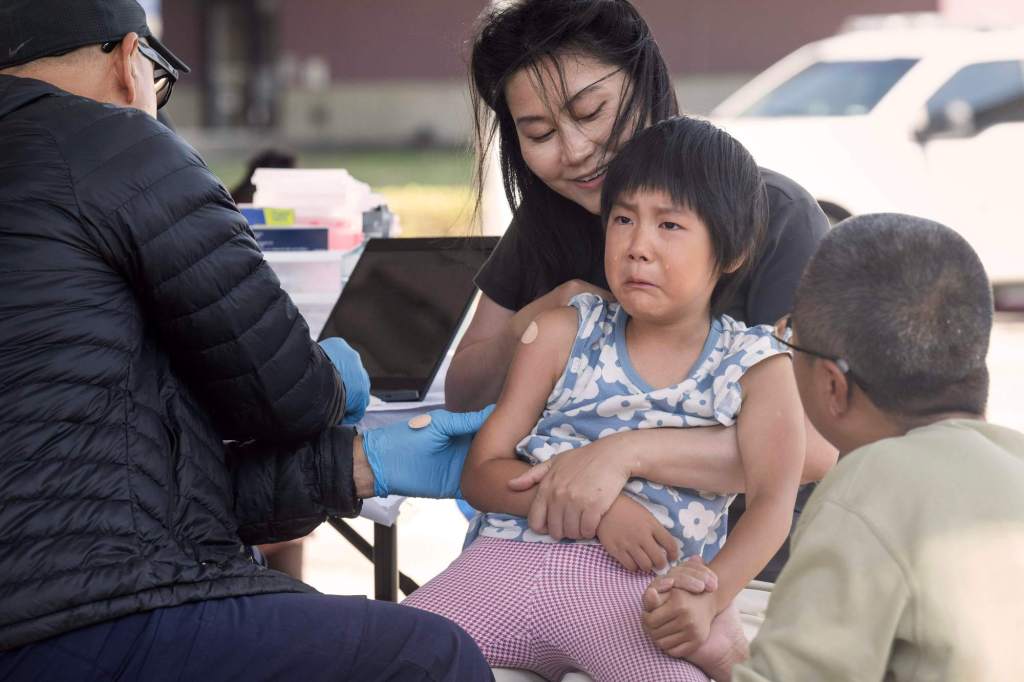
The federal government’s decision Monday to remove six vaccines from the nation’s routine childhood vaccination schedule was immediately felt by San Diego County pediatricians on Tuesday as parents began asking questions about how the change would affect their children.
The U.S. Department of Health and Human Services published a memo Monday that shifted immunizations against hepatitis A and B, rotavirus, meningococcal disease, influenza and COVID-19 from vaccinations recommended for all children to those that should be given if a child is at increased risk of disease or “based on clinical decision-making” in conversation with one’s physician. Special medications to prevent respiratory syncytial virus, often called RSV, are recommended to all newborns if their mothers had not received the RSV vaccine during pregnancy; they were moved to a “high risk” designation, though that shift is functionally the same, as babies are at high risk if their mother was not vaccinated.
Trump administration officials justify the unprecedented change in a 10-page “decision memo” signed by Jim O’Neill, acting director of the U.S. Centers for Disease Control and Prevention, arguing that these particular shots are not given universal recommendations in other countries, such as Denmark, and thus should not be routinely administered in the U.S.
“The United States administers significantly more doses of childhood immunizations than its peer nations, yet there is a significant knowledge gap due to a dearth of randomized vaccine trials and limited post-licensure infrastructure for monitoring potential adverse reactions and long-term chronic events,” the memo states.
The American Academy of Pediatrics, which has continued to publish what it calls an evidence-based childhood vaccination schedule, has decried the administration’s repeated assertions that evidence is lacking. It posted a “fact check” statement on its website, addressing the comparison to schedules in other nations.
“The truth is that while vaccine guidance is largely similar across developed countries, it may differ by country due to different disease threats, population demographics, health systems, costs, government structures, vaccine availability, and programs for vaccine delivery,” the AAP statement said.
California has made its stance clear. In September, the Golden State joined with Oregon and Washington, creating a West Coast Health Alliance, convening “trusted scientists, clinicians and other public health leaders” who have recommended continuing to follow the AAP’s broader recommendations. The California Department of Public Health reiterated its stance Monday, stating that it does not “expect these changes to affect insurance coverage for vaccines in this plan year,” and that existing recommendations as of Dec. 31, 2025, “will remain available and covered by public and private insurers.”
But those assurances did not prevent an immediate uptick in the amount of parent concern felt in local doctors’ offices.
“There are some people who are more concerned about vaccines, particularly ones such as hepatitis B that’s given at birth,” said Dr. Pia Pannaraj, an infectious disease specialist at Rady Children’s Hospital in San Diego. “We’re seeing more patients turn that one down.
“There are also patients that are the complete opposite; they’re calling and saying, ‘hey, can we come in now before they make changes to insurance coverage, and just get all of our vaccines done now.’”
Some are picking up the federal schedule change, but not the nuance of continuing health insurance coverage for vaccines recommended for universal use under the previous schedule.
“It’s functionally business as usual; it’s just that there’s confusion now,” Pannaraj said.
The federal changes, she added, have created frustration for physicians and other medical providers as they elicit more conversations with parents.
“I’d say pediatricians are up in arms because, even though they know that we’re going to stick with the AAP schedule, they also know that the families coming in are going to be confused, and so they’re going to have questions, and how do they as providers communicate?” Pannaraj said.
Dr. Wendy Pavlovich, a San Diego pediatrician, said she has definitely noticed an uptick in vaccination questions that take time to resolve.
“Today I had a family second-guess their decision a couple of weeks ago to do the routine AAP vaccination schedule,” Pavlovich said. “In general, this is what worries us, that as frontline pediatricians we’re continuing to spend more time, even with families that are definitely vaccine acceptors, clarifying information and explaining why our recommendations are differing.”
The benefits of broad vaccination of healthy children, Pannaraj added, are visible every day in hospital units, especially against common seasonal illnesses such as the flu.
“Occasionally, we will see somebody who was vaccinated and still hospitalized,” Pannaraj said. “Those patients usually have some other kind of underlying condition, you know, abnormal lungs to begin with, or some other chronic lung disease or chronic neurologic disease.
“But for healthy kids, I would say 99% of them that are hospitalized are unvaccinated.”