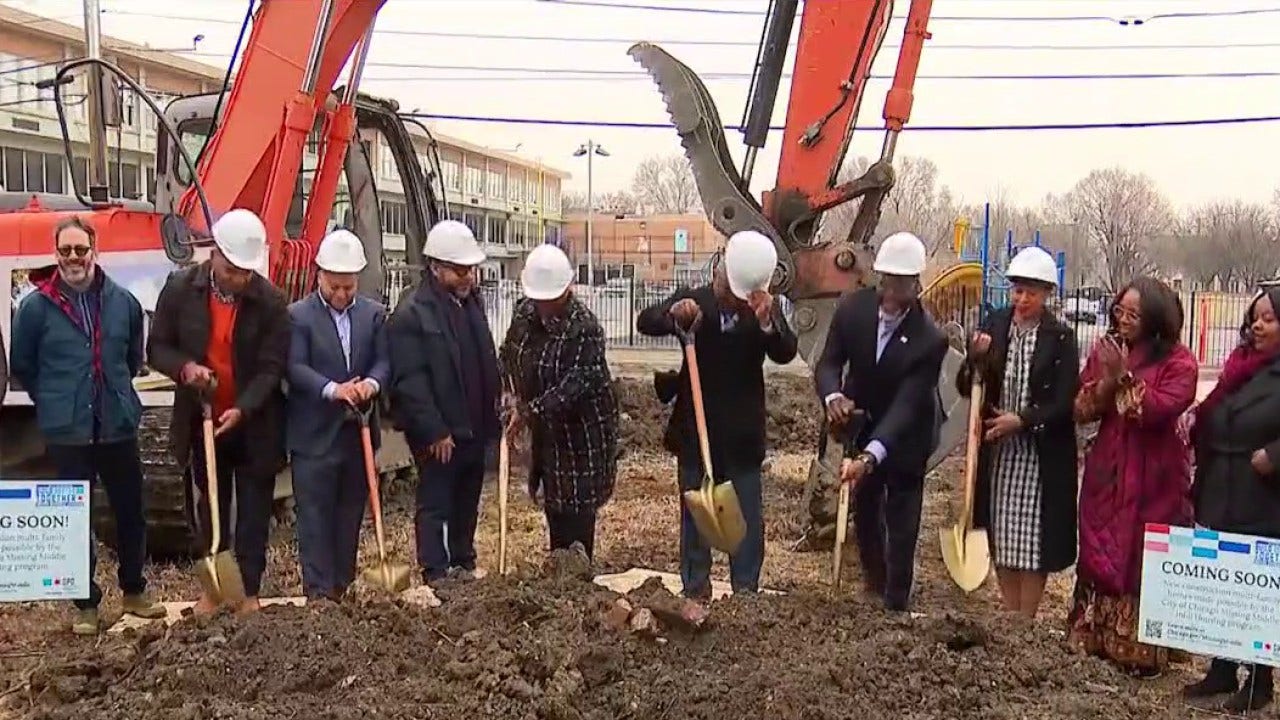
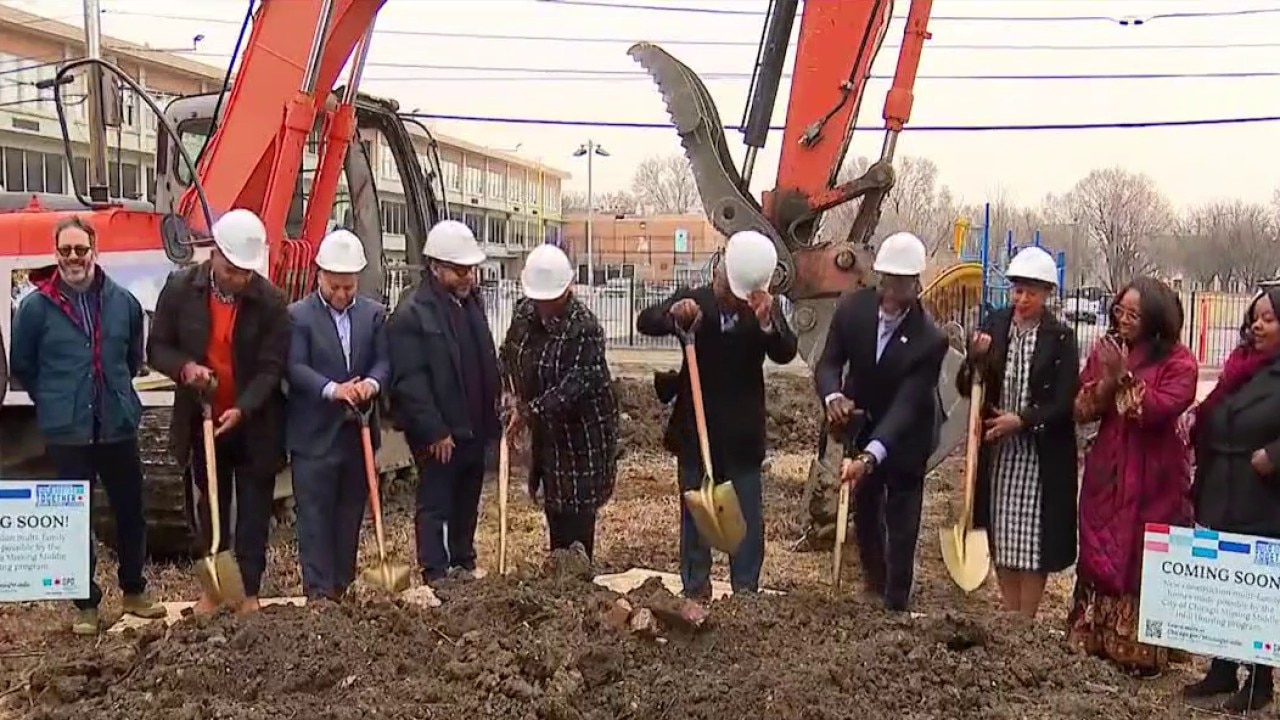
CHICAGO – Construction has begun on seven two-flat homes in North Lawndale, the first tangible result of Chicago’s push to create more housing options for working families squeezed out of the market.
On Tuesday, city officials and community leaders broke ground at 3353 W. Douglas Blvd., where city-owned land has sat empty for years. Citizens Building a Better Community is developing the homes, which represent the first of 115 market-rate units coming to the neighborhood.
The project falls under Chicago’s Missing Middle Infill Housing initiative, which was launched last fall. It aims to convert vacant lots into small multi-unit buildings that blend into existing neighborhoods while boosting the city’s housing stock.
“This represents intentional development,” 24th Ward Ald. Monique Scott said at the groundbreaking. “Development that centers the people who already call this community home.”
What ‘Missing Middle’ means:
“Missing Middle” describes the gap between single-family homes and big apartment complexes, a gap that’s grown wider over time. Zoning rules, construction costs, and market forces have pushed developers toward those two extremes. The city’s definition covers single-family homes with accessory units, two- and three-flats, row houses, townhouses, and six-flats, according to the Chicago Sun-Times. Officials argue these housing types let more people live on a block without completely transforming how it looks and feels.
The program focuses on neighborhoods on the South and West sides, where decades of disinvestment left thousands of city-owned lots vacant.
Mayor Brandon Johnson framed the project as part of a broader shift in how the city invests in those areas.
“There was a time when this neighborhood was destabilized instead of supported,” Johnson said. “This is a move from destruction to construction.”
Who the homes are for:
The North Lawndale two-flats will target buyers earning up to 140% of the area’s median income. For a two-person household, that equals $134,400 a year.
Prospective buyers can find application details through the city’s housing department website or by contacting participating community centers. The city is also hosting information sessions to guide applicants through eligibility and requirements.
Officials set the income limit to reach households that earn too much to qualify for subsidized housing but not enough to compete in the current market.
Teachers, nurses, city workers, people like that often get stuck in this gap. As prices climb, advocates say they’re being pushed farther out, into distant neighborhoods or the suburbs.
The city sold each lot for $1 and is contributing up to $150,000 per unit toward construction. The public funding helps close the gap between building costs and what working families can afford. To maintain affordability, the city added resale restrictions that cap future sale prices.
“When the city puts skin in the game, projects like this become possible,” Johnson said.
Why this matters:
Housing experts say development in one neighborhood can ease pressure across the city. Increasing supply where land is available can help cool tighter markets, especially when those new homes serve middle-income buyers.
Chris Egan of the Staines Family Foundation said real estate investment has an impact that residents can see and feel.
“When done correctly, investing in the built environment allows multiple outcomes at once,” Egan said. “It supports families, stabilizes blocks, and strengthens neighborhoods.”
In the program’s first round, developers will build 30 multi-unit buildings valued at $39.4 million, according to Urbanize Chicago. Each developer is handling a cluster of lots in neighborhoods like Chatham, South Chicago, and Morgan Park.
The Chicago Housing Authority says the process involved community meetings with local officials and residents to explain the sale and build support. City officials describe the approach as a commitment to transparent, equitable development.
In addition to Citizens Building a Better Community, the other developers are Alteza Group, Westside Community Group, Beauty for Ashes, and Sunshine Management.
What’s next:
Four additional Missing Middle projects are expected to break ground later this year, according to the city.
The program has also expanded beyond North Lawndale. In 2025, Chicago extended the initiative to parts of the South Side, including Chatham, South Chicago and Morgan Park.
According to the Chicago Sun-Times, the Harvest Homes II project in East Garfield Park will be built by the People’s Community Development Association of Chicago and the National Housing Partnership Foundation, following up on the first phase. Developers for the next round, focusing on McKinley Park, West Garfield Park, and East Garfield Park, are expected to be announced by spring.
For now, city leaders see the North Lawndale project as an early test: Can modest, block-scale housing make a difference in a growing affordability crisis?
Residents can get involved by showing up to public meetings and workshops, where they can offer feedback, raise concerns, and talk about what they want for the neighborhood.
The city also set up an online platform for submitting ideas, giving residents a direct line to help shape what comes next.
The Source: The information in this article was reported by FOX 32’s Terrence Lee.
North LawndaleSpecial ReportsNews