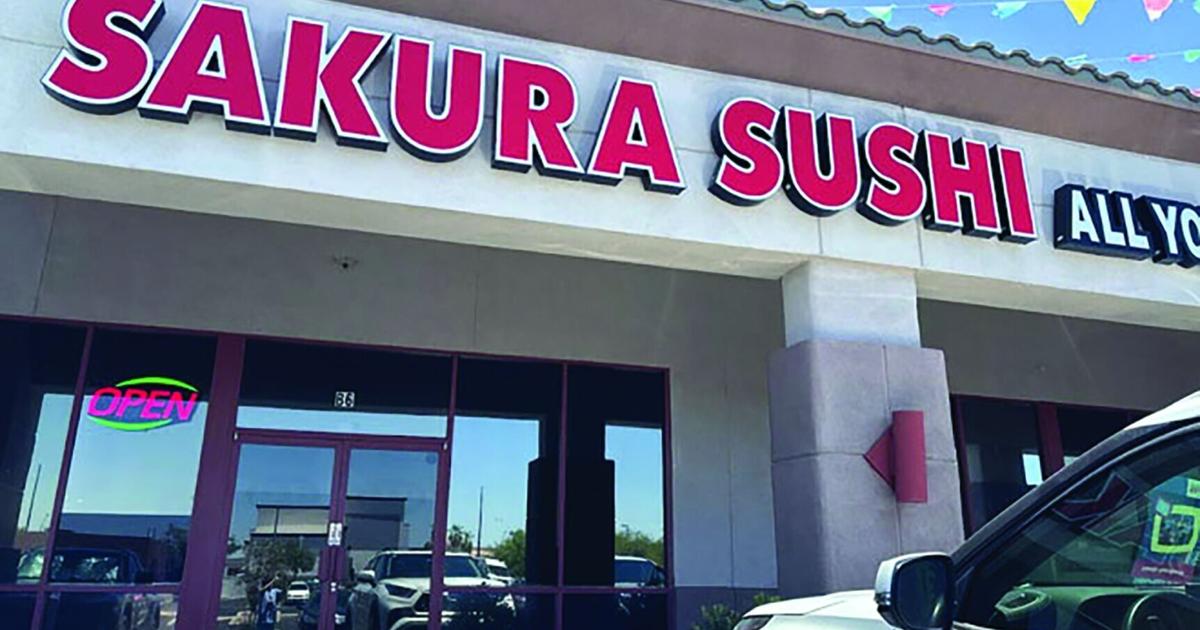
A Chandler man who owns stakes in four East Valley sushi restaurants is accused in federal court of employing undocumented workers and housing them in multiple residences investigators described as “stash houses” in Tempe, Mesa, Gilbert and Scottsdale.
Yung Lau also is alleged to have used passenger vans to shuttle workers to and from the restaurants, according to a criminal complaint and a Homeland Security Investigations affidavit filed in U.S. District Court in Arizona last month.
He was described as an owner of Sakura Sushi, which has venues in Ahwatukee, Gilbert, Chandler and Mesa. Lau’s involvement in the Gilbert Sakura is unclear, as court records said he admitted owning the other three Sakura Sushi venues.
Lau, who is charged in a two-count criminal complaint, was released on bond with the condition that he have no contact with anyone associated with the case.
Further action in his case was deferred on Dec. 30 to an unspecified date this year.
The indictment alleges Lau knowingly “conceal[ed], harbor[ed], and shield[ed] from detection” two people identified as Noe Nunez-Perez and Francisco Salas-Maldonado, “knowing or recklessly disregarding that they were in the United States unlawfully.”
The two men were ordered detained at the request of investigators, who said they “are citizens and residents of Mexico or Guatemala who entered the United States illegally and who would return to Mexico or Guatemala if released” and that they “could not be required of the court system of the United States and securing each presence by subpoena would become impractical.
Lau engaged in a “pattern and practice” of knowingly hiring and continuing to employ unauthorized workers,” the indictment states.
The complaint is supported by a lengthy affidavit by Justin Cowan, a special agent with Homeland Security Investigations (HSI), who said the agency began looking into the operation last March.
He said agents developed “information about suspected unlawful employment and harboring tied to four restaurants in the Phoenix metropolitan area.”
The affidavit said Lau has “full or partial ownership” in Sakura Sushi Phoenix Inc., 4747 E. Elliot Road, Ahwatukee; Mesa Sakura Sushi Inc., 1545 S. Power Road, Mesa; Akita Sushi Inc., 9011 E. Via Linda, Scottsdale; and Sakura Sushi Gilbert, 825 S. Cooper Road, Gilbert.
Investigators also identified four residences they said were used to house workers near the restaurants: 1029 E. Mission Drive, Tempe; 2635 E. Vermont Court, Gilbert; 11302 E. Jenan Drive, Scottsdale; and 1753 E. Gable Avenue, Mesa.
Cowan alleged Lau owned the Tempe, Gilbert and Mesa homes — and that each had a corresponding vehicle used to transport workers. The affidavit said the vans would each home in the morning, drive to a restaurant, and return to the house at night after closing.
Cowan wrote that in March 2025 he visited the Ahwatukee restaurant and noticed what he described as a “split workforce.” Some employees appeared to be of Asian ethnicity and others appeared Hispanic.
He said the communications appeared “one-way,” with “Chinese employees” giving directives and Hispanic employees doing tasks with limited interaction with customers. He also described a young Hispanic female employee who cleared tables without making eye contact and did not respond when asked a question; a Chinese employee answered instead.
Cowan wrote that he “grew concerned there could be unlawful employment in human trafficking.”
The affidavit cites Tempe Police reports from 2023 and 2024 in which callers reported a van “comes and goes full of people” and suggested possible human trafficking.
Cowan said he spoke with a neighbor who reported that several men lived at the Tempe house and only left as a group in the van each morning.
On March 25, 2025, Cowan and another agent conducted surveillance and reported seeing several people leave the Tempe home, enter the van around 9:30 a.m., and drive directly to the Ahwatukee restaurant. The passengers then entered the restaurant through a rear door, the agent wrote.
On April 2, he wrote, a Tempe police officer stopped the van around 9 p.m. for a traffic violation and found seven people in the vehicle, none of whom spoke English. The officer reported that another employee arrived at the scene and identified the seven people as employees of the Ahwatukee Sakura.
Further investigation found that five of the individuals were in the country illegally from Mexico – including one who had been deported earlier.
Investigators also found none of the seven people were listed anywhere officially as employees of the Aahwatukee restaurant.
The affidavit describes multiple traffic stops by local police departments that investigators said supported the allegations.
A second stop involved the Mesa operation. Cowan wrote that on March 25, he saw several Hispanic men exit the Mesa restaurant late at night, enter a van and drive to the Gilbert residence.
He later cited a June 16 Mesa Police traffic stop of that van shortly after closing time. Officers identified six occupants, including a driver and that DHS checks indicated the other occupants were undocumented or lacked employment authorization. Cowan again said DES records did not list those individuals as employees.
Cowan said surveillance on April 1 showed four Hispanic men leaving the Scottsdale restaurant and traveling in a passenger van to the Scottsdale residence. He later described additional surveillance in June 2025 in which two Asian men entered the front seats of the van and Hispanic men entered through the rear, which the agent characterized as appearing deliberate.
For the Gilbert restaurant, Cowan said surveillance in early June 2025 showed several Hispanic-appearing individuals leaving the restaurant at closing time in a van and traveling to the Mesa residence, where agents also saw a BMW with California plates.
On Nov. 25, HSI agents conducted surveillance at all four residences, the affidavit says.
In each of them agents saw vans leaving homes in the morning, transporting occupants to the corresponding restaurants, and the workers entering through employee entrances.
The affidavit also references updated DES records obtained on Nov. 24, stating that the restaurants collectively reported about 60 employees in 2025 and that the names and Social Security numbers “identified them as being of Chinese origin except for one,” even though agents said the males they saw transported were Hispanic.
On Dec. 10, HSI executed federal search warrants at the four restaurants, the four residences, and Lau’s Chandler home.
They arrested multiple people they said were foreign nationals without authorization to be in the U.S. or to work.
In the affidavit, the agent lists six Mexican nationals without legal status in the Tempe home, seven in the Mesa home, eight in Gilbert, including the two men who have been detained for further court action in Lau’s case, and seven in Scottsdale. An eighth man at the Scottsdale home was a Chinese national with no authorization to work in the U.S.
The affidavit also describes living conditions at the Scottsdale residence, saying rooms were subdivided multiple times “using drapes hanging from the ceiling” to create private areas for multiple occupants.
Cowan said agents seized Lau’s cellphone and that Lau and his wife initially declined to speak after receiving Miranda warnings in Mandarin.
The criminal complaint’s two named alleged “harboring” victims, Nunez-Perez and Salas-Maldonado, are central to the government’s narrative.
Cowan reported that Nunez-Perez told agents in a recorded Spanish-language interview that he worked at the Mesa restaurant, was hired by “the boss,” and identified Lau from a photograph as that boss.
Nunez-Perez allegedly said he was paid $1,500 every 15 days and that the person who paid him was Lau’s “brother,” whom he identified as Qin Liu. Nunez-Perez said he lived at the Gilbert residence, paid no rent, and had lived there about three years, beginning when he started work at the Mesa restaurant, according to the affidavit.
Cowan reported that Salas-Maldonado, in another recorded interview, said he was born in Guatemala and entered the U.S. on or about Sept. 25, 2025, paying 80,000 Guatemalan quetzals to be smuggled in.
He allegedly said he was told in Mexico about a job and housing, was brought to the Gilbert residence and lived there with one Asian male and seven Latino males.
Salas-Maldonado said he was paid cash every 15 days, about $2,000 per month, did not receive overtime pay, and did not receive tips.
According to the affidavit, on Dec. 11, Lau waived his rights and acknowledged owning stakes in all four restaurants and stated he operated three of the ones in Ahwatukee, Mesa and Scottsdale.
Cowan wrote that Lau described having two categories of workers — “Chinese workers” paid by check and “Mexican workers” paid in cash.
The agent said Lau initially claimed he had documents for all workers, but later admitted that the Mexican workers were “illegal.”
Cowan also wrote that Lau said he hired unauthorized workers because it was hard to find workers, and that he knew it was wrong.
The affidavit further alleges Lau admitted owning three of the residences used to house workers and said he provided housing as a benefit. Cowan wrote that Lau said there was at least one Chinese worker living in each residence as a caretaker to “monitor” the Mexican workers.