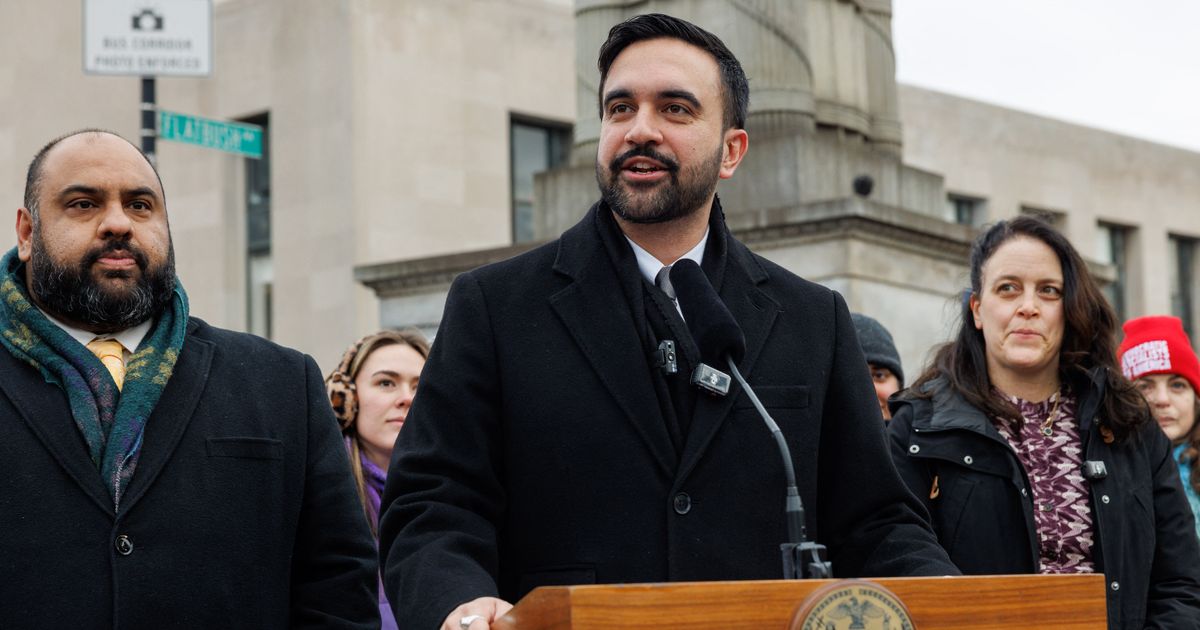
Photo: Jason Alpert-Wisnia/Hans Lucas/AFP/Getty Images
On the last day of the year, Eric Adams’s attempt to stack the Rent Guidelines Board fell apart: Both of his picks for one of the public-member seats dropped out. With that seat empty and four additional vacancies to fill in the coming year, Zohran Mamdani is in a much better position to make good on his campaign promise to freeze the rent for rent-stabilized tenants across the city. So what happens now?
The system that governs rent stabilization is sort of byzantine, but the basics are as follows: The board is composed of five public members, two tenant members, and two landlord members, all appointed by the mayor. The last two groups usually cancel each other out when it comes to voting to raise or maintain rents, so it’s the five public members who generally matter most when setting the annual rate of increase. Right now, Mamdani is poised to appoint a majority to the board — three public members, a tenant member, and a landlord member.
Meanwhile, Adams’s remaining appointees include economist Alex Armlovich and NYU finance professor Arpit Gupta as public members, Legal Services NYC’s Sagar Sharma as a tenant member, and lawyer Christina Smyth as a landlord member whose firm represents owners (and has sued tenants for rent they don’t actually owe). Mamdani says he will make his appointments soon. And while he doesn’t control the vote himself, he will almost certainly choose members he believes are aligned with his agenda. “The path to the rent freeze feels clear in terms of the Rent Guidelines Board appointments,” Ritti Singh, a spokesperson for New York State Tenant Bloc, a group that has been organizing for a rent freeze, told me.
But is it really that simple? When asked about curveballs or possible hiccups, Sam Stein, a housing-policy analyst at the Community Service Society, told me that unless Sharma is some sort of “sleeper agent,” the next steps seem straightforward enough. (Neither Singh nor Stein seem actually concerned — Sharma works at Legal Services, a well-known organization that defends tenants’ rights. Sharma did not respond to a request for comment.)
Once the composition of the board is set, there will be early meetings in the spring. (There are no dates posted just yet.) The board then spends a few months going over housing reports and hearing from tenants and landlords. Then there’s a preliminary vote, during which the board will put out the range of rent increases it’s considering. Last year, the range was between 1.75 percent and 4.75 percent for one-year leases and between 3.75 percent and 7.75 percent for two-year leases. The result is usually somewhere in the middle of these ranges: The board ended up voting to increase rents by 3 percent for one-year leases and 4.5 percent for two-year leases. This all tends to be a bit of a circus — tenants get mad, landlords get mad, then the board comes out with a number everyone hates. But that could change this year.
Still, Singh, from the Tenant Bloc, emphasized that the matter isn’t totally settled: “It’s good to have the math on our side, but we are always going to be organizing.” Mamdani still has a tighter majority than, say, when Bill de Blasio instituted a historic rent freeze in 2015 with a board, which he had appointed in full, voting 7-2 in favor. But Singh is confident that the data is also on the side of a rent freeze — net operating income for buildings with at least one rent-stabilized unit was up by 12.1 percent in 2023 and 10.4 percent in 2022 (the most recent years the board’s reports have data on). Landlords claim these numbers don’t show the full picture of buildings in distress, but even for buildings with 100 percent stabilized units, net operating income was up by 4.6 percent. “We feel pretty confident that there’s the Rent Guidelines for path to the rent freeze, a clear case for the rent freeze, and public support for the rent freeze,” Singh said.
So if a rent freeze goes through, when will tenants see it reflected in their leases? The final votes tend to happen in the summer and apply to leases the following fall. (Last year’s vote happened in June and applied to leases starting on October 1.) There’s still some waiting to do; rent-stabilized tenants will have to hold out until the fall to see a potential rent freeze take effect. And obviously, there will be fighting until then. When Mamdani made a rent freeze a central part of his platform, the real-estate industry balked — unsurprisingly. Kenny Burgos, CEO of the New York Apartment Association, a group that represents rent-stabilized landlords, was blunt: “There is no free lunch.” One might counter that that applies to rent-stabilized landlords, too.
Sign Up for the Curbed Newsletter
A daily mix of stories about cities, city life, and our always evolving neighborhoods and skylines.
Vox Media, LLC Terms and Privacy Notice
Related