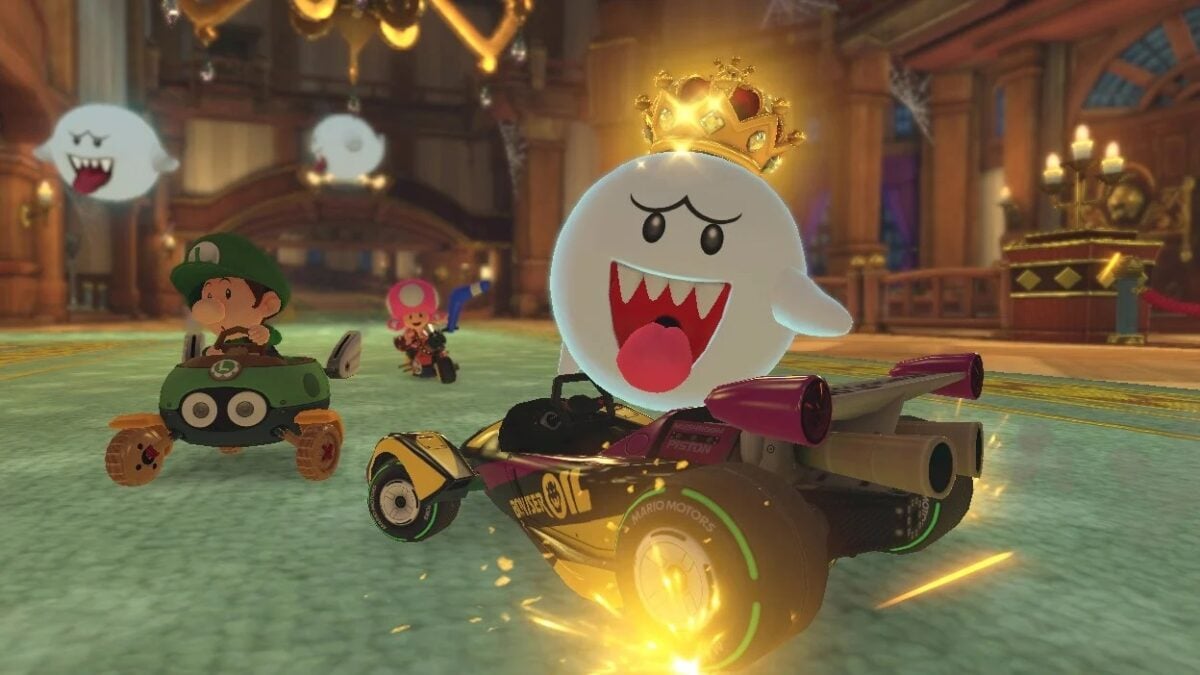
Whenever my kids get stuck playing a game, they run around the house yelling for me to help them. Doesn’t matter where I am or what I’m doing. Making dinner, taking out the trash, going to the bathroom, nowhere is safe. I patiently try to explain to them that back in my day, there was no grownup to help me beat Snake Man in Mega Man 3 or find Excalibur in Final Fantasy IV. I just had to bash my head against the wall until I figured it out or give up until I got older.
They never find this paternal wisdom satisfactory, so there I am finding them Zonai devices in The Legend of Zelda: Tears of the Kingdom or turning off damage in the Minecraft settings menu like a personal accessibility assistant. Will they do the same for their children? They might not have to. New AI “ghosts” might be able to do everything in the game for them. The games will, on command, be able to play themselves. Perfect for grinding crypto-currency in the Roblox mines while the oceans rise. RIP my future grandchildren.
A Sony patent for these AI ghosts has been making the rounds online today. As reported by VGC, the September 2024 registration documents which were publicized earlier this week reveal a technology that would allow people to get AI to help them beat games. These AI “ghost players” would be trained on existing game footage and either demonstrate the solution to an obstacle (“Guide Mode”) or beat it entirely (“Complete Mode”).
It’s not clear from the patent whether Sony actually plans to move forward with this new AI help tool now or in the future. People have made jokes online about how bad current AI is at hallucinating gameplay, showing you something that looks normal enough before shifting into surreal nightmare fuel just moments later. There are also concerns about how the AI “helper” would be trained, which would seemingly include footage shared on social media and YouTube.
the point of a movie is not to be done watching it. the point of a song is not to be done listening to it. the gamers’ obsession with completion as the only motivator to play a game has directly led to the medium’s worst traits. “AI gaming ghost” is a reflection of the lack of willingness to engage
Gaming has a long history of companies trying to help players overcome the difficulty that they themselves designed into their games. In the past there were hotlines and strategy manuals. More recently, companies have tried to embed guides directly into the games. Game Help on PlayStation 5 shows you videos of how other players have completed a particular section of a game. It’s a neat idea whose implementation is messy and incomplete. Microsoft is trying to go a step further and embed its Copilot AI into games to offer chatbot-style assistance as an overlay like a new version of Clippy.
Tools like this could be a boon for helping more people enjoy games or at least “unstuck” themselves before bouncing off in a fit of boredom or frustration. But there’s also a Black Mirror version where all of the friction of actually playing a game is offloaded to AI agents entirely. How many games would be improved by adding a skip button that lets you fast-forward your progression by 20 seconds or 20 minutes? How many games would you stop playing entirely if you could offload the drudgery entirely?
AI ghosts grinding AI optimized battle passes
Players love to optimize strategies and get one over on the games they’re playing. Sometimes that means doing a lot of work to grind as effectively as possible or craft the most broken build. Other times it means wrapping a rubber-band around an analog stick and going to sleep while the game does all the work for you. What would it be like to play Diablo 4 if those builds you had to look up online were automatically recommended inside the skill tree menu?
What would be the point if at any time you could put the mouse and keyboard down and let an AI agent, trained on YouTube or even your own play history, take the wheel and grind until all of that hyper-rare loot finally drops? Not everyone would go for it. Maybe some would. We already know what choice Elon Musk would make.
Experience-based games would probably be safe. The ones where you’re there for player choice or the story, though even fans of things like Dispatch might be tempted to have someone else handle all of the less engaging mini-games. Multiplayer games have faced an ongoing arms race with cheaters for years. Who wouldn’t be tempted to take credit for a duos Battle Royale win pulled off by their AI counterpart? None of this is in the Sony patent for AI help, but it’s all in the same Pandora’s box.
In fact, some of the most popular games of the past few years play with automating the player’s role to some degree until they are irrelevant to the outcome. That’s what made people obsessed with Vampire Survivors. It’s what helped Ball X Pit sell over a million copies. It’s what made Megabonk so popular, it ended up being nominated for an award at the Game Awards that the developer had to recuse himself from. Some games call upon us to embrace the moment-to-moment drudgery of simulated work. Others lure us with the siren’s call of participating in a high-score chase where the big reward is seeing our own participation incrementally diminished.
In 20 years, even that concept might sound as alien to my grandkids as calling something a “button masher.” By then, the computers will no doubt be able to read the inputs directly from their minds. What the AI chooses to do with those, well, that’s anybody’s guess.