Advocates for space science research are concerned about job losses and cuts to funding at NASA’s Marshall Space Flight Center in Huntsville.
Marshall has lost about 350 people through the deferred resignation program established by the Trump administration as part of its cuts to federal agencies, Jack Kiraly, director of government relations for the Planetary Society, told AL.com. That’s in addition to dozens of employees being laid off because the International Space Station is scheduled to be decommissioned in 2030.
“It’s certainly not unique to Marshall, unfortunately,” Kiraly said. “All of the NASA centers are experiencing layoffs both of the civil service and contractor workforce.”
But he specifically sees it impacting Huntsville and the north Alabama space eco system.
“It’s really detrimental to the long-term health,” Kiraly said. “There is a lot of activity happening specifically in Huntsville generated by the national space and civil service space programs. It really has a detrimental long-term effect on health and capabilities of NASA and its partners.”
Roger Baird, associate director at Marshall, did not mention job losses or budget cuts during the Huntsville-Madison County Chamber’s Redstone Arsenal. But he said the space center faced “challenges.” He did not elaborate on the challenges.
Marshall is currently without a permanent director following Joseph Pelfrey’s resignation in September.
Kiraly is concerned about the loss of expertise of those departing from the agency, from those involved with asteroid finders to earth monitoring satellites, to missions to basically every planet in the solar system, some of them to non-planets. Many of those programs are managed out of Marshall.
During the Redstone update, Baird Marshall continues to lead in cutting-edge science and technology, supporting both human space flight breakthroughs and scientific discovery. He the Marshall team is supporting several space science missions in orbit, including:
- Chandra X-ray Observatory, which is a space telescope that observes x-rays from high energy regions in the universe, helping study black holes and super novas;
- the Fermi Gamma Ray Burst Monitor, an instrument that detects bursts of gamma ray energy from deep space events;
- the Hinode satellite payload, a solar satellite that monitors solar activity, including the recent science of the Northern Lights that people saw here in north Alabama;
- IXPE, a space telescope that measures x-ray polarization to study extreme cosmic events.
“We’re also preparing for the launch of Starburst, a mission that will advance astronomy by detecting short gamma ray bursts,” Baird said. “That instrument spent the summer at Marshall undergoing flight vibration and thermal vacuum testing as well as instrument calibration.”
Kiraly is specifically concerned about the decommissioning of the ISS, which he said is going to be a big hit to the space community regardless.
“Marshall manages the selection and the administration of the science instruments of the space station,” he said.
Kiraly wonders if similar scientific research or instruments would be allowed on commercial space stations that are planned to take the place of the ISS and if there will be a lag time.
A lot, he said, depended on Jared Isaacman’s confirmation as NASA director. Isaacman was confirmed last month. During his confirmation hearings, Isaacman pledged there would be no lag time between the decommissioning of the ISS and the transition to commercial stations, a role in which Marshall and companies in Huntsville are expected to play.
Isaacman also pledged support for the type of missions Kiraly is concerned about. But Kiraly is not the only person concerned about the loss of missions and personnel at Marshall.
“NASA and the Marshall Space Flight Center have been the engine behind so many of America’s most historic and famous achievements, while also driving economic opportunities across northern Alabama,” said Pamitha Weerasinghe, campaign director for Knowledge for a Competitive America. “NASA’s work doesn’t just take us to new frontiers in space; it deepens our understanding of our home planet by studying the weather and climate. Alabamians across the political spectrum recognize the importance of funding scientific research at NASA, and it is critical we protect this funding for the work that keeps America competitive, prosperous, and secure.”
She said, “there are a lot of core questions about the universe that happen because of the work happening at Marshall that could very well be impacted by these significant cuts.”
Artemis safe?
Kiraly said the Artemis program that is sending humans back to the moon for the first time since the 1970s appears to be safe. Isaacman voiced support for the Artemis program and future manned missions to Mars.
A budget for NASA introduced by the Trump Administration early in 2025 left the Artemis program beyond the Artemis II mission in doubt. But Congress later restored funding for the program in the Big Beautiful Bill through Artemis V. The Artemis III mission would be the first to land astronauts on the moon since Apollo 17 in December 1972, with the U.S. in a race with China to return humans to the moon.
Isaacman pledged support for the funding restored by Congress.
Isaacman singled out Marshall’s role in space exploration during his confirmation hearing. According to Fox News Radio, he plans to demolish several testing facilities in Alabama as the space agency looks to modernize its infrastructure under Isaacman’s new leadership.
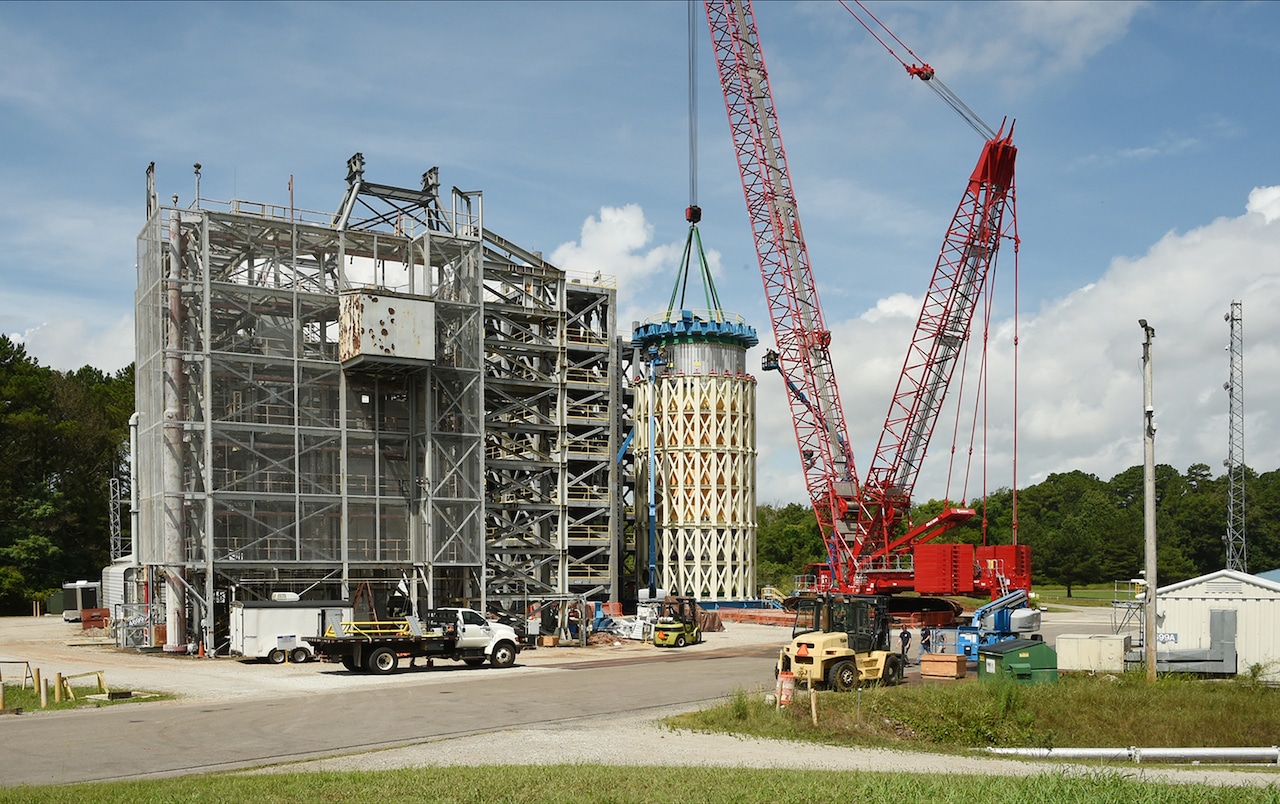
The agency will demolish the Dynamic Test Stand and the Propulsion and Structural Test Facility, known as the T-Tower at Marshall. The removal is set to begin Saturday, Jan. 10.
“NASA is embarking on an exciting infrastructure modernization effort to prepare for the future of exploration,” Isaacman told Fox News Digital in a statement. “The first phase will make way for new facilities by retiring outdated ones, enabling investments in the capabilities needed to deliver on our world-changing mission of science and discovery.”
According to U.S. Rep. Dale Strong, R-Monrovia, the Big Beautiful Bill included over $4.2 billion for NASA’s Marshall Space Flight Center to support the Space Launch System, Orion integration, and critical infrastructure upgrades.
NASA’s latest economic impact report in Alabama shows $8 billion in total impact, more than 35,000 jobs supported, $265 million in state tax revenue and $2.7 billion in state procurement investments.