We’re currently right in the middle of peak flu season, which means immune support is top of mind for pretty much everyone. Staying on top of your vaccines (flu, COVID and, for some, RSV), is key to protecting your health. So are the hygiene basics we’ve been taught since kindergarten, like covering your mouth when you sneeze and washing your hands frequently.
Diet plays a role in immune support, too, and maybe you’ve been downing orange juice like it’s your job in an effort to avoid getting sick. While oranges are a good source of vitamin C, bell peppers have even more, making them a worthwhile veggie to incorporate into your meals.
While all bell peppers offer nutritional benefits, what they offer varies slightly depending on color. We talked to registered dietitians about how bell peppers’ benefits vary by color. Curious as to which one you should go for to support your health goals, including immune support? Here’s everything you need to know.
How the nutritional benefits of bell peppers vary based on their color
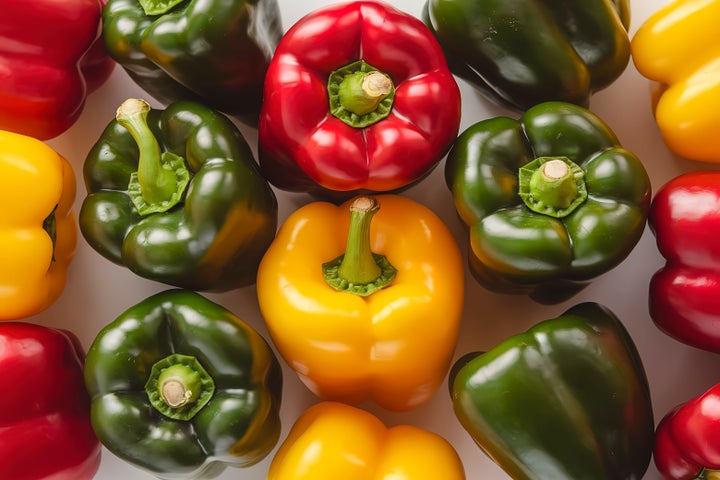
When comparing the nutritional benefits of the different colors of bell peppers, it’s helpful to know why their colors vary to begin with. Ginger Hultin, a registered dietitian nutritionist who has a doctorate in clinical nutrition and is the author of “Anti-Inflammatory Plant-Based Eating 101,” told HuffPost that a bell pepper’s hue has to do with how ripe it is.
“Bell peppers change color as they ripen on the vine, with green peppers being the least ripe and red peppers being the most mature,” Hultin said. She explained that green bell peppers are high in chlorophyll, a pigment that gives them their green color. “As the peppers mature on the vine, the chlorophyll breaks down, and more carotenoids [a type of antioxidant] are produced, accounting for the change in color and nutrient profile,” she said. Hultin added that, unlike bananas, bell peppers are non-climacteric fruits and don’t ripen after they’ve been picked.
As a 2021 review published in the journal Molecules explains, all bell peppers contain carbohydrates, fiber, antioxidants, vitamin C, vitamin A, potassium, calcium and phosphorus. All three dietitians we talked to told HuffPost that the amount of these nutrients varies slightly, based on a bell pepper’s color.
Ramona Macedonski / 500px via Getty Images
These are all the same plant, just at different levels of ripeness.
Red peppers have distinct health benefits
Want to get the most nutrients across the board? Registered dietitian and intuitive eating counselor Kara Lydon recommends eating red bell peppers. “Red bell peppers typically come out on top in terms of overall nutritional value. Since red peppers ripen the longest, they boast the most antioxidants,” she said. Registered dietitian Maggie Michalczyk said this too, explaining, “Red bell peppers are the highest in vitamin C and A due to longer ripening times, followed by orange, yellow and green.”
In terms of which color bell pepper offers the most immune support, red comes out on top again. “Studies show that red bell peppers have the highest content of vitamin C out of all the bell peppers, potentially as high as 60% more vitamin C than their green counterparts,” Lydon shared, highlighting a study published in the International Journal of Food Science and Nutrition. As Michalczyk pointed out earlier, red bell peppers are also the highest in vitamin A, another nutrient that supports immune health.
But don’t discount orange, yellow and green
Even though red bell peppers are the most nutrient-rich, that doesn’t mean that orange, yellow and green bell peppers aren’t worth eating. All three dietitians emphasized that the nutritional differences between different colored bell peppers aren’t huge, so you shouldn’t get too hung up on it.
“Each bell pepper offers a unique antioxidant profile, so it’s best to ‘eat the colors of the rainbow’ when it comes to bell peppers so that you can reap the nutritional benefits of each kind,” Lydon said. For example, yellow bell peppers are particularly high in lutein and zeaxanthin, two nutrients that support eye health.
As for green bell peppers, Hultin said they are lower in calories. “Green bell peppers have slightly fewer calories than their red, orange and yellow counterparts since they are less ripe and their natural sugars haven’t accumulated yet. However, this difference is negligible,” she said. A red bell pepper contains about 37 calories per pepper, while a green pepper contains 24.
It bears repeating that when it comes to the nutritional differences among bell pepper colors, all three dietitians say these differences are pretty minimal across the board, so it’s important not to get too hung up on them.
How you cook them matters
If you want to get the maximum benefits from your peppers, how you cook them matters. “Steaming and stir-frying are two good ways to cook bell peppers to help prevent the loss of water-soluble vitamins like vitamin C,” Michalczyk said.
She recommends avoiding boiling or cooking bell peppers at high heat to preserve their nutrient density as much as possible. “It’s good to keep in mind that overcooking can degrade nutrients found in vegetables and boiling can cause the water-soluble vitamins to leach into the water,” she explained.
Since vitamin A is fat-soluble, Hutlin recommends sautéing peppers in extra-virgin olive oil to help maximize nutrient absorption.
There is no shortage of bell pepper recipes you can find online to experiment with to learn your favorite ways to eat bell peppers. Lydon said that, personally, she loves stuffed bell peppers because they’re easily customizable based on taste preferences and the ingredients you have on hand. “Make it a well-balanced, satisfying meal by adding a source of lean protein like ground turkey, chicken or fish, a starch high in fiber like brown rice or quinoa and a dietary fat like cheese or avocado,” she shared.
Hultin says that bell peppers can be easily mixed into soups, stews, omelettes or frittatas for breakfast, roasted as a side or enjoyed raw and sliced to pair with hummus.
“Ultimately, all colors of bell peppers make a great addition to the diet, so I wouldn’t stress too much about getting one color vs. the other,” Michalczyk emphasized. “Go for a variety to reap the benefits from the health compounds that are unique to each color. In the winter, during cold and flu season, I think it’s great to know that red bell pepper has more vitamin C than an orange and incorporate those into different meals and snacks to support your immune system.”
It’s also important to remember that bell peppers are just one of many nutrient-rich foods, including ones that support your immune system. So it’s worth it to vary your meals with other foods too, like cauliflower, butternut squash and apples. Besides providing your body with a wider range of nutrients, switching things up will keep your taste buds happy, too.