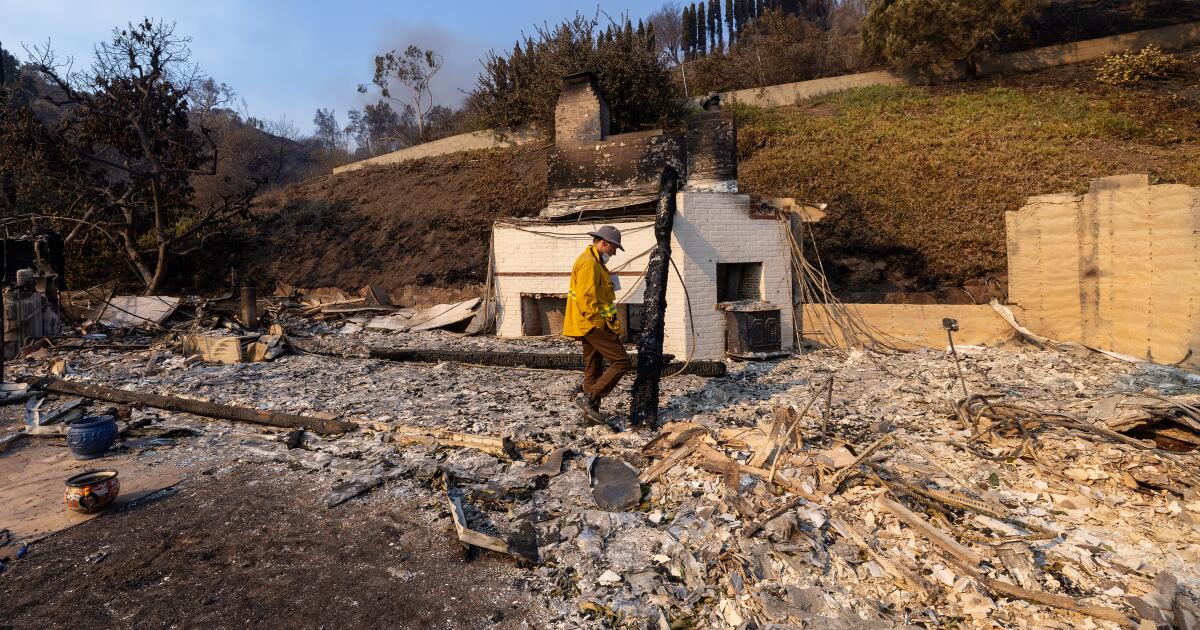
When we went around the table at Thanksgiving, our close ones laid out their myriad plans and wishes for the coming year: writing projects, work goals, fitness regimens, travel plans. All the wishes sort of blended into a bit of white noise for me. Until our friends Betsy and Howard took their turns. “I want a home,” was all Betsy said. “Yeah,” Howard agreed, “a home.”
The home they owned in Altadena — near the top of Lake Avenue and just below wild brushland — burned down one year ago tonight. I recall it as a beautifully quirky place, where you could soak in a hot tub or cook a pizza in an outdoor brick oven, or look over a small fruit orchard and take in a good portion of the western San Gabriel Valley.
You’re reading the Essential California newsletter
Betsy and Howard are among the lucky ones. They have good insurance and they’re roosting in a fine temporary place in Pasadena. But like thousands of others, they don’t feel they’re home.
We all know a home is more than just the roof over our heads. Often it’s those who’ve lost theirs who understand what it really means. It’s a set of routines developed over years, the comfort of the familiar and a monument to the different ways families learn to feel safe and like themselves.
Our friends’ holiday wish clarified the way in which disasters can be simultaneously crushing and affirming. They leave us lost and bewildered. And they remind us what really matters.
The scope of postfire logistics can overwhelm
The family home where I grew up in Malibu, which we still own, also burned a year ago. Our old ranch house, built in 1948 and bought by my parents in 1969, had survived too many fires to remember. But the monster of 2025 finally took it down, leaving a void in place of the house where my mom had died just months earlier.
We already had taken much of what we wanted from the old place. But some photos and my mom’s artwork went up with the flames.
What should we do next? The most sensible thing might be to sell. But in this postfire environment, potential buyers are fleeting and prices have swooned, especially given the difficulty that any owner, new or old, will find in insuring properties in the fire zone.
In the meantime, properties have been carrying costs. To get the county to restart water service, I had to get a plumber to install a backflow inhibitor. The device prevents contaminated water from things like fires from flushing back into the public water lines. That cost several thousand dollars to install and get certified. Several thousand more went to building a temporary irrigation system to prevent the last remnants of our landscaping from dying altogether.
Like many folks in the two fire zones, I’m still working to get a full settlement from our insurance company. To do that, you’d better have a specific bid from a contractor or contractors, showing what the costs will be. I’m still diving into that morass, finding contractors crazy busy and some loath to give a price if they’re not sure you’ll hire them for the job.
I can count a few small victories: After multiple calls and emails, the county assessor’s office finally acknowledged there is no home on our land anymore. That will reduce our taxes considerably. And I was able to find original plans for our house, designed by renowned architect Cliff May, in an archive at UC Santa Barbara. So we now have a full-color rendering of what the house once was and might be again.

Rendering of the Rainey Malibu home.
(Art, Design & Architecture Museum / UCSB)
Rebuild or not, we’ll never go back to life before Jan. 7
Within our own families, rebuilding can feel overwhelming. Even if you turn out to be one of the rare families with enough insurance to cover reconstruction, do all of your loved ones want to go through the ordeal? And what kind of neighborhood will you return to?
An old friend from the neighborhood, Bill Stange, has found plowing through all the rebuilding details amounts to a full-time job. And he’s not sure how many of his neighbors will stay the course, even if he does.
“You’re working to rebuild your house and put memories back where they’re supposed to be,” Stange said to me this week. “But you’re also looking for your tribe. And, you know, most of the tribes have gone far and wide with the wind since this fire. …So you could lose that character and that cohesiveness that doesn’t come with every neighborhood. That’s the shrinking part of Malibu that I hope doesn’t go away totally, you know?”
More on the firesToday’s top stories 
Rep. Doug LaMalfa (R-Richvale) answers questions during a town hall meeting in Chico in August.
(Hector Amezcua / Sacramento Bee)
California Rep. Doug LaMalfa, 1960-2026Trump’s operation in VenezuelaLAFD fire reportL.A.’s lower homicide rates
- The city of Los Angeles recorded its lowest homicide total in more than half a century, tallying 230 homicides in 2025.
- The number is nearly 19% lower than the year before, but theories on why killings are down have varied.
What else is going onCommentary and opinionsThis morning’s must readsOther must readsFor your downtime  Going outStaying inAnd finally … your photo of the day
Michaela Vuong, a server for more than 25 years, serves food at the Original Saugus Cafe on its last day of business.
(Juliana Yamada / Los Angeles Times)
Today’s great photo is from staff photographer Juliana Yamada of Michaela Vuong serving food at the Original Saugus Cafe on its last day of business. The cafe has been operating for 139 years and is the oldest restaurant in L.A. County.
Have a great day, from the Essential California team
Jim Rainey, staff reporter
Hugo Martín, assistant editor, fast break desk
Kevinisha Walker, multiplatform editor
Andrew Campa, weekend writer
June Hsu, editorial fellow
Karim Doumar, head of newsletters
How can we make this newsletter more useful? Send comments to essentialcalifornia@latimes.com. Check our top stories, topics and the latest articles on latimes.com.