
While heat in everyday materials spreads gradually from a hot point outward, this rule breaks down inside superfluids, substances that flow without any resistance. In these strange materials, heat can slosh back and forth like a wave, even as the fluid itself appears perfectly still. The team at MIT has developed a new method of thermal imaging to track this movement, marking a leap forward in visualizing one of the most elusive features in quantum fluid dynamics.
The experiment centered around ultracold lithium-6 atoms, cooled to near absolute zero, that behave in extraordinary ways. This research doesn’t just prove a theory; it visualizes a form of heat transmission that acts completely differently from anything we observe in our daily lives. And while it might sound abstract, understanding how second sound works could have real consequences for how we understand matter in extreme conditions.
A New Way to See Heat in a Frictionless World
In traditional materials, heat spreads through conduction or convection. But in superfluid quantum gases, like the ones created at MIT, heat can travel as a wave, not just a temperature increase. This is what physicists call second sound, and until now, no one had seen it directly.
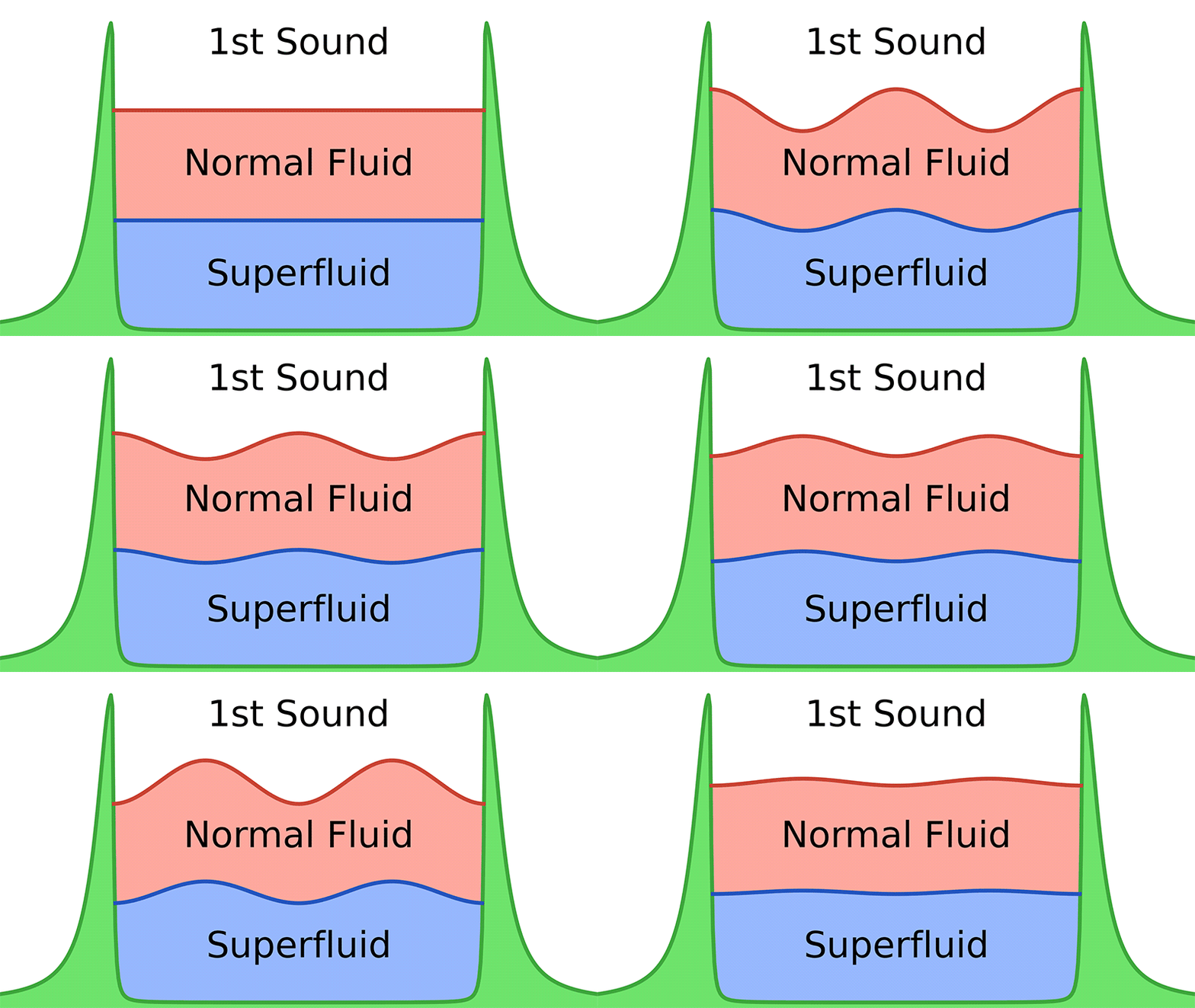 First sound, depicted in a simple animation, is ordinary sound in the form of density waves, in which normal fluid and superfluid oscillate together – © MIT News
The team, including lead author of the study Martin Zwierlein and assistant professor Richard Fletcher, designed an innovative thermal mapping system that bypasses the limitations of traditional infrared thermography. According to Popular Mechanics, they couldn’t use infrared because the temperatures involved were so cold that no infrared signal could be detected.
Instead, the researchers used radio frequencies to track a specific kind of atom: lithium-6 fermions. These atoms respond to different radio frequencies depending on their temperature. That allowed scientists to essentially listen in on the heat, detecting warmer and colder areas of the gas by tuning into these frequency shifts.
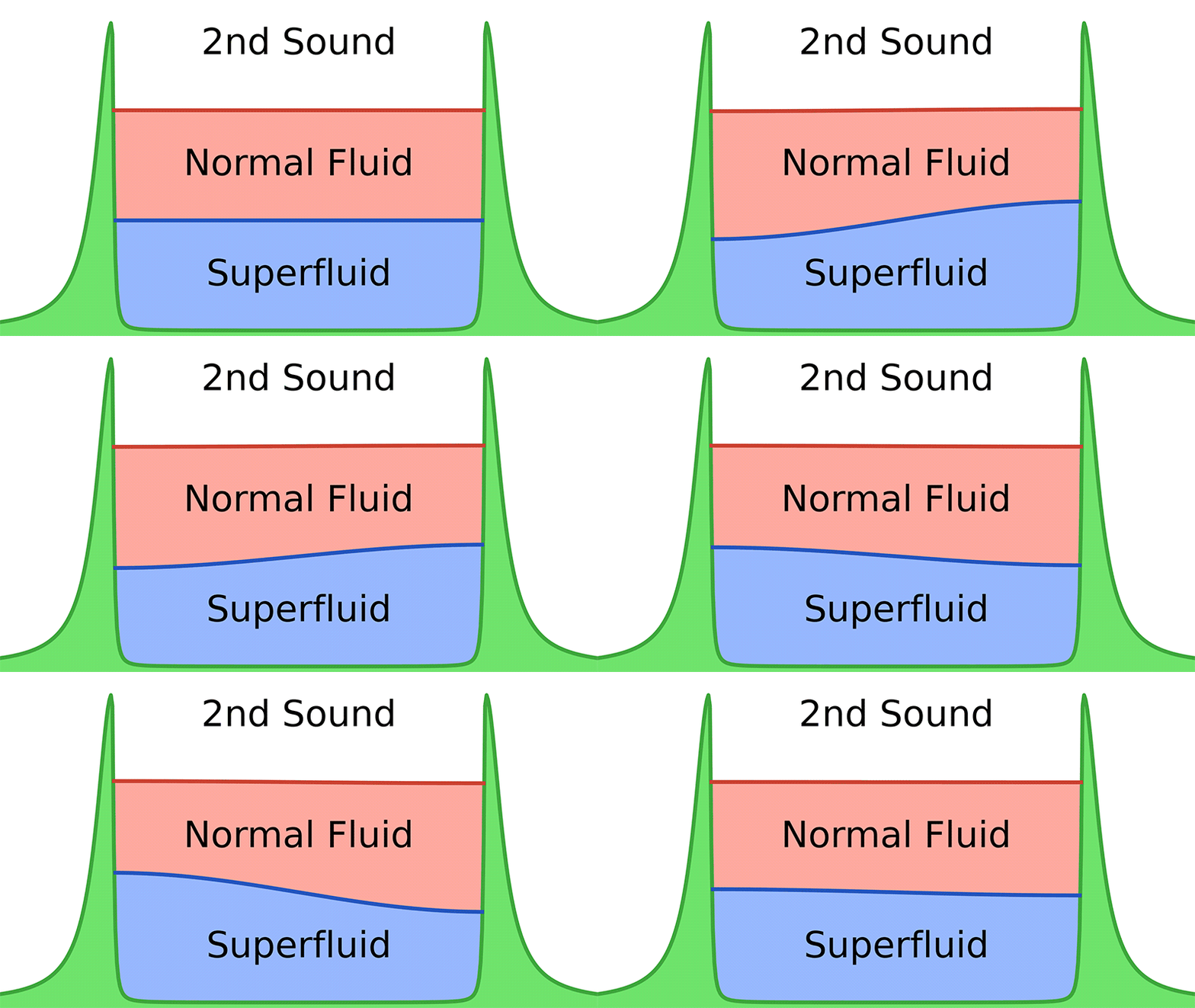 Second sound is the movement of heat, in which superfluid and normal fluid “slosh” against each other, while leaving the density constant – © MIT News
According to Zwierlein, previous attempts only revealed a faint shadow of second sound in the form of subtle density ripples. “The character of the heat wave could not be proven before,” he explained in the university’s press release.
A Strange and Silent Back-And-Forth
Fletcher offered a vivid analogy to explain what the phenomenon looks like. “It’s as if you had a tank of water and made one half nearly boiling,” he said. “If you then watched, the water itself might look totally calm, but suddenly the other side is hot, and then the other side is hot, and the heat goes back and forth, while the water looks totally still.”
This eerie calmness on the surface of the superfluid makes the sloshing heat wave even more surreal. In regular fluids, temperature changes are visible through movement, steam, bubbling, or convection currents. In superfluids, those visual cues disappear. The energy moves without friction or turbulence, making it impossible to track with the naked eye.
That’s why the imaging method developed by MIT is so critical. It provides a visual proof of something that has long been described mathematically and indirectly measured, but never directly seen.
Deeper Implications for Extreme Physics
The visualization of second sound doesn’t just solve an academic puzzle, it opens the door to answering much bigger questions. The behavior of superfluid quantum gases could offer new clues about high-temperature superconductors, materials that conduct electricity with zero resistance under certain low-temperature conditions.
It could also inform studies of neutron stars, where the densities and quantum effects are so extreme that frictionless states of matter might exist deep within their cores. Although we are far from applying superfluids in daily technologies, knowing how heat behaves in these environments helps researchers build better models for complex systems.