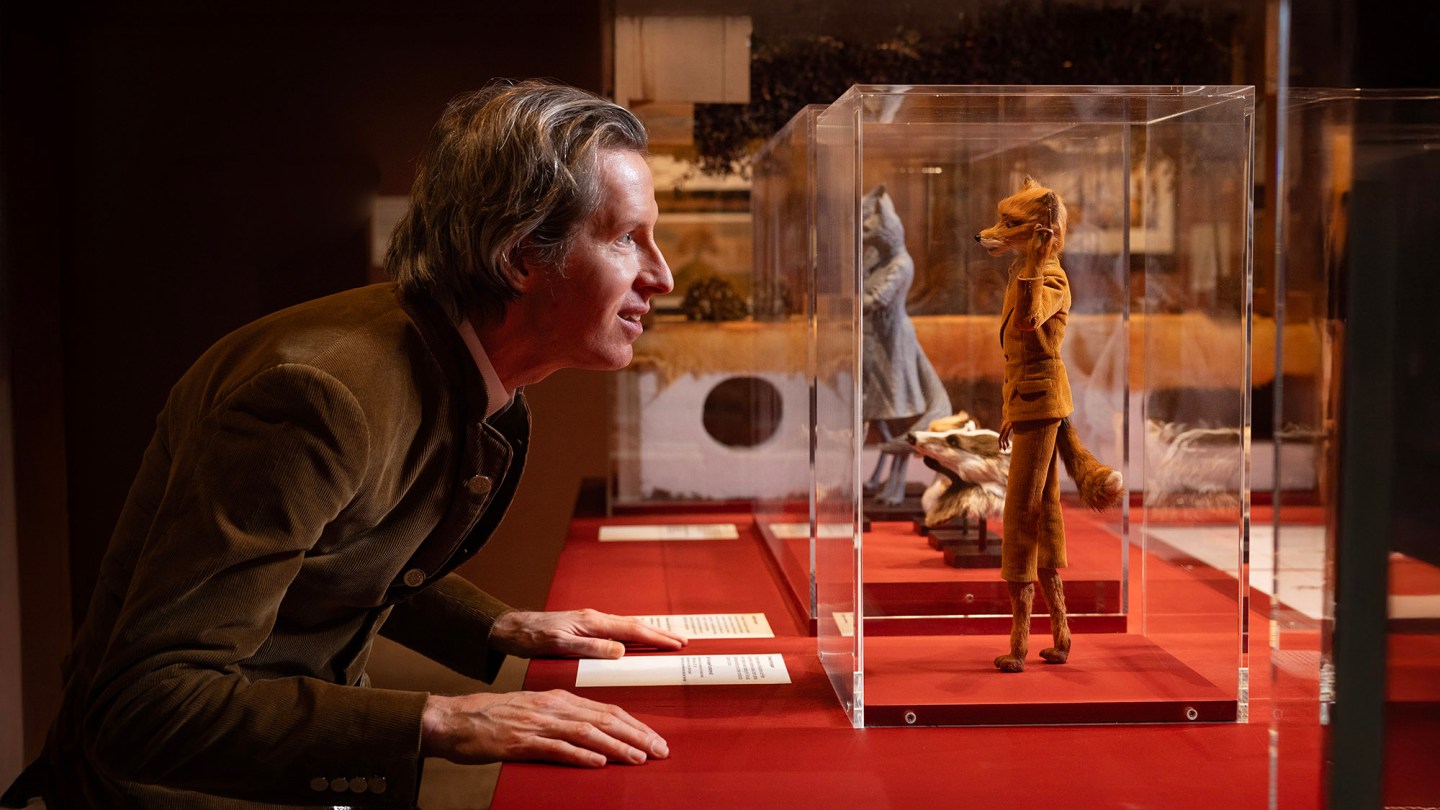
More than three decades and a dozen films since making his unusually assured debut with Bottle Rocket, director Wes Anderson is marking a new phase in his artistic career, with buzzy exhibits in London and Paris showcasing his distinctive aesthetic. Anderson’s idiosyncratic, singular style — think of the candy-colored palette of The Grand Budapest Hotel or the saffron hues of The Darjeeling Limited — and his exacting eye for detail are being celebrated in Wes Anderson: The Archives at the Design Museum in London through July 26. Produced in collaboration with la Cinémathèque française, the British iteration of the show reimagines and expands on the 2025 Paris presentation with more than 700 objects, including original storyboards, notebooks, photographs, puppets, models, sketches and costumes from his movies.
“Curating this exhibition has been a journey of discovery into Wes Anderson’s creative process and his unique approach to commissioning works of art and design for his films,” says Johanna Agerman Ross, Conran Foundation chief curator at the Design Museum, who curated the exhibition with Lucia Savi. “In studying his methods, it has been fascinating to realize how clearly he sees the worlds he constructs, even from a very early stage of the filmmaking process.”
Jasper Sharp, a British historian, curator and longtime Anderson collaborator, agrees: “He is every bit an artist.” The two worked together on Anderson’s most recent film, The Phoenician Scheme, for which Sharp sourced original paintings by such masters as Pierre-Auguste Renoir and René Magritte for the art collection owned by Zsa-Zsa Korda (played by Benicio Del Toro). Sharp had tapped Anderson and his wife, designer and novelist Juman Malouf, to curate an exhibition at the Kunsthistorisches Museum in Vienna (where Sharp was formerly a curator) in 2018. For that show, which traveled to Milan’s Fondazione Prada in 2019, Anderson and Malouf picked more than 400 works spanning 5,000 years from the museum’s collection, which included overlooked oddities like assorted limbs from broken sculptures.

Anderson poses at the Design Museum with vending machines featured in his 2023 film Asteroid City. The pastel-colored, retro-futuristic fixtures sell unique items like martinis, cigarettes, soup and even real estate.
Matt Alexander/PA Media Assignments
For their latest collaboration, Sharp and Anderson conceived The House on Utopia Parkway: Joseph Cornell’s Studio Re-Created by Wes Anderson, on view through March 14 at Gagosian’s Rue de Castiglione gallery in Paris, the city Anderson calls home. Joseph Cornell, an avant-garde filmmaker and visual artist known for his intricate boxed assemblages, “belongs to a constellation of people and places that have in some way, small or large, shaped Wes’ thinking and approach to his craft,” says Sharp. The curator adds that Anderson became an admirer of the late American artist’s oeuvre after visiting an exhibition of his famed shadow boxes at the Menil Collection, in Anderson’s native Houston, in the late 1990s.
Working with exhibition designer Cécile Degos, Anderson transformed Gagosian’s storefront space into a veritable life-size Cornell box, inviting visitors into Cornell’s studio in the basement of his family’s home on Utopia Parkway in Queens. Both finished and in-progress works are set amid stacks of shoeboxes containing the mundane materials, from feathers and marbles to postcards and maps, that the artist (self-taught like Anderson) turned into enigmatic collaged tableaus. Though Cornell was infatuated with Paris, dedicating dozens of artworks to the city, he never left the U.S. One could easily imagine Cornell’s unrequited love story as an Anderson plotline — the artist even referred to his collection of ephemeral curiosities as his “spare parts department,” an Andersonian conceit if there ever was one.
Much as Cornell did, Anderson fills every inch of space available, whether in his film frames or immersive installations. Each detail is meticulously considered. As for Easter-egg movie references hidden within the Gagosian installation, Sharp remains tight-lipped: “That’s for the visitor to discover!”
One of the works by Cornell on display in the Paris show: Pharmacy, 1943. Glass-paned wood cabinet, marbled paper, mirror, glass shelves and 20 glass bottles containing various paper cuttings (crêpe, tissue, printed engravings and maps), colored sand, pigment, colored aluminum foil, feathers, paper butterfly wing, dried leaf, glass marble, fibers, driftwood, wood marbles, glass rods, beads, seashells, crystals, stone, wood shavings, sawdust, sulfate, copper, wire, fruit pits, paint, water and cork. (151/4 x 12 x 31/8 inches)
©2025 The Joseph and Robert Cornell Memorial Foundation/Licensed by VAGA at Artists Rights Society (ARS), New York Dominique Uldry/Courtesy Gagosian
Also part of the Anderson’s co-curated Joseph Cornell show: A Dressing Room for Gille, 1939. Glazed wooden box, wood panel cover, paint, mirror, cork, printed paper collage, cotton thread, textiles, ribbon tape. (15 x 85/8
x 63/4 inches)
©2025 The Joseph and Robert Cornell Memorial Foundation/Licensed by VAGA at Artists Rights Society (ARS), New York.
A signed poster of Richie Tenenbaum, the troubled tennis champion played by Luke Wilson in Anderson’s 2001 film The Royal Tenenbaums, at the Design Museum.
Richard Round-Turner
Joseph Cornell’s studio in the basement of his family home in Queens, pictured in 1971, served as the inspiration for The House on Utopia Parkway: Joseph Cornell’s Studio Re-Created by Wes Anderson, on view at Gagosian’s Rue de Castiglione gallery in Paris through March 14.
Harry Roseman 1971/Courtesy Gagosian
Grand Budapest Hotel costumes worn by Ralph Fiennes as Monsieur Gustave H. and Tilda Swinton as Madame D. are among the 700-plus objects on view at London’s Design Museum.
Luke Hayes
This story appeared in the Jan. 2 issue of The Hollywood Reporter magazine. Click here to subscribe.