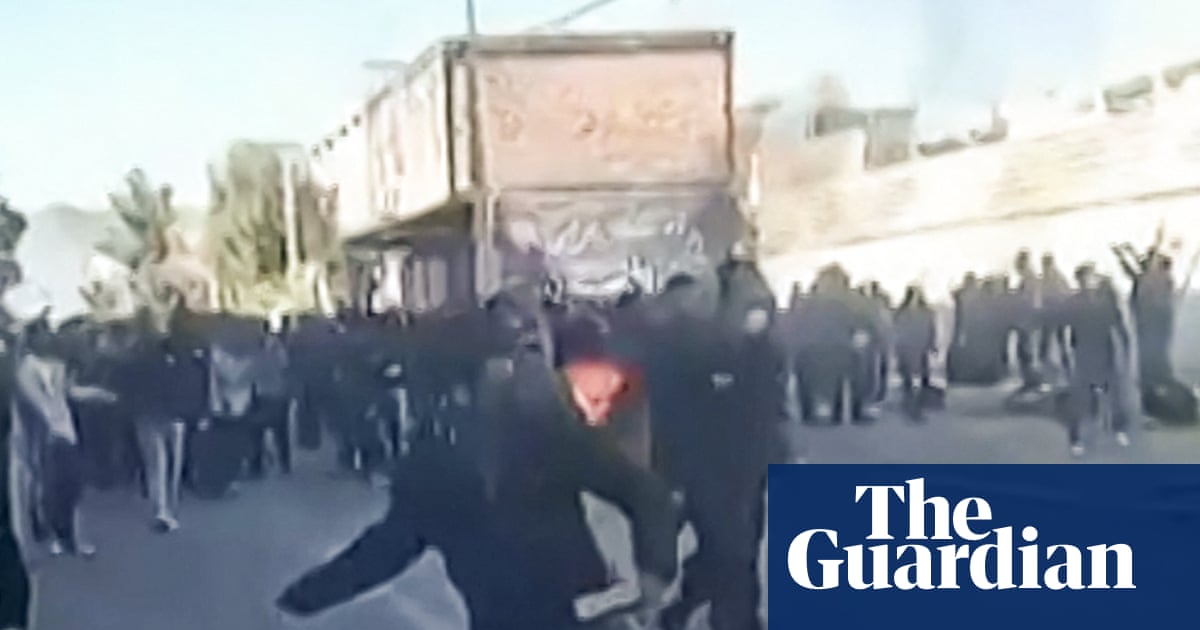
Demonstrations over economic conditions broke out in Kurdish regions of Iran on Wednesday despite authorities using violence to try to disperse protests before an announced general strike, according to witnesses and rights groups.
Protesters took to the streets across Kurdish cities in western Iran, with shopkeepers shutting down stores and demonstrators chanting against government corruption. People said they were met with force as authorities fired teargas, pellet guns and what demonstrators said were live bullets at crowds.
“They are killing us. They’re showing no mercy. In Kermanshah, we’ve all come out, we’re all under pressure. At noon in the square they beat a woman so badly she couldn’t stand up. I’m begging all the people of Iran, let’s all rise up together,” said a 35-year-old female protester in the Mossadegh area of, Kermanshah, a Kurdish city in western Iran, her voice breaking over the crackle of gunfire as she spoke.
Video footage shows protesters in the Malekshahi district of western Iran’s Ilam province on Saturday. Photograph: UGC/AFP/Getty Images
Demonstrations are continuing to spread across Iran as the protest movement, initially sparked by a sudden nosedive in the value of the Iranian rial, enters its 11th day. Though increasing in size, they have not yet reached the size of previous movements such as the 2022 Mahsa Amini protests, which saw popular anger erupt after the 22-year-old woman died in police custody.
Initially sparked by economic conditions and led at first by traders, the demonstrations have since expanded to address grievances of the public towards the government, particularly as its crackdown intensifies. Videos showed students at Kermanshah University calling for the return of Reza Pahlavi, the exiled son of the former shah of Iran, while other videos showed protesters resisting teargas shot by authorities to disperse them.
Seven Iranian Kurdish opposition parties called for a general strike on Thursday, while Pahlavi also called for unified protests across the country on the same day.
“[The strike] will send an important signal to the entire country: that the resistance in Kurdistan is standing strong and that people are ready to continue. This is a peaceful action, and we sincerely hope that people will not be attacked,” said Hiwa Bahrami, the head of foreign relations for the Democratic party of Iranian Kurdistan.
Video footage shows protesters in the Malekshahi district of western Iran’s Ilam province on Saturday. Photograph: UGC/AFP/Getty Images
Two separate protesters from Kermanshah told the Guardian they had witnessed security forces shooting at protesters. The eyewitness testimony was confirmed by the Norway-based Hengaw organisation for human rights, which said it had documented the use of Kalashnikov rifles against protesters on Wednesday.
At least 36 people, including four children and two members of Iran’s security forces, have been killed in the violence surrounding protests, according to the US-based Human Rights Activists news agency (Hrana). More than 2,100 people have been arrested so far, according to the agency, with a spate of detentions of Kurdish protesters on Wednesday.
Iran’s government has thus far taken a carrot-and-stick approach to the protests, with public servants offering dialogue and economic reform while security forces have struck a more defiant tone.
Footage appears to show Iranian security forces using teargas to disperse demonstrators in Tehran. Photograph: UGC/AFP/Getty Images
Iran’s president, Masoud Pezeshkian, has ordered investigations into videos which show riot-gear clad security forces raiding a hospital in Ilam, and his government announced the doubling of a state subsidy for breadwinners across the country. The new subsidy, which would provide £5.20 a month, is meant to ease the soaring price of basic goods such as food and medicine.
At the same time, the head of Iran’s army warned the military would not sit idly by as international powers threatened to strike Iran in aid of protesters, and would take pre-emptive action. The US president, Donald Trump, had said last week that the US would come to the rescue of protesters if Iran’s government shot and killed them – a threat that has grown more alarming for Iran since the US capture of the Venezuelan president, Nicolás Maduro, on Saturday.
“The Islamic Republic considers the intensification of such rhetoric against the Iranian nation as a threat and will not leave its continuation without a response,” said Maj Gen Amir Hatami, according to Iranian state media. He said while protests were normal, the transformation of demonstrations into riots was “undoubtedly planned by the enemies”.
As demonstrations continue, the economic conditions which initially triggered them worsen. The nation’s currency is depreciating, and traders have warned the price of basic goods would soar after the government announced it would cancel a programme which allowed importers and producers to use a preferential exchange rate for certain goods.
Protests continued well into the night in Isfahan on 1 January. Photograph: X/IranProtestsCom
The people of Iran have suffered for years due to economic mismanagement and some of the world’s harshest sanctions being placed on the country. Iran’s currency has lost two-thirds of its value in the last three years while the prices of basic goods have continued to increase. The average price of food had increased by 72% over the last year.
The government has acknowledged the population’s economic woe, but has said further belt-tightening would be necessary, blaming the crisis on external factors. The vice-president, Mohammad Jafar Ghaempanah, said on Wednesday that Iran was in a “full-fledged economic war”, calling for the elimination of corruption and price-gouging within the country.
Despite the escalating violence, protesters said they intended to stay on the streets and respond to the calls for protests tomorrow. Families of demonstrators killed during the 2022 protests said they had been instructed by the intelligence services not to join protests tomorrow.
“They are shooting at anyone and everyone. We are united with the rest of the people across [Iran]. They stood by us in 2022 and will stand by them this time. Tomorrow is the day all the Kurdish people will be on the streets,” said Soran, from Kermanshah, speaking under a pseudonym.
Quick GuideContact us about this storyShow
The best public interest journalism relies on first-hand accounts from people in the know.
If you have something to share on this subject, you can contact us confidentially using the following methods.
Secure Messaging in the Guardian app
The Guardian app has a tool to send tips about stories. Messages are end to end encrypted and concealed within the routine activity that every Guardian mobile app performs. This prevents an observer from knowing that you are communicating with us at all, let alone what is being said.
If you don’t already have the Guardian app, download it (iOS/Android) and go to the menu. Select ‘Secure Messaging’.
SecureDrop, instant messengers, email, telephone and post
If you can safely use the Tor network without being observed or monitored, you can send messages and documents to the Guardian via our SecureDrop platform.
Finally, our guide at theguardian.com/tips lists several ways to contact us securely, and discusses the pros and cons of each.
Illustration: Guardian Design / Rich Cousins
Thank you for your feedback.