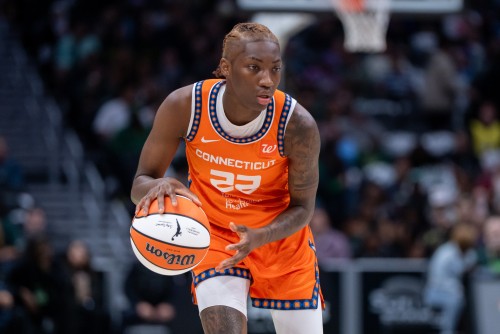
Draft picks
The Connecticut Sun finished 11th in the WNBA standings in 2025 with an 11-33 record. Connecticut won’t be picking as high in the draft as it could be, given its poor results, but it does have two late-first-round picks in what could be a decently deep draft — No. 12 and 15 overall. The Sun also has its own second and third-round picks — No. 18 and 33.
Under contract
The Sun have good young talent on cheap contracts. Four of their under-contract players are entering just the second year of their unprotected rookie-scale contracts — Saniya Rivers, Aneesah Morrow, Leila Lacan and Rayah Marshall — having shown what their future in the WNBA could look like.
Rivers and Lacan, under contract for $77,156 and $73,905, respectively, make up the best young wing duo in the league. The NC State graduate brought continuous contagious joy throughout the hardest season of her life. Though Rivers missed out on All-Rookie honors, the 6’1 guard averaged 8.8 points, 2.8 rebounds, 2.7 assists and 1.5 steals in 26.1 minutes per game while shooting 40.7% from the field and 34.1% from three. Lacan joined the Sun after competing in EuroBasket for France and gave the squad a significant boost. The 5’11 guard later missed the end of the WNBA season due to personal reasons, ending her run of 25 consecutive appearances, including 15 starts. Lacan averaged 10.4 points, 3.7 assists, 2.4 rebounds and 2.2 steals in 26.6 minutes per contest. The Frenchwoman shot very efficiently from the field at 47.7%, but not from three, where she only converted 22.4% of her 2.7 attempts per game. Both players have the potential to contribute to a title-winning team, but neither is a No. 1 option star.
Connecticut also picked two bigs in the 2025 WNBA Draft, Morrow and Marshall. Marshall played exclusively off the bench in her 15 appearances and averaged 1.7 points and 1.7 rebounds in 6.0 minutes per game. She’ll have to fight for a roster spot, but she could be cheap depth to fill out a roster. Morrow, meanwhile, emerged as a potential unique role player. The 6’1 forward grew into an important defensive role for the Sun and was the team’s leading rebounder, averaging 7.7 points and 6.9 rebounds per game.
Aaliyah Edwards rounds out the young talent in Connecticut after she was traded from Washington in early August in exchange for Jacy Sheldon and 2026 first-round-pick swap rights. The third year of her unprotected rookie-scale contract would see her paid $82,399 in 2026. Though the former UConn Husky didn’t perform as well in her 15 games for Connecticut as she did over one and a half seasons in Washington, the 6’3 forward’s first two seasons showed her value as a versatile big.
Contracts
-
Saniya Rivers – $77,156
-
Aneesah Morrow – $77,156
-
Leila Lacan – $73,905
-
Rayah Marshall – $70,653
-
Aaliyah Edwards – $82,399
Value of all protected contracts: $0
Value of all contracts: $381,269
Extension candidate
During this offseason (pending CBA changes), Connecticut has to determine if it will exercise the fourth-year team option on Edward’s contract. If the team does not exercise its option, the Canadian would become an unrestricted free agent after the conclusion of the 2026 season. The fourth-year option is fully protected. Despite the post-trade lull, Edwards has shown enough in her professional play to warrant a protected, low-cost contract, so Connecticut is likely to extend her commitment.
Unrestricted free agents
The Sun only has four unrestricted free agents, but two of them played the most minutes and led the team in scoring: Marina Mabrey and Tina Charles. Another, Bria Hartley, played heavy minutes.
Charles was overall very productive in her age-36 season. The UConn alum averaged 16.3 points, 5.8 rebounds and 1.7 assists in 28.4 minutes per game over 43 appearances (42 starts). Following her final match of the season, one of the best bigs in league history indicated that she hopes to return to the WNBA for the 2026 season. She agreed to a contract well below the veteran maximum in 2025 and is ineligible to be cored under the rules of the expiring CBA. Perhaps she’ll want to stay in Connecticut if that’s where she can get playing time, but she has also played for five different clubs over her last four WNBA seasons.
Mabrey was the team’s next leading scorer as she averaged 14.4 points, 4.2 rebounds and 4.0 assists in 31.5 minutes per game over 35 appearances. The 5’11 guard was traded to the Sun in August 2024 when the team was actively competing for a WNBA Championship before they lost all five starters and head coach Stephanie White in the offseason. Ahead of the 2025 season, Mabrey requested a trade for the third time in three years but was denied by the Sun. The tension between player and franchise seemed to resolve throughout the season, but a return still seems unlikely.
In Hartley’s long-awaited return to the WNBA after suffering a torn ACL in July 2022, she averaged 8.9 points, 3.1 assists and 2.0 rebounds while shooting 36.2 percent from the field across 22.8 minutes per game in 38 regular-season games (32 starts). She missed the end of the season with a knee injury but was expected to make a full recovery.
Lindsay Allen, meanwhile, saw her role decrease significantly from the previous two years she played for other teams. She started in just nine of her 31 appearances. Allen was traded to Connecticut from Chicago ahead of the 2025 season. The 30-year-old averaged just 2.4 points, 2.0 assists and 1.0 rebounds in 14.5 minutes per game, so she could seek out opportunities elsewhere.
Free agent spotlight
Mabrey is still just 29 years old and a proven scorer who will be a free agent target for many teams. But she will not necessarily be a priority with a majority of the league’s players technically available in free agency. Connecticut could be the team willing to offer her the most money to continue shepherding their young players and play a big role on the court, providing needed perimeter shooting. However, a return is even more unlikely if Mabrey is still set on chasing a championship immediately, as she was when she initially requested the trade to Connecticut. However, the combination of her age and production makes the Notre Dame guard the unrestricted free agent most capable of significant contributions for the next few years.
Restricted and reserved free agents
Olivia Nelson-Ododa, having played the last year of her rookie-scale contract, is a restricted free agent. She played a significant role for the Sun in 2025, making 37 appearances, starting 21, and averaging 8.2 points, 5.0 rebounds, 1.2 blocks and 0.7 steals in 21.6 minutes per game. She was a strong defensive presence and remarkably efficient offensively. Yet another UConn alum, Nelson-Ododa shot a team-high 52.6% from the field. Even if her role is off the bench, she can consistently contribute and should receive a restricted qualifying offer.
Haley Peters is the other restricted free agent in Connecticut. Though the 6’3 forward hadn’t played in the WNBA since 2019, she made 33 appearances (2 starts) for Connecticut in 2025. Her role became more inconsistent as the season progressed, and she only averaged 2.1 points and 2.2 rebounds in 11.5 minutes per game.
The Sun also hold rights to two reserved free agents, Mamignan Touré and Nikolina Milić. Touré made 18 appearances for the Sun last year but didn’t make much of a statistical impact in her limited minutes. Milić was traded to the Sun ahead of the 2025 season but sat out of league play for a second consecutive year. The Serbian showed in the past that she can be a serviceable backup, but she’ll also be 32 by the time the 2026 season starts. She is not a piece that will change a franchise’s future.
Analysis
It always looked like it was going to be a difficult season in Connecticut after the Sun lost its entire starting lineup from 2024 to a combination of free agency and trade requests, and then had no particular appeal to attract new free agents. The rebuild had to start from nearly zero without lottery picks to move it along. Now they have some promising young talent, but no title-leading stars.
The biggest questions for this team are off the court. During the season, possible relocations to Boston or Hartford dominated the news. The most recent reporting has the NBA’s Houston Rockets ownership in “substantive talks” with the Sun regarding the “potential purchase and relocation” of the team. No official decisions have been made, and the two sides have not signed an “exclusivity agreement,” per ESPN’s December report. The team will continue playing at Mohegan Sun Arena in Uncasville, Conn., for the 2026 season.
The Sun franchise’s uncertain future will make it even harder to sell the rebuild project to free agents. A new CBA (eventually anyway, hopefully soon) means that players will be more open to committing to long-term plans — no more refusing to commit beyond 2025 because of the expiring deal. The odds of the franchise’s future being locked in for impending free agency are very low, but if things progress more quickly than CBA negotiations, perhaps there is hope yet. Until decisions and agreements are made, the team is in limbo.
Head coach Rachid Meziane is set to enter his second year after a rocky first season in the U.S., as there were lots of reasonable explanations for his team’s difficulties.
The Sun, like most other teams, has some young players on cheap, unprotected contracts and plenty of cap space to pay free agents. But as it is, they are the worst free agency destination in the league. So, the youth that Connecticut already has under contract, and its picks in the upcoming drafts, will be the building blocks of any success as long as the Sun remain in Uncasville and continue to struggle attracting players to market.
Note: This will be updated accordingly with salary cap details and any relevant definitional changes when a new Collective Bargaining Agreement is signed.