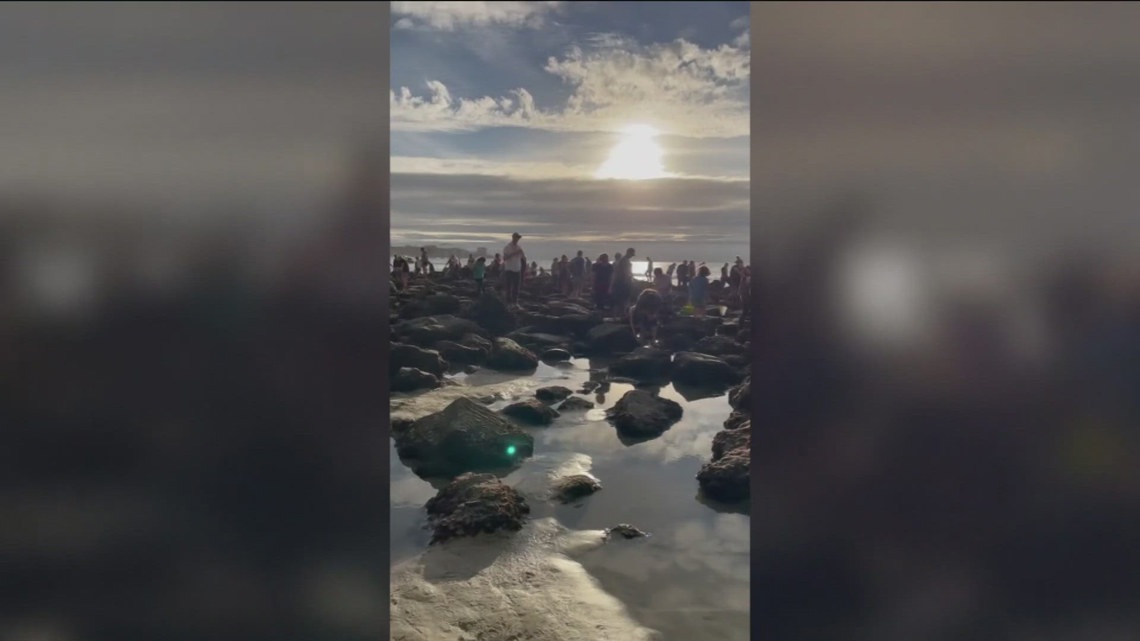
Viral videos are prompting questions about who enforces the rules along San Diego’s coast and what happens when they’re broken.
SAN DIEGO — Tide pooling is one of San Diego’s most popular coastal pastimes, especially during king tides when unusually low water levels reveal sea stars, anemones and other marine life. But recent social media videos from the last king tide are raising concerns about how those fragile ecosystems are being treated.
Videos posted online show large crowds packing into tide pools across San Diego County, including in La Jolla, where people stepped on marine life and picked up sea creatures, actions that are illegal in many of these areas.
“The tide pools are certainly a sensitive habitat, and there’s a lot of small sea life in the tide pools that could be easily trampled and killed,” said Lt. Austin Smith with the California Department of Fish and Wildlife.
Many of San Diego’s tide pools fall within Marine Protected Areas, where it is illegal to injure, damage, take or even temporarily handle marine life.
“If people are collecting wildlife in those tide pools, even if they’re going to just hold them for a little bit, it is a violation of that section, and they could be issued a citation for that,” Smith said.
Enforcing those rules can be challenging. Smith is one of just eight wildlife officers responsible for patrolling nearly 70 miles of San Diego County coastline. During the most recent King Tide, the department was stretched thin to manage the crowds.
“Our wildlife officers made over 300 contacts, issued over 25 warnings and issued about 13 citations,” Smith said.
Fines for violations can reach around $500, but officers say education is just as important as enforcement.
“At the end of the day, all the creatures in and out of the water are wildlife,” said snorkeler Noah Tadd-Colburn. “We just need to admire them from afar without bothering them.”
That same message applies beyond the tide pools. La Jolla’s Children’s Pool is currently closed during harbor seal pupping season to protect mothers and newborns.
“The best thing we can do is just leave them be, give them their space,” said Robert Torres.
Later this year, during sea lion pupping season at Point La Jolla, a time when officials say people often get too close for photos, the City of San Diego plans to staff the area daily with park rangers to keep the public at a safe distance.
“This was their land long before it was ours,” said Sue Bonga, a tourist visiting La Jolla Cove. “It’s us who are imposing on their territory.”
Officials say the rules for tide pools and marine mammals are simple. You can look, but don’t touch. Anyone who sees wildlife being harassed or tide pools being damaged is encouraged to report it to the California Department of Fish and Wildlife through the CalTIP hotline at 888-334-2258.