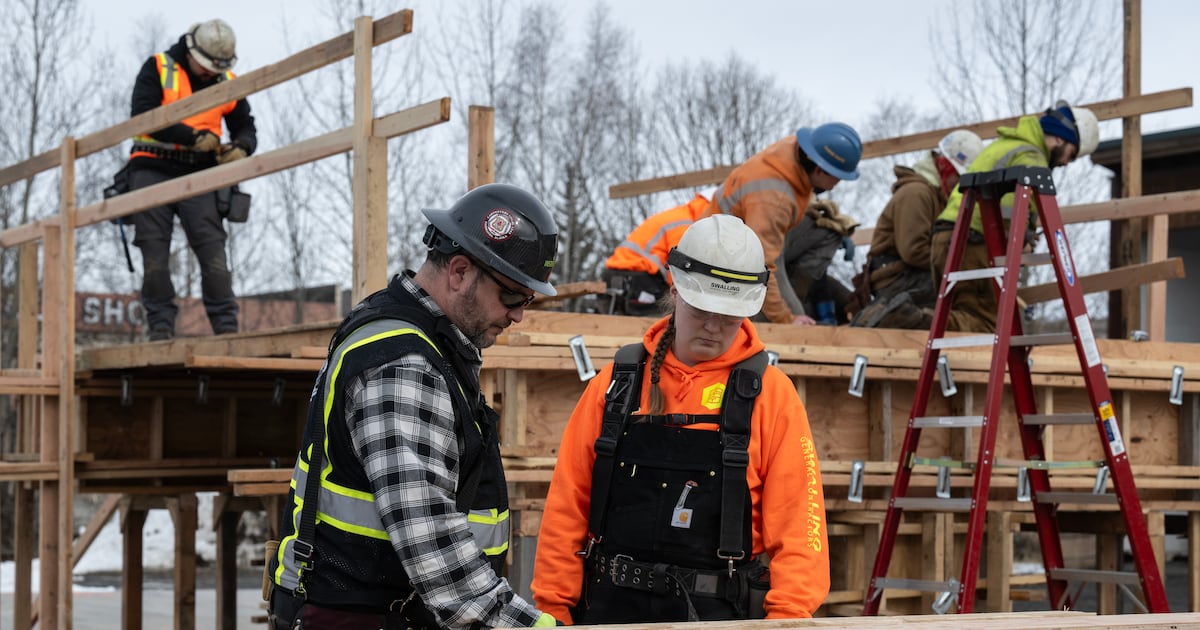
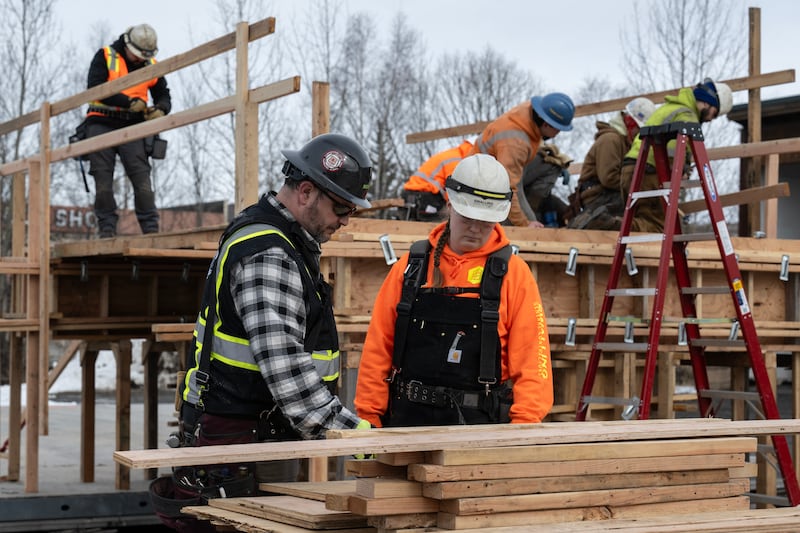
 Instructor Matt Hackenmiller, left, works with pile driver apprentices who construct a bridge pier and deck project outside the Anchorage Carpenters Training Center on King Street in Anchorage on March 24, 2025. (Marc Lester / ADN)
Alaska will gain about 3,000 jobs this year as key industries like oil and gas and construction continue to shine, state economists predict.
The 0.9% increase, pushing the total to nearly 341,000 jobs, will come even as Trump administration policies and business uncertainty create potential headwinds, according to a recent report from the Alaska Department of Labor and Workforce Development.
Alaska’s economic drivers are “mostly strong” to start the year, Karinne Wiebold, an economist for the state, writes in the state’s Alaska Economic Trends magazine.
Alaska has experienced record levels of federal capital spending in recent years, and that federal support will continue to play a key role, she writes.
Spending at major oil field projects and in the health care industry will also be important, helping boost the construction industry, while tourism and cargo at the Ted Stevens Anchorage International Airport will buoy the transportation sector.
But there are lot of “moving parts” to the forecast, she said in an email.
“It’s complicated,” she said. “The state is facing a wide array of factors and a lot of uncertainty.”
Estimated 300 federal jobs lost
The forecast growth comes amid “countervailing wind” from the Trump administration’s cuts to federal jobs and contracts, along with tariffs and reduced immigration, she writes.
[Previous coverage: EPA cancels $280M in Biden-era grants to Alaska communities]
“Nationally, federal job and funding cuts have been appealed and sometimes reversed, and litigation around the tariffs is still moving through the courts,” she writes.
“It will take time for the dust to settle,” she writes. “However, tariffs generally chill consumption as they drive costs up, and restricting immigration reduces available labor, which can also raise costs.”
Alaska lost an estimated 300 federal jobs in 2025, not counting the military, Wiebold writes.
The losses to federal jobs are expected to deepen slightly this year, she writes, noting that the federal government has a huge footprint in the state. Federal job losses are estimated at 400 this year, bringing those jobs down to 14,800.
“Further federal reductions will negatively affect multiple sectors in Alaska, but national defense priorities may provide some insulation,” she writes.
The Trump administration has also created optimism for resource development in Alaska, expanding opportunities on federal land for drilling and mining, Wiebold writes.
Large projects that might benefit from those polices will take time to develop, she writes.
The state’s long-term trends also continue to weigh on employment in Alaska, such as years of losses in the working-age population, according to the magazine, which also forecasts employment in key cities and in Southeast Alaska.
Predictions include 1,200 additional jobs for 0.8% growth in Anchorage, and 400 additional jobs for 1.3% growth in the Matanuska-Susitna Borough.
Help from federal spending
One bright spot for Alaska jobs is federal spending on projects, supported by major laws such as the $1.2 trillion 2021 bipartisan infrastructure law that allocated billions of dollars for Alaska.
“Alaska’s federal capital spending has topped $2 billion a year for four of the last five years — the highest years on record,“ Wiebold writes.
Some of that spending continues to play out.
“One of the state’s biggest infrastructure projects, the deepwater port in Nome, is moving forward this year after the Army Corps of Engineers awarded the nearly $400 million prime contract for the first of four phases in 2025,“ she writes.
Other big projects include the Pretty Rocks landslide reconstruction to reopen the road at Denali Park, which is nearing completion, she writes.
Also, the U.S. Coast Guard base in Kodiak will see more upgrades to support the arrival of three new fast-response cutters. And repairs in Western Alaska villages tied to Typhoon Halong will also begin this year.
Spending associated with those projects and others, including in oil and gas, will help boost the construction and transportation sectors, Wiebold writes.
Construction is also coming off a two-year boom in which it saw the state’s highest wage growth in 2024, plus jobs expansion that included 1,000 new jobs last year.
This year, state economists predict about 700 new jobs in the industry, “as ongoing demand for construction workers will increase pressure to raise wages and seek out-of-state labor,” she writes.
The sector that includes transportation should add about 600 jobs, slightly less than last year, with the Ted Stevens Anchorage International Airport expected to remain an economic leader.
The airport is a global standout in cargo shipping, and new sorting and support facilities are under construction and on schedule there, the report says.
“Visitors also support the transportation industry, and 2026’s anticipated traveler numbers are strong,” she writes.
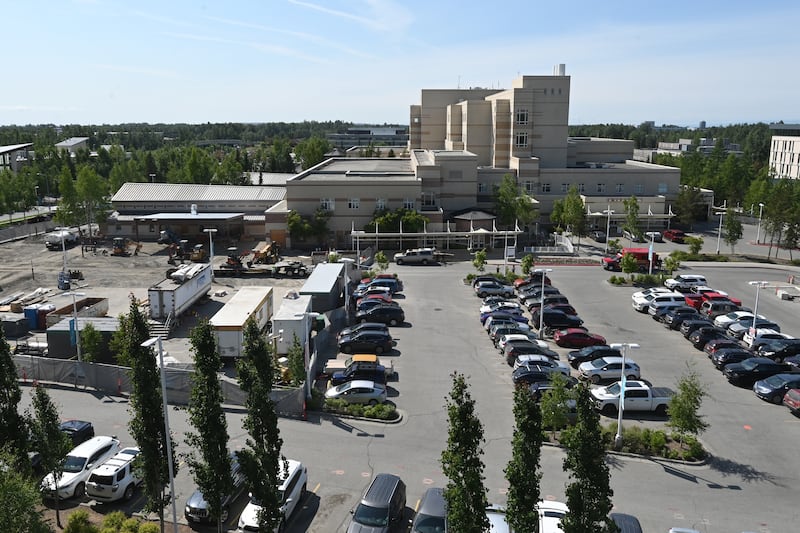 Construction work was underway in July 2024 on the $257 million expansion of the emergency department at the Alaska Native Medical Center. A temporary emergency room was being built, at left. (Bill Roth / ADN) Health care growing, but subsidies an issue
The health care sector will also keep adding jobs, about 1,100 this year, as medical needs increase for the state’s aging population.
“Major projects such as the Alaska Native Tribal Health Consortium’s Anchorage emergency room expansion generate construction jobs first, then health care jobs when the facility opens,” Wiebold writes. “The new emergency room is scheduled to open in 2028.”
The industry could also face headwinds if there’s no solution to the removal of the expanded health care subsidies, she writes.
“As of late 2025, national efforts to extend Affordable Care Act subsidies have failed, and health insurance costs for as many as 25,000 Alaskans will rise sharply in 2026 without mitigation,” Wiebold writes. “Beyond dampening demand for health care, this could significantly reduce households’ ability to spend on other needs, with spillover effects across sectors.”
[Thousands of Alaskans are facing a health care ‘cliff’ amid gridlock in Congress]
Losses in fish processing slow
Jobs in seafood harvesting and processing have both been declining for a decade, and those will continue but at a slower pace, Wiebold writes.
That will slightly push down the job count in the manufacturing industry, where fish processing has a major role.
“In late 2023 and 2024, the seafood processing landscape shifted when major players Trident, Peter Pan, and OBI announced sales or closures in the wake of historically low prices and an internationally flooded market,” she writes. “Disruptions eased last year, stemming the job losses, although some small additional loss is expected this year.”
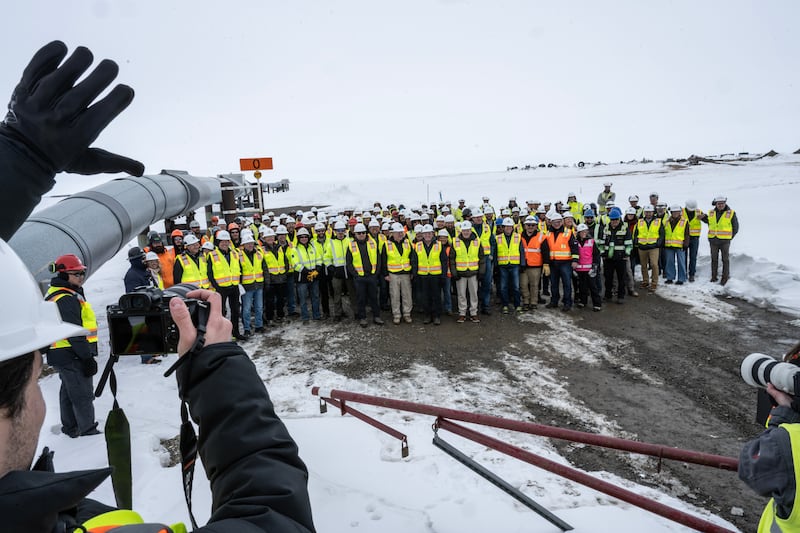 Workers, dignitaries and guests gather for a photo near milepost zero of the Trans-Alaska Pipeline. Several members of the Trump administration joined Sen. Dan Sullivan and Gov. Mike Dunleavy for a rally with North Slope workers and international visitors at Pump Station 1 of the Trans-Alaska Pipeline System on June 2, 2025. (Marc Lester / ADN) Growth in oil jobs and falling state revenue
The oil and gas sector is expected to have the highest rate of job growth in Alaska this year, though employment in the industry remains well below its 2015 peak.
An additional 1,000 jobs are expected this year in the industry as work continues at major new oil fields, Pikka and Willow, and elsewhere, the report notes.
That represents 11.1% growth, pushing overall industry jobs to 10,000.
However, oil revenues to the state are expected to fall in the coming years, largely through estimates for lower oil prices, she writes, citing forecasts from the state revenue department.
“The revenue model built in the 1980s, heavily reliant on oil and gas taxes, no longer fully supports government operations,” she writes.
“Pikka, located on state land, will produce an estimated 80,000 barrels a day but will not pay the state production taxes until 2034 because of development-related deductions and credits, although the state will receive royalties,” she writes.
“Overall, oil revenues are unlikely to return to 2025 levels until 2036,” she writes.
• • •