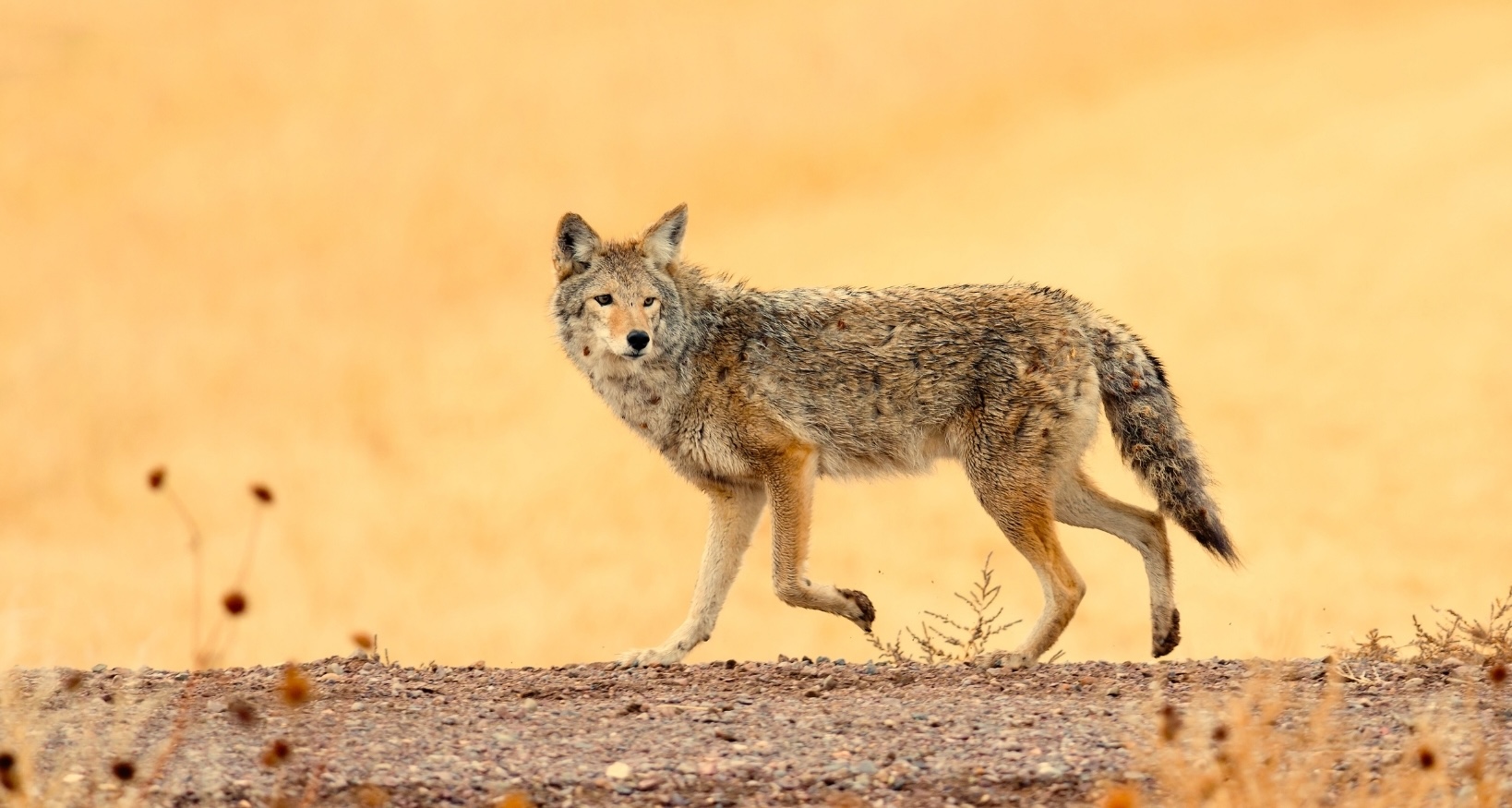
What urban coyotes eat depends a good deal on the city where they live. In Chicago, the large lakeshore population of Canadian geese has become a major food source for Cook County coyotes, not so much the adult geese themselves as the contents of their nests, nearly half of which get raided in most years. Where there are populations of deer in American cities, coyotes can quickly become major predators of fawns. Coyotes acting as a control for urban populations of deer and geese, it turns out, is one of those “beneficial” outcomes Olaus Murie wrote about in the 1930s. Although not many cat owners will want to hear it, increasing numbers of studies indicate that when coyotes come to town and pilfer the odd cat, the survivability of local songbirds goes up markedly.
Article continues after advertisement
Compliments of the Los Angeles of thirty years ago, coyote dumpster diving is an urban legend with legs. Some biologists believe that as much as 25 percent of the diet of some coyote packs in LA in the naive 1980s was human food. More recent studies of urban coyote scat indicate that in most cities the percentage of trash, pet food, and other human food actually comes in at only about 2 percent. A recent study in modern Denver pegged that figure at less than one-half of 1 percent, and today it has dropped to 6 percent even in LA. Despite all the anecdotes from the 1980s, except in rare cases of localized coyote culture, the vast majority of town coyotes are not scavenging behind Sonic and Burger King. They’re not really much of a threat to the six-pack of tallboys you left on the porch.
Sometimes, especially in summers when a coyote pair is stressed trying to raise pups, the parents might become serial killers of cats (one British Columbia coyote den yielded fifty-five cat collars). If you are halfway intelligent with your animals, though, coyotes are not remotely as great a threat to your cat or dog as traffic is. Coexisting with coyotes just requires paying attention, the way we’ve done around predators for a couple hundred thousand years, after all.
Still, coyotes are a kind of wolf. Living in our midst, are they a danger to us?
*
Article continues after advertisement
Los Angeles is famous among ecologists for having the most extensive wildlands-urban interface of any city in America, a zone at least seven hundred miles long where subdivisions abut chaparral and sharply incised canyons cut deeply back into mountain ranges like the San Gabriels, the San Bernardinos, and the Santa Monicas. Those canyons provide thousands of patches of natural habitat that interpenetrate the edges of greater Los Angeles. From the Coyote Hills to the Hollywood Bowl, from urban parks to university campuses, coyotes are everywhere in the six counties of greater LA. They probably always have been, but in the 1980s they began to attract attention for some of the same reasons Central Park’s “Otis” would freak out New Yorkers in 1999.
Coexisting with coyotes just requires paying attention, the way we’ve done around predators for a couple hundred thousand years, after all.
As Mike Davis wrote in The Ecology of Fear, published a year before Otis showed up in Manhattan, in 1980s LA coyotes became “symbols of urban disorder,” of a breakdown in our own conceits about what city life meant. We’ve thought of cities for 5,500 years of recorded history as the one spot where, at long last, humans could escape predators. But in modern America, it turned out, not so fast.
The Los Angeles of the 1980s became the place that wildlife managers in Denver, Seattle, Chicago, St. Louis, Cleveland, and New York are today doing their best not to emulate. Coyotes had been in LA for decades, only attracting passing notice; as far back as 1938 the city government paid bounties on 650 coyotes the first year bounties were offered. A population of at least five hundred coyotes was residing in LA by the 1960s. But the lure of the Southern Californian good life and the success of the sprawling late-twentieth-century city gave LA a population of people from across America and the globe, many of them recent arrivals who knew little or nothing about coyotes other than that one endlessly fell off cliffs in Saturday morning cartoons.
In the 1980s, scientific studies of urban coyotes were still in the future. The majority of the LA population did know one thing about coyotes though: As wild predators they sure as hell weren’t supposed to be inside the city limits of a giant metropolis. Yet there they were, trotting through the tombstones of local cemeteries, loping across the runways of Los Angeles International Airport, and, most disconcertingly, hunting along suburban streets where people lived.
The unease about coyotes in LA spilled over into panic on August 26, 1981. That morning, in a new suburb of Glendale, three-year-old Kelly Keen wandered, unattended, out of her house and into the driveway. A single coyote attacked, killing her. It was the first human death attributed to a coyote in recorded American history. Glendale officials responded by killing every coyote they could find and astonished Los Angeles when their efforts produced fifty-three dead coyotes in the square mile around the Keen home.
Article continues after advertisement
Los Angelenos’ immediate, emotional response was to describe areas like Glendale as “teeming coyote ghettos” and to compare coyote packs to “gang bangers.” Any coyote spotted in the daytime became a “brazen criminal,” bold enough to show itself “in broad daylight.” To writer Mike Davis, assessing LA’s reaction fifteen years later, coyotes were “the textbook example of a protean, ‘unfinished’ species” that engaged in “continuous behavioral improvisation.” Coyotes survived city life, he wrote, by eating garbage, pets, even zoo animals. The title of his chapter on the story of coyotes and cougars in LA: “Maneaters of the Sierra Madre.”
We’ve thought of cities for 5,500 years of recorded history as the one spot where, at long last, humans could escape predators. But in modern America, it turned out, not so fast.
Today biologists believe that more than 5,000 coyotes inhabit greater Los Angeles. Their territories so blanket the city, and they do so well there—living significantly longer on average than rural coyotes—that biologists suspect LA, like Chicago, has most likely reached its carrying capacity for coyotes and is actually producing a surplus number of animals that leave the city to find territories outside it. Plenty of LA residents still hate them, but in a pattern that urban coyote researchers are finding increasingly common, residents have slowly recovered from the initial shock of realizing they share their city with a small, wolflike predator. Over time, urban people get used to coyotes. They go Aztec and learn how to live with them, which essentially entails keeping coyotes wild and a little nervous even in the city. By now plenty of people with urban coyote experiences under their belt have come to relish the presence of coyotes in the city for ecological reasons or just because they’re so beautiful and it’s such a cool thing to get to see a small wolf among us as we go about our daily routines.
Wildlife managers respond to the winds of politics, and one bit of evidence that attitudes toward coyotes are beginning to evolve is that in cities like Los Angeles, Chicago, and Denver, officials charged with managing the relationship between urban coyotes and city residents have developed progressive plans of coexistence to replace the early kneejerk attempts to eradicate every coyote anyone sighted. Managers certainly still take out problem coyotes, the ones that are aggressive toward people or become dependent on pets as a food source, but in most cities these are still a tiny percentage of the total coyote population. No city wants to replicate the Los Angeles experience, where between 1960 and 2006 nearly seventy people were bitten by coyotes, accounting for fully half of all the coyote-bite incidents in North America. Too many Angelenos, often unintentionally or due to ignorance, had fed coyotes. Smart as ever, the animals came to suburban yards for food, with disastrous consequences.
With LA’s history in mind and a rapidly growing coyote population approaching 2,000, Chicago by 1999 was witnessing annual removal of three to four hundred “nuisance” coyotes, which seems like a lot until you realize that in the first decade of coyote presence in any city, simply being seen and recognized made a coyote a “nuisance.” By 2001 coyotes were so much in the news in the Windy City that in that year Chicago homeowners listed them—not street gangs, not burglars, but coyotes—as the single greatest threat to their safety. At the time there had not been a single aggressive coyote incident in Chicago. With an even larger coyote population now, the figures for nuisance animals have dropped as residents have become more familiar with Chicago as a coyote town.
And the vast majority of the Chicago coyote population consists of upstanding citizen animals. In a recent study there, only 5 coyotes out of 175 tracked became actual nuisance animals, stalking pets or refusing to back away from people. In fact, of 260 animals radiotracked in Chicago and Los Angeles two decades after the biteathon of the 1980s, not one showed any aggression toward people. In the same years, between 2,000 and 3,000 people were bitten by dogs in Chicago alone.
Article continues after advertisement
“If anything,” Stan Gehrt told me, “some people and some communities in greater Chicago have by now become too accepting of coyotes, tolerating behavior I wish they wouldn’t.” Biologists like Stan and Denver’s Stewart Breck want to make sure coyotes in town are like coyotes in Yellowstone, still wild, still a little nervous about us.
__________________________________
Excerpted from Coyote America: A Natural and Supernatural History by Dan Flores. Copyright © 2016 by Dan Flores. Used with permission of Basic Books, a division of Hachette Book Group, Inc.
Article continues after advertisement