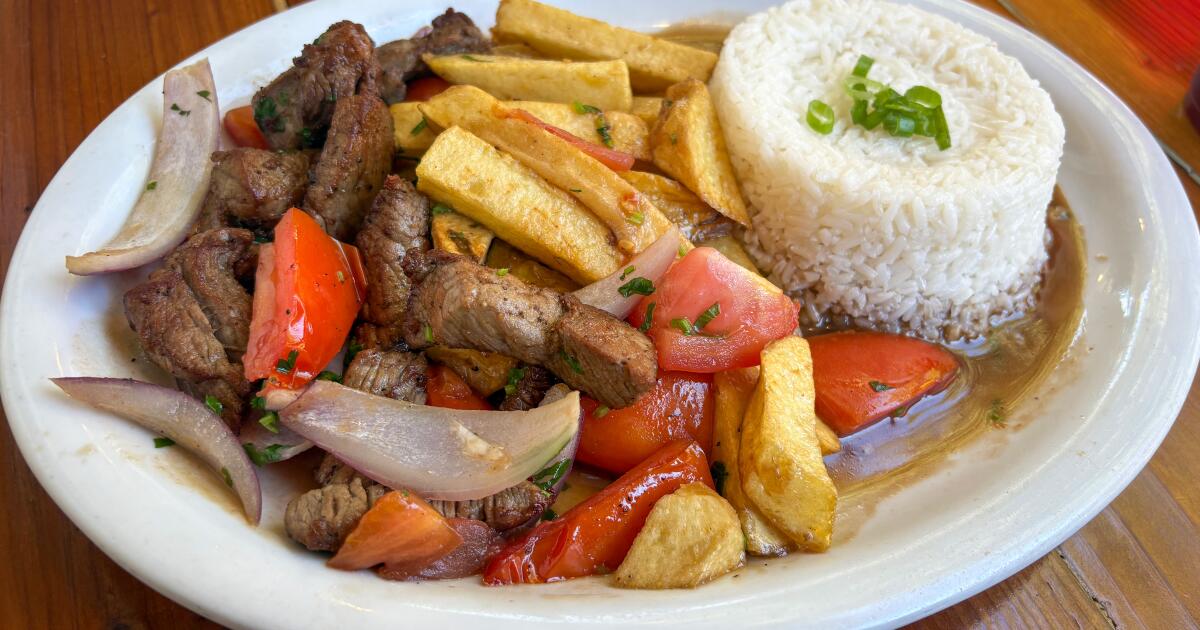
The main ingredient in lomo saltado, the juicy, stir-fried comfort dish of my childhood, only takes a minute to cook. It can go by in such a flash that you can miss it if you’re not paying attention, so I always made sure to watch for that moment when the flames go up.
I remember standing in rapt attention at the edge of the stovetop as my mom tossed fresh, thinly sliced beef into an oiled pan set on maximum heat. The steak hissed and leaped in a dramatic dance as flames licked the pan from underneath. My mom turned to me and said, “This is why it’s called lomo saltado: the lomo is the steak, and watch how it’s saltando — jumping.”
“The secret is in the smoke,” says Miriam Ramirez, owner of Lonzo’s Restaurant in Culver City. “When you cook lomo saltado, the room should be filled with the smell of smoke. I remember getting it for lunch in Peru and thinking, ‘Oh no, my hair smells like smoke!’ But that’s how I knew it would be good.”
Lomo saltado consists of tomato, onion and bell pepper, seared with steak, traditionally in a wok, and served with sides of rice and potato fries. Peruvians call soy sauce, which is used generously in the dish, “sillao” (pronounced see-yow).
Newcomers to Peruvian cuisine might be surprised to find that soy sauce has a major place in recipes. My Peruvian family always says that in any good meat dish, sillao is the secret ingredient.
“When the dish is already so simple, every ingredient matters,” Ramirez says.
“See-yow” is also the pronunciation for soy sauce in Cantonese. Understanding how a Cantonese word entered Peru’s lingo is a long historical lesson that can be best explained by another Chinese-Peruvian word: chifa. Chifa, which comes from the Mandarin word “chīfàn,” meaning to eat, describes the thriving Chinese-Peruvian fusion cuisine and indirectly, the immigrant history of Peru.
According to researcher Patricia Palma, Chinese immigrants arrived in Peru in the mid-19th century, as laborers after the abolishment of slavery created a demand for cheap labor. As this population grew over the years, Chinese-Peruvian descendants carved out a niche in chifa that reflected their heritage alongside centuries-old Peruvian staples.
“L.A. is so diverse and that’s why I think Peruvian food draws people in. It has a multicultural identity too,” says Benny Gomez, owner of Rosty Peruvian Food in Highland Park. “There’s Chinese and Japanese communities who identify with the Asian influence but also Mexican people who are seeing a different type of Latino food.”
Peru’s lomo saltado is not only a beautiful marriage of the two cultures, but a perfectly balanced ode to each culture’s culinary traditions: Peru is reflected in the potatoes, aji amarillo and bell pepper, and China in the stir-fry technique and of course, the sillao.
“Peruvian food has 14,000 years of history,” says Ignacio Barrios Jacobs, lead chef of Merka Saltao in Culver City. “I think [lomo saltado] holds the story of Chinese immigrants who were cooking their food for people who said, ‘this needs my potato and chile peppers.’”
In Culver City, East Hollywood, and the San Fernando Valley, Peruvian restaurants are combining traditional flavors with distinctly Angeleno flair, like saltado burritos or California oak wood-fired rotisserie chicken.
“When my dad opened his Peruvian restaurant 30 years ago, Peruvian was not popular at all in L.A.,” says Dennis Tamashiro, owner of Mario’s Peruvian and Seafood. “Now, people are paying attention, because it proves that it’s unique.”
Here are eight takes on lomo saltado to try in Los Angeles, from classic versions that remind me of home, to creative takes that make the dishes distinctly L.A.