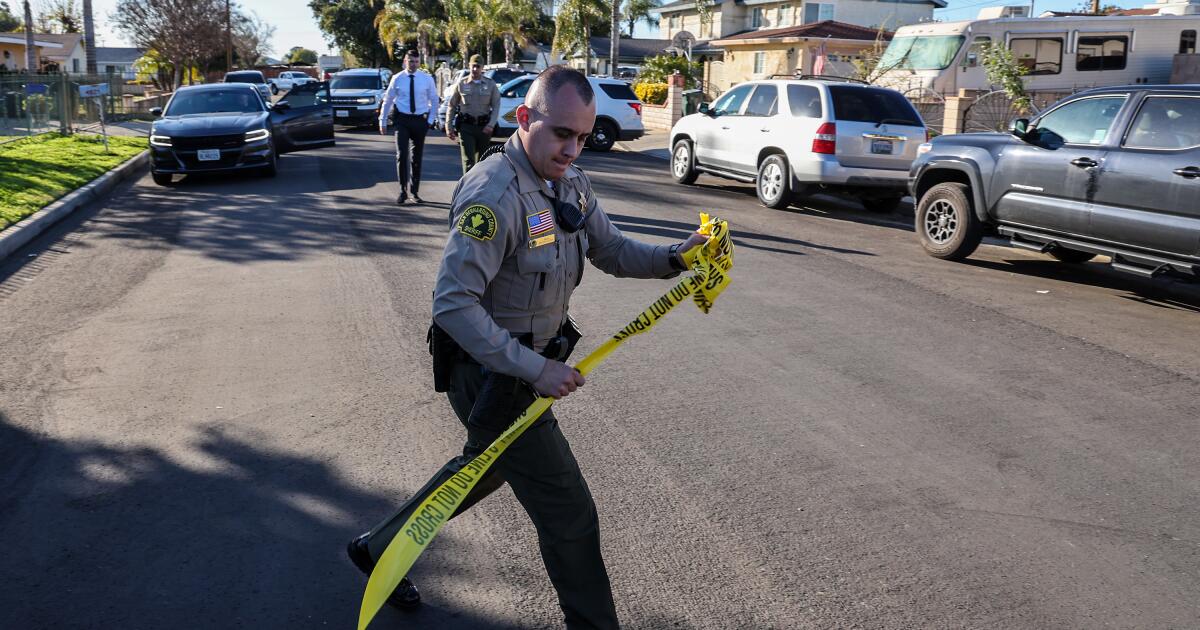
The number of homicides in some of California’s biggest cities dropped to remarkably low levels in 2025, a piece of good news that immediately touched off debate about who, or what, was responsible.
It’s safe to say that while politicians in both parties claimed credit for improved safety, there won’t ever be a definitive explanation for what caused the decline in killings in Los Angeles, San Francisco, Oakland and other cities.
Los Angeles tallied 230 homicides in 2025, as my colleagues Libor Jany and Richard Winton reported. Although that number is not final, because investigators are continuing to assess some deaths, it would probably represent the fewest killings since 1966, when LA. had 30% fewer residents. Measuring per capita, it was the city’s safest year since 1959.
Similarly, San Francisco counted just 28 homicides in 2025, a 20% decline from the 35 killings it had the year prior. It marked the Bay city’s lowest total since 1954. And Oakland logged 66 homicides through Dec. 28, on pace to become the lowest annual total since 1967. That’s a huge decline from the 125 homicides that rocked the city in 2023.
A positive national crime trend
Those figures mirror what’s being reported in cities across America. A spike in violence that accompanied the start of the COVID pandemic in 2020 has reversed itself sharply. The numbers don’t only reflect a drop in homicide rates but also lower overall rates of violence. In Oakland, for instance, crimes categorized as violent — including homicide, aggravated assault, rape and robbery — declined by one-quarter from 2024 to 2025.
Axios quoted a crime statistics expert as saying that the U.S., as a whole, was on pace for the the largest one-year drop in murders ever recorded.
New York City and Memphis recorded nearly a 20% drop in murders compared with 2024, and Chicago recorded a drop of almost 28%.
Authorities pinned the high urban homicide rates of the 1980s and 1990s, in part, to turf battles over the crack cocaine business. Although the sale of other illicit drugs, like fentanyl, has emerged in recent years, the rates of violence associated with them have not been as high.
The national Council on Criminal Justice, a nonpartisan think tank, cautioned analysts not to read too much into the homicide figures and not to draw conclusions without more information.
“After reaching an historic low in 2014, the national homicide rate spiked by 23% just two years later,” the Council on Criminal Justice says on its website. “While there are plausible theories for that turnabout, and for the volatile patterns over the past five years, the drivers of these trends are poorly understood. Greater investment in rigorous research is critical to shed more light on the changing crime landscape and to craft effective crime control approaches for the future.”
As my colleagues reported earlier, some experts in L.A. credited the return of social services that declined during the pandemic. The LAPD warned that fewer resources and manpower risk triggering an uptick in crime. But the latest data show killings have fallen even as the LAPD staffing has declined and seen officers conduct fewer traffic stops and interactions with the public than in past years.
The White House takes credit
When asked about the decline, the White House said in a statement: “It’s amazing what happens when you have a President committed to enforcing the law and punishing criminals. President Trump’s policies are Making America Safe Again from California to DC and everywhere in between — and he’s just getting started.” That echoed a statement from Republicans in the House.
Los Angeles Mayor Karen Bass issued a statement of her own, saying her comprehensive approach to public safety made a difference. She said her office of Community Safety “has served thousands of Angelenos through the Gang Reduction and Youth Development program, case management, connections to mental health treatment and drug treatment, reentry services and community programming like Summer Night Lights that served more than 110,000 Angelenos across the city this past year.”
She scoffed at Republican claims, saying they “are famous for voting to cut funding to the very programs that keep people safe.”
Today’s top stories 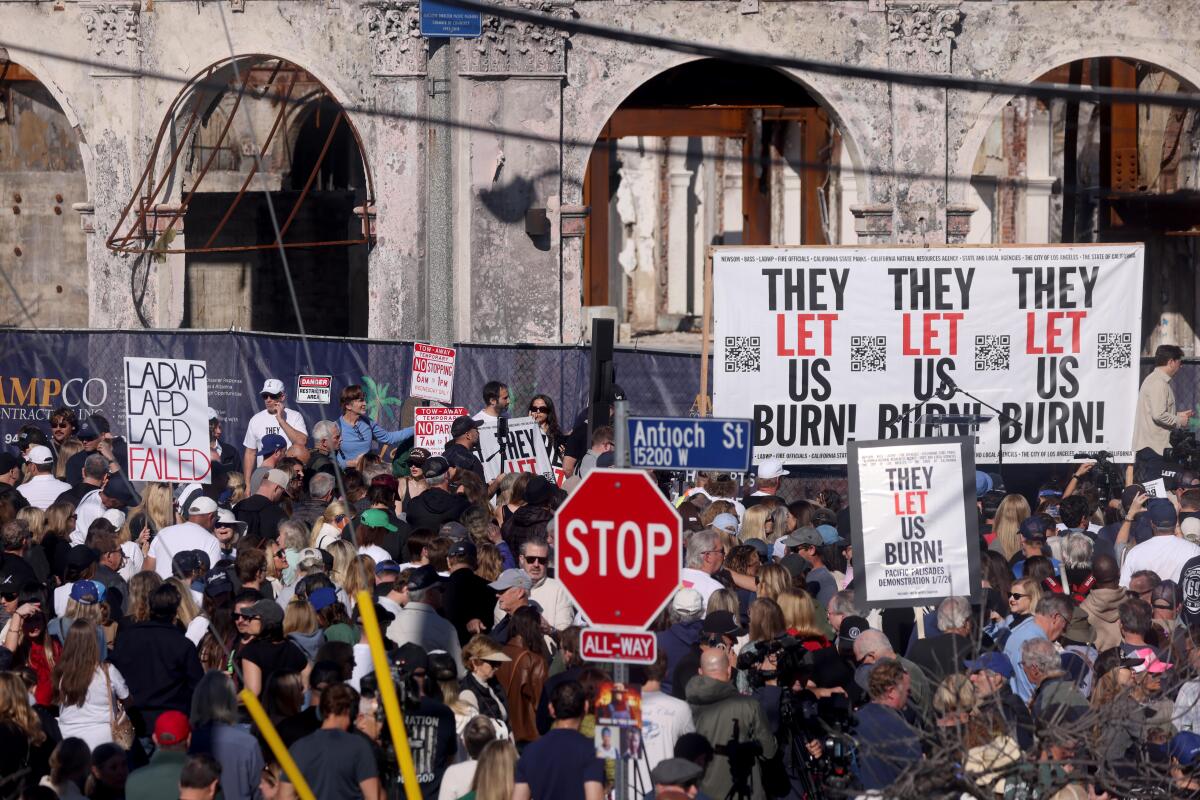
Hundreds of survivors gather in Palisades Village to commemorate the anniversary of the Palisades fire.
(Genaro Molina / Los Angeles Times)
Anniversary of the January firesTrial of Nick Reiner
- Defense attorney Alan Jackson stepped down as counsel for Nick Reiner, who faces two counts of murder in the brutal December stabbings of his parents, Rob and Michele Reiner.
- The Los Angeles County public defender’s office will instead represent Nick Reiner.
- The change of counsel postponed Reiner’s arraignment until Feb. 23.
Trump’s operation in VenezuelaThe fight for Warner Bros.ICE shootingsWhat else is going onCommentary and opinionsThis morning’s must-readsOther must-readsFor your downtime 
Meow Wolf artist Emmanuelle John is working on multiple pieces for Meow Wolf Los Angeles.
(Gabriela Campos / For The Times)
Going out
- Dining: Treat your taste buds at these 31 newcomers from the 101 Best Restaurants list.
- Exhibits: Check out a fish-shaped spaceship and other cool things at Meow Wolf L.A.
- Music: Jam out with live music at West Hollywood’s Sun Rose Hotel.
Staying inAnd finally … from our archives 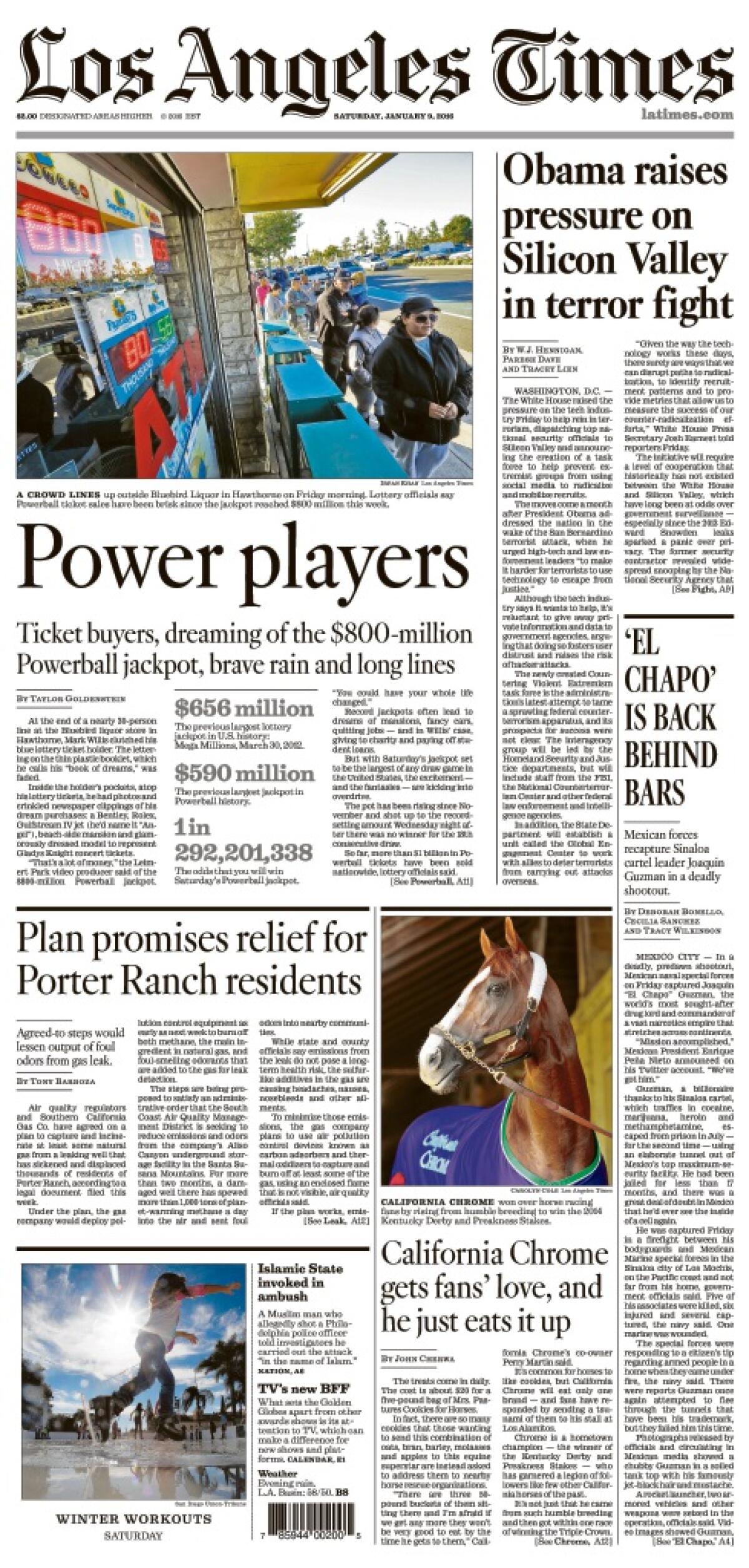
Front cover of the Los Angeles Times on Jan. 9, 2016.
(Los Angeles Times)
On Jan. 8, 2016, Mexican authorities captured and arrested the notorious drug lord Joaquin “El Chapo” Guzman.
Have a great day, from the Essential California team
Jim Rainey, staff reporter
Hugo Martín, assistant editor, fast break desk
Kevinisha Walker, multiplatform editor
Andrew Campa, weekend writer
June Hsu, editorial fellow
Karim Doumar, head of newsletters
How can we make this newsletter more useful? Send comments to essentialcalifornia@latimes.com. Check our top stories, topics and the latest articles on latimes.com.