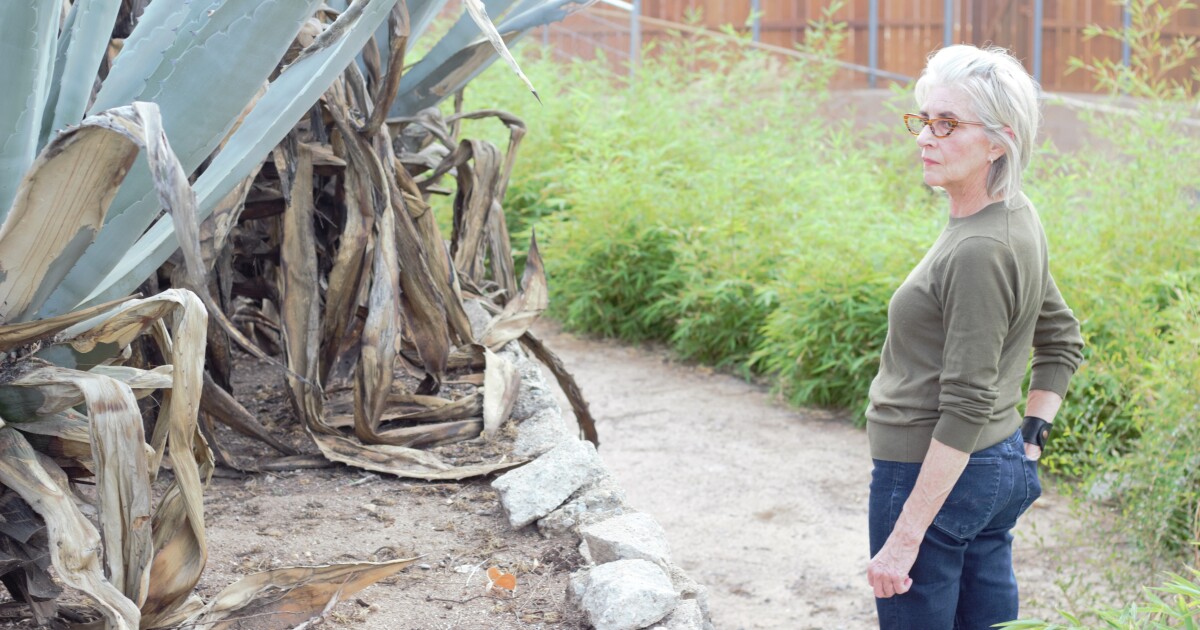
When Ariel Pittman thinks about the Eaton Fire, she said she thinks about the person with a disability who died waiting to be evacuated, and about the importance of knowing who’s in the area.
“We need to have a sense of responsibility for each other,” Pittman said.
And she thinks about how to get relief money to survivors immediately, Pittman said, “rather than making them fill out mountains of paperwork and drive all over town trying to get resources.”
Pittman, owner and founder of the art gallery Official Welcome in Westlake, is among a group of five women art workers and artists — including Kathryn Andrews, Andrea Bowers, Olivia Gauthier, and Julia V. Hendrickson — who created the mutual aid fund Grief and Hope.
Mutual aid refers to individuals pooling resources to help one another. This collective action can build new social relationships but can also represent a shared understanding that existing relief systems often fail to help everyone.
After the Palisades and Eaton fires a year ago, there was an outpouring of giving for artists and art workers who experienced loss. In small and large gestures, this aid created connection, served as recognition of this shared moment, and suggested new ways of relating to one another.
But those who received aid have ongoing needs beyond what those homegrown efforts have provided, and those who manage aid told LAist that more needs to be done to improve relief systems ahead of the next disaster.
Supporting the art community after the fires
The Grief and Hope fund was intended to draw attention to the economics of working in culture and to the art workers who go unrecognized. It was among a number of initiatives to support artists and art workers after the fires; it raised approximately $1.6 million, much of that already distributed to 271 people.
“I think we all had this shared sense too of just not wanting to see our art world disappear here. And that felt very prescient when the fires happened,” gallery director Gauthier said.
A recent survey about artists in the labor force found more than half of the artists reported being “somewhat or very worried” about being able to afford “food, housing, medical care, or utilities” and around 10% “juggled three or more jobs.”
While some artists do well financially, Pittman said, she has seen art workers living on the edge: self-employed workers, underpaid gallery and museum employees, people who are underemployed or managing multiple jobs.
A disaster only makes their situations more precarious.
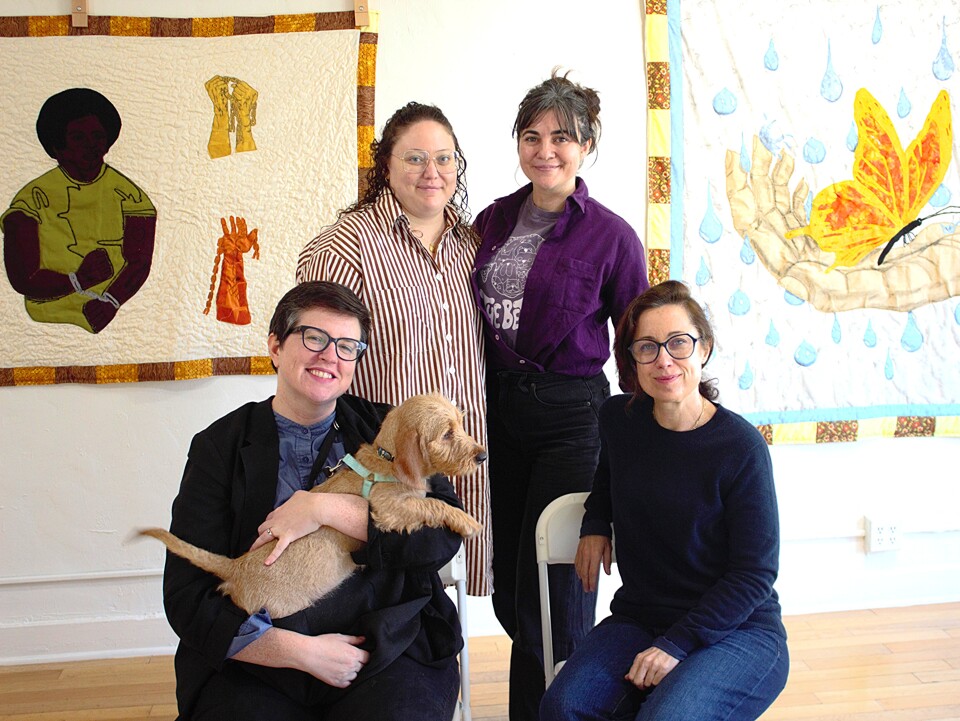
The organizers of the mutual aid fund Grief and Hope. From left standing, clockwise: Olivia Gauthier; Ariel Pittman; Kathryn Andrews, Julia V. Hendrickson. Not pictured: Andrea Bowers.
Grief and Hope’s organizers were already active in supporting artists before the fires, so it came naturally to continue to do so. They quickly set up a fiscal sponsor through The Brick nonprofit to manage the money and researched the minimum requirements needed to distribute aid.
Hendrickson, a small business owner of the arts agency Verge, checked applications for false information, but overall the group aimed to cut red tape — an example they hope bureaucracies can learn from.
The most dominant response Grief and Hope’s organizers heard from aid recipients in a survey was their gratitude for “how little information and hoops we required people to jump through,” Pittman said. She pointed out “the number of people who were just like, ‘thank you for not asking me to quantify my suffering to receive support.’”
Recipients also reported in the survey that they felt more connected.
With its organizers bearing close ties to the community, Grief and Hope was also a hub for information, channeling requests from people wanting to help and sharing opportunities like temporary housing, access to studio space and free art supplies.
In their efforts to distribute funding quickly, members of Grief and Hope recognized that they missed a lot of older people who weren’t on social media or connected to those that are. To remedy this, Grief and Hope organizers were able to distribute funding to those who were less online at a later date.
I hope that the people who saw what we did would do the same for us, that there would be another group like this in the future, for the next thing that needs it, you know?
— Ariel Pittman, Grief and Hope organizer
Pittman said this is another reason why there needs to be data for those distributing resources after a disaster, so that resources could be brought to people, rather than people having to find them or rely on an algorithm to learn about them.
Pittman said her group plans to make one more payment to applicants, but speaking for herself, she doesn’t see Grief and Hope being revived unless they’re uniquely situated to help.
“I hope that the people who saw what we did would do the same for us, that there would be another group like this in the future, for the next thing that needs it, you know?” she said.
And better data would mean future aid groups could get a head start. This group shares an understanding that with climate change, disasters will inevitably become more frequent.
One of Pittman’s collaborators, Andrews, an artist and founder of the gender equality nonprofit Judith Center, has now lost her home twice (first to the Bobcat Fire in 2020, second to the Palisades Fire).
She recognized this is a unique opportunity where people can come together and think about a different future, on how to construct a community anew, but also how to prepare for a different disaster response.
“I don’t think a solution after the fact is the right approach because there’s just not enough we can do. We need to reengineer it on the front end,” Andrews said. “And I think collectively we should make demands that the government does step up differently, that insurance performs differently.”
Needs after a disaster
Margaret Ross Griffith learned from her neighbor’s car camera that the Eaton Fire had made it to her Altadena home.
She also lost her and her husband’s art studios, their art storage, and also the period of time, the “soft space” she called it, that her family of four shared before her eldest daughter would go off to college.
When various relief efforts sprung up in the aftermath, the last thing she could imagine doing was driving anywhere to pick up anything.
“You’re like, ‘I have to drive where?’” she recalled. “I mean, you’re just in such a state of shock that driving anywhere is a hardship.”
Margaret Griffith learned from her neighbor’s car camera that the Eaton Fire had made it to her Altadena home.
Griffith and her husband lost their art studios and their art storage in the Eaton Fire.
Friends showed up for her and her family. At least two rented trucks to bring items to fill their empty rental home. One day five of her husband’s friends came with shovels and screen to remove and filter debris. The friends who took Griffith and her family in after the Eaton Fire said they could stay as long as they needed.
It also helped that she could receive funds quickly from Grief and Hope. There were immediate costs to cover, including paying for a security deposit and rent for a place that cost twice as much as their mortgage.
Even before having furniture for their rental, Griffith said with some amusement, she used aid from art groups to invest in a laser cutter. Griffith, an artist who makes intricate sculptures by cutting repeated patterns through metal and other materials, said it was an essential need for her art practice.
The value of having a space to create
At 72 years old, Coleen Sterritt had retired from teaching at a community college and had plans for her art practice and life in her community. She said that this has now been erased. The materials gathered for future projects have burned, along with her house and two art studios. The people in her former Altadena community who consider themselves too old to rebuild or who rented do not plan to return.
“It was like one day you had your life and the next day you did not,” Sterritt said. “It was just gone.”
For survivors of Eaton Fire, recovery has been a full-time job
After the Eaton Fire, Sterritt, her husband, and their two dogs have moved five times. She said it helps to be around people who understand what they went through. There is a sense of isolation among others, including family.
“They don’t really understand that it’s with us all the time. It’s with us all the time,” she said.
Going to art galleries today is a reminder of the art she has lost: sculptural art in the last 15 years, and the works on paper that went back nearly 50 years, her notebooks, and her sketchbooks.
Sterritt received mutual aid from a GoFundMe a former student created for her. Sterritt was initially reluctant, but was persuaded that the GoFundMe was a connection to others who wanted to give, regardless of how much someone could contribute.
But as the one-year mark approached, she said she has noticed that the attention has begun to fade. Sterritt points out, for example, businesses that were so quick to offer discounts at the time of the fires, did not continue much past early 2025. By summertime, businesses appeared to have moved on, she said.
Recovery has been a full-time job — between working to create an inventory of all that was lost and participating in the lawsuit against SoCal Edison, Sterritt has not been able to make art.
Sterritt misses having a studio and the privacy it affords. The loss of a physical place for an artist isn’t the same as it is for a person whose profession isn’t so tied to having a space for creativity, Sterritt said. And space in Los Angeles is hard to come by.
Griffith, too, has found it challenging to make art since the fire. She said to do so, she needs to have three components — time, money and space. She recently was given access, however, to a temporary studio for her eight-week art residency with Arts at Blue Roof. There she seemed to relax.
“There’re no distractions here. I’m not, you know, dealing with the burdens of the house rebuild when I come into this room,” she said in an interview at her Blue Roof studio.
She is not expecting her new home to be ready until 2027, so she hopes that organizations continue to offer studio space to those affected by the fires.
And she hopes people do not forget how long recovery takes.
Funding for this story was provided by UC Berkeley’s Greater Good Science Center, as part of its “Spreading Love Through the Media” initiative, supported by the John Templeton Foundation.