ORANGE PARK — Members of the Orange Park Town Council weighed some pros and cons of using the controversial Flock camera system at Tuesday night’s meeting.
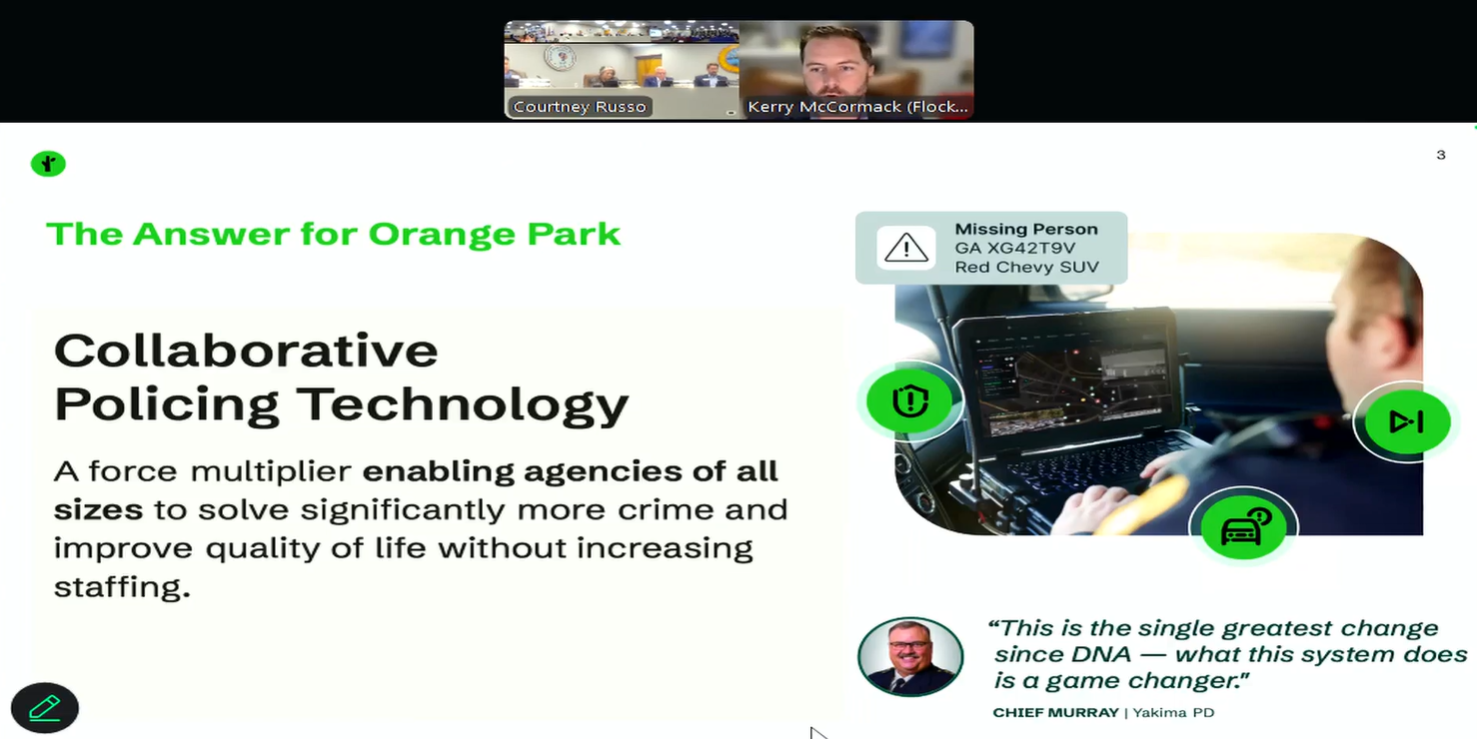
Flock cameras are an AI-surveillance system made by Flock Safety that uses automatic license plates, make, model and colors of a car to store data in a centralized, searchable database. It can be accessed by law enforcement to solve crimes, track stolen vehicles and even find missing people in real time.
The devices are solar-powered and LTE-connected, allowing for data to be found within hours, according to Flock Safety. Cameras function day and night.
In a discussion that raised more questions than answers, the council spoke with an expert to gain additional insight. Kerry McCormack spoke on behalf of the Atlanta-based company.
The Orange Park Police Department first raised the possibility of using the system during the Dec. 2 meeting. The police department, along with the town’s Public Works Department, proposed using the $40,000 License Plate Reader System.
This product would allow cameras in the public right-of-way to capture the rear of vehicles. The law enforcement agency would upload a ‘hot list’ with vehicles linked to crimes into the database. Police officers would then receive real-time alerts whenever those vehicles pass a community camera.
“If the license plate is not in that hot list system, it will not notify anyone nor provide an alert,” McCormack said.
Oftentimes, McCormack said, suspects will remove or switch plates to flee from police. For vehicles without a plate, they can still be pinpointed using unique vehicle traits, such as the vehicle make, color and body type.
So far, more than 160 Florida agencies use the cameras, with 90 in Clay County. More than 2,800 crimes have been solved per day.
In Taylor County, the cameras helped to arrest 14 child predators in an undercover operation, as well as teens in the shooting death of a 14-year-old. In Key Largo, the system was credited with helping solve a missing persons case.
The entire system, McCormack said, is built with privacy in mind. Data is never sold, and private customers don’t have access to hotlists or government data. Additionally, Flock automatically deletes data after 30 days and does not have access to personally identifiable information. Each individual agency also decides who to share information with.
Flock also has a partnership with Ring. Individuals who own a Ring camera may opt into the network server, which notifies them of crimes nearby. The individuals would then have the option to provide their footage to the police department for further investigation.
Council members addressed their concerns with potential tracking and wrongful police stops.
“There is potential for good. There’s also potential for bad,” Vogel said.
Mayor Randy Anderson and Vice Mayor Winette Sandlin both raised the possibility of outsiders accessing the system. McCormack rebutted this by saying the system is secure and has never been hacked.
Councilman Glenn Taylor called mass surveillance a “problem,” while Councilman Doug Benefield questioned Flock’s future financial stability.
Residents also spoke against the cameras, some citing police bias and potential abuse. Another said that the Flock system sounded utopian in a way, placing all responsibility and trust in technology.
“It’s worse than naive,” he said.
The council still made no definitive decision on whether the town will be adding the cameras anytime soon.