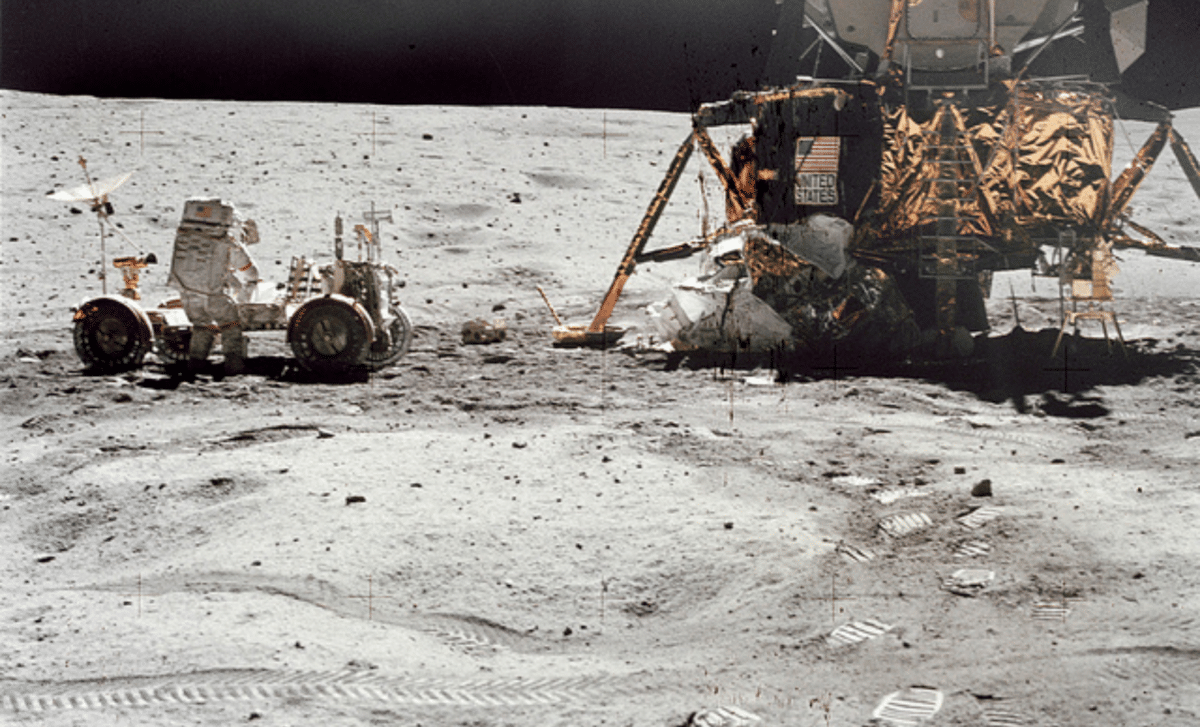
As lunar exploration intensifies, the potential for contamination of the Moon’s surface by spacecraft exhaust has become a growing concern among scientists. A recent study published in Journal of Geophysical Research: Planets highlights how the exhaust gases released during lunar missions could compromise the delicate, pristine environment of the Moon, particularly areas that could contain vital clues to the origins of life on Earth.
The Risk of Contamination: A New Challenge for Lunar Science
The study, published in Journal of Geophysical, reveals that the introduction of spacecraft exhaust could disrupt crucial scientific endeavors aimed at unraveling the Moon’s ancient history. “We are trying to protect science and our investment in space,” said Silvio Sinibaldi, the planetary protection officer at the European Space Agency and senior author of the study. The Moon, with its preserved surface largely unaltered by geological activity, holds the potential to unlock secrets about the early solar system, including the origins of life on Earth. However, this potential could be compromised by the introduction of contamination from spacecraft.
The research specifically highlights how methane, the primary organic molecule released by spacecraft engines, could spread rapidly across the Moon’s surface. In their study, Sinibaldi and his team modeled how exhaust methane from a spacecraft landing at the Moon’s South Pole could travel all the way to the North Pole in less than two lunar days. This discovery is concerning because it means that, regardless of the landing site, contamination would likely spread across the entire lunar surface. “In a week, you could have a distribution of molecules from the South to the North Pole,” Sinibaldi explained.
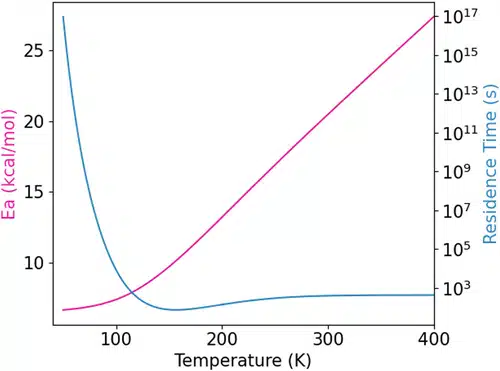 Distribution of methane activation energies and corresponding residence times on the lunar surface, based on values estimated by Hodges (2016).
The Moon’s Polar Regions: A Key Area for Prebiotic Research
The Moon’s polar regions, particularly those in permanent shadow, are of immense scientific interest. These areas, known as permanently shadowed regions (PSRs), contain ice that might have been delivered to the Moon by comets and asteroids billions of years ago. Researchers believe these ice deposits could hold prebiotic organic molecules, the building blocks of life, such as DNA, which could offer insight into how life on Earth may have originated. However, as Sinibaldi warns, the release of methane and other organic molecules from spacecraft exhaust could interfere with the integrity of these crucial sites.
“We know we have organic molecules in the solar system—in asteroids, for example,” Sinibaldi said. “But how they came to perform specific functions like they do in biological matter is a gap we need to fill.”
The pristine condition of the Moon’s surface, especially in these polar craters, provides an opportunity to study these organic molecules in their original form, unaltered by Earth’s dynamic surface conditions. But with increasing lunar missions, the risk of contaminating these vital sites grows.
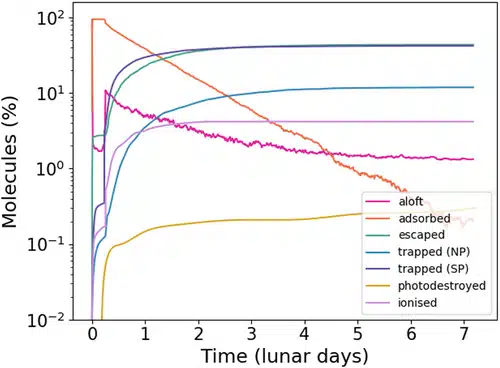 Evolution of the percentage of molecules that are aloft, adsorbed onto the lunar surface, trapped at the South and North PSRs, that have escaped the Moon’s exosphere, have been photodestroyed or have been ionized, over the course of 7 lunar days. Ionized molecules are also accounted for within the other categories; this additional line is included to provide context for their eventual fate. Credit: Journal of Geophysical Research: Planets
A Deep Dive into Computational Modeling of Lunar Contamination
To assess the potential spread of methane and its effects on lunar research, Sinibaldi and his colleague Francisca Paiva, a physicist at Instituto Superior Técnico, developed a complex computational model. This model simulated how methane molecules released by spacecraft would behave across the Moon’s surface, taking into account variables like solar wind and ultraviolet radiation.
“We were trying to model thousands of molecules and how they move, how they collide with one another, and how they interact with the surface,” said Paiva. “It required a lot of computational power. We had to run each simulation for days or weeks.”
The results of the simulation were surprising. Methane molecules, propelled by sunlight and slowed by the Moon’s cold surface, could travel vast distances across the landscape. “Their trajectories are basically ballistic,” Paiva explained. “They just hop around from one point to another.” This behavior underscores the difficulty in preventing contamination, as methane molecules are free to move across the entire surface without significant obstacles.
Protecting the Lunar Environment: What Needs to Be Done?
The implications of the study are far-reaching, especially as governments, private companies, and NGOs ramp up lunar exploration efforts.
“I want to bring this discussion to mission teams, because at the end of the day, it’s not theoretical—it’s a reality that we’re going to go there,” said Sinibaldi. “We will miss an opportunity if we don’t have instruments on board to validate those models.”
The study emphasizes the need for lunar missions to not only account for the scientific risks posed by spacecraft exhaust but also to implement measures to minimize contamination and protect valuable research sites.
While the study highlights the potential challenges, it also offers solutions. Colder landing sites on the Moon could help contain exhaust molecules better than warmer ones. Additionally, researchers hope to explore whether the exhaust molecules might settle on the icy surfaces of PSRs, leaving the material beneath them untouched. These strategies could help mitigate the impact of contamination and preserve the Moon’s ancient environmental record.
A Call for Planetary Protection on the Moon
The Moon is a unique and valuable environment, and just as Earth has laws to regulate the contamination of pristine regions like Antarctica, the same level of protection must be extended to the Moon. Paiva draws a direct parallel between the need for planetary protection on the Moon and the regulations in place on Earth.
“We have laws regulating contamination of Earth environments like Antarctica and national parks,” she said. “I think the Moon is an environment as valuable as those.”
As exploration of the Moon advances, ensuring that we do not jeopardize its scientific potential will require robust planetary protection strategies.