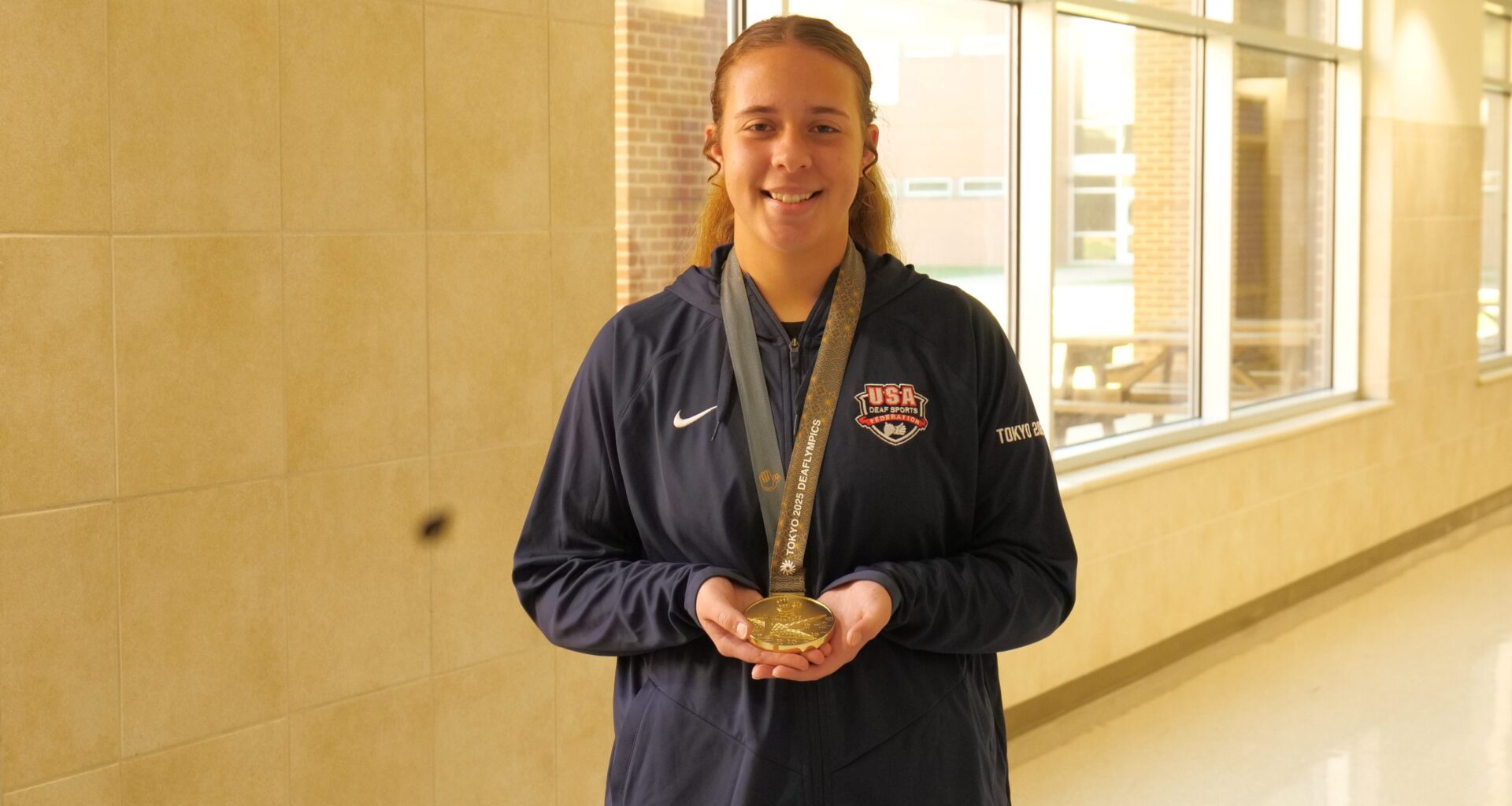
The gold medal sits in a case in Sierra Kaspar’s bedroom, its place of honor not yet fully settled.
The teen is still deciding where it belongs, how it should face the room, what kind of permanent display it deserves.
The medal is new enough that it doesn’t yet feel like an ending, she said.
Sierra, a 17-year-old goalkeeper from Brewer High School, joined the U.S. Women’s Deaf National Soccer Team just six months before traveling to Japan for the Deaflympics.
She arrived the newest player on the roster. She departed a gold medalist, a starter in three matches and part of a team that did not allow anyone to be alone — on the field or off it.
“There’s no such thing as isolation on the team,” Sierra said. “If you try to sit alone, someone’s going to pull you over.”
The final game was played against Japan, on that team’s home turf and before a packed crowd that included members of the Japanese royal family. It was the kind of environment that rattles even seasoned soccer professionals. For Sierra, it was familiar in one way: The noise existed largely outside her world.
Japan tested the Americans the way clever teams always do — with movement, deception and restarts designed to exploit hesitation.
Sierra remembers one free kick in particular, set up just outside the penalty area. She arranged her wall, braced for a shot and watched the ball slide right in front of her, where a late runner struck it just wide of the goal.
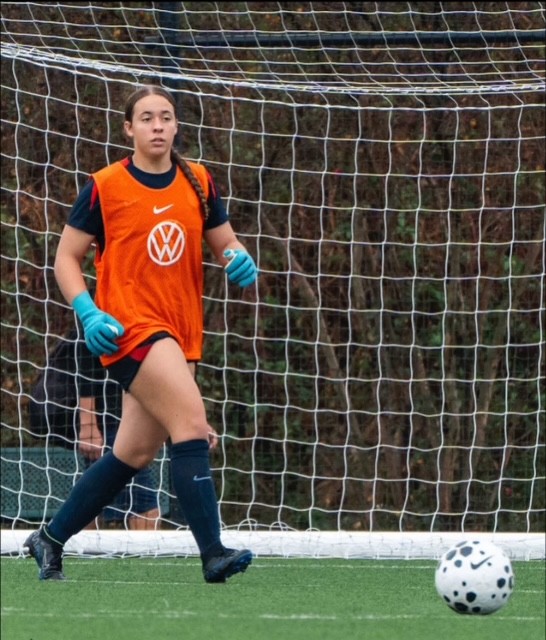 Brewer High School goalkeeper Sierra Kaspar trains in front of the net. (Courtesy | White Settlement ISD)
It was a reminder of how little separates a goal from a miss at that level, she said. A reminder, too, that goalkeeping is as much about anticipation as reaction.
When a referee blew the final whistle, there was no ambiguity, even for the players completely unable to hear it.
Teammates rushed together. Two of them found Sierra first. The gold medal, when it came, felt almost unreal, she said — less a prize than proof that the unlikely path led the team somewhere tangible.
Learning to adjust — on and off the field
For Sierra, that path to victory began years earlier in elementary school. That’s when she started failing routine hearing tests.
At first, it seemed insignificant, she said. Then, near the end of sixth grade, her phone rang at full volume beside her — and she didn’t hear it.
Hearing aids followed quickly.
So did discomfort, frustration and the particular self-consciousness that comes with standing out as different at a young age. Sierra didn’t want to stand out. She wanted to blend in at school, with friends, on the soccer field.
The hearing aids, at first, made the world louder but not clearer, she said.
Background noise overwhelmed conversation. Group discussions became exercises in guesswork and timing. Eventually, the trade-off revealed itself. Wearing them made her less isolated than pretending she didn’t need them, she said.
On the field, the adjustment was ongoing.
Goalkeepers organize defenses by voice, but Sierra could not always hear replies, especially in face of wind, distance or the higher pitches of most women’s voices.
Her solution was not volume but awareness.
She learned to watch constantly. To read posture, spacing, hesitation. To stop play when necessary and communicate directly. Teammates adapted, walking to her if they needed clarity. Hand signals replaced shouted instructions. Eye contact mattered.
With the Deaf National Team, the adjustment wasn’t hers alone, Sierra said.
Communication became visual by default. Everyone had to look. Everyone had to anticipate. The game slowed, in a sense — not physically, but cognitively. Patterns emerged more clearly. Space mattered more.
Sierra, analytical by nature, flourished.
Consistency under pressure
At Brewer High in White Settlement ISD, head coach Nathan Hamilton saw it early.
Sierra was already a high-level player as a freshman — confident, technically sound, capable of playing in the field as well as in goal, Hamilton recalled.
That experience sharpened her understanding of the game, the coach said. When she returned to goal full time, Sierra brought a defender’s instincts with her.
In pressure moments, she was unflappable. During district play, for example, Brewer went to penalty kicks five times. Sierra saved roughly 25% of on-target attempts — an extraordinary number at any level, Hamilton said.
More important than the statistic was the effect, he said: Teammates trusted her. They listened.
“She was like a coach on the field,” Hamilton said.
That trust carried over to the national team, where Sierra arrived unsure of her signing ability and uncertain of her place.
That uncertainty didn’t last long.
Veterans greeted her immediately. Meals were communal. Sitting alone wasn’t allowed.
Teammates taught her signs patiently and corrected her gently. They pulled her into conversations she didn’t yet fully understand. A captain sat beside her at meals, translating meanings and building camaraderie as much as language.
The result was something Sierra hadn’t expected. She belonged without effort.
Now, the future looms in familiar ways. College soccer awaits and decisions remain. Sierra has options and time but no interest in comfort, she said.
What unsettles her most is not the speed of the next level or the strength of opponents, she said. It’s stagnation.
“I don’t want to ever get comfortable,” Sierra said. “I always want to be on a team that pushes me to be better than I am right now.”
Sierra does not want to arrive somewhere and stop being pushed. The teen does not want the game to become routine. The Deaflympics showed her what is possible when attention sharpens, when communication evolves, when no one is allowed to disappear.
But the medal is less about what she’s already done than what comes next, she said — goals on the field and off that are still taking shape.
Matthew Sgroi is an education reporter for the Fort Worth Report. Contact him at matthew.sgroi@fortworthreport.org or @matthewsgroi1.
At the Fort Worth Report, news decisions are made independently of our board members and financial supporters. Read more about our editorial independence policy here.
This <a target=”_blank” href=”https://fortworthreport.org/2026/01/08/fort-worth-high-school-student-wins-deaflympics-gold-as-newest-member-of-u-s-team/”>article</a> first appeared on <a target=”_blank” href=”https://fortworthreport.org”>Fort Worth Report</a> and is republished here under a <a target=”_blank” href=”https://creativecommons.org/licenses/by-nd/4.0/”>Creative Commons Attribution-NoDerivatives 4.0 International License</a>.<img src=”https://i0.wp.com/fortworthreport.org/wp-content/uploads/2021/04/cropped-favicon.png?resize=150%2C150&quality=80&ssl=1″ style=”width:1em;height:1em;margin-left:10px;”>
<img id=”republication-tracker-tool-source” src=”https://fortworthreport.org/?republication-pixel=true&post=359818&ga4=2820184429″ style=”width:1px;height:1px;”><script> PARSELY = { autotrack: false, onload: function() { PARSELY.beacon.trackPageView({ url: “https://fortworthreport.org/2026/01/08/fort-worth-high-school-student-wins-deaflympics-gold-as-newest-member-of-u-s-team/”, urlref: window.location.href }); } } </script> <script id=”parsely-cfg” src=”//cdn.parsely.com/keys/fortworthreport.org/p.js”></script>