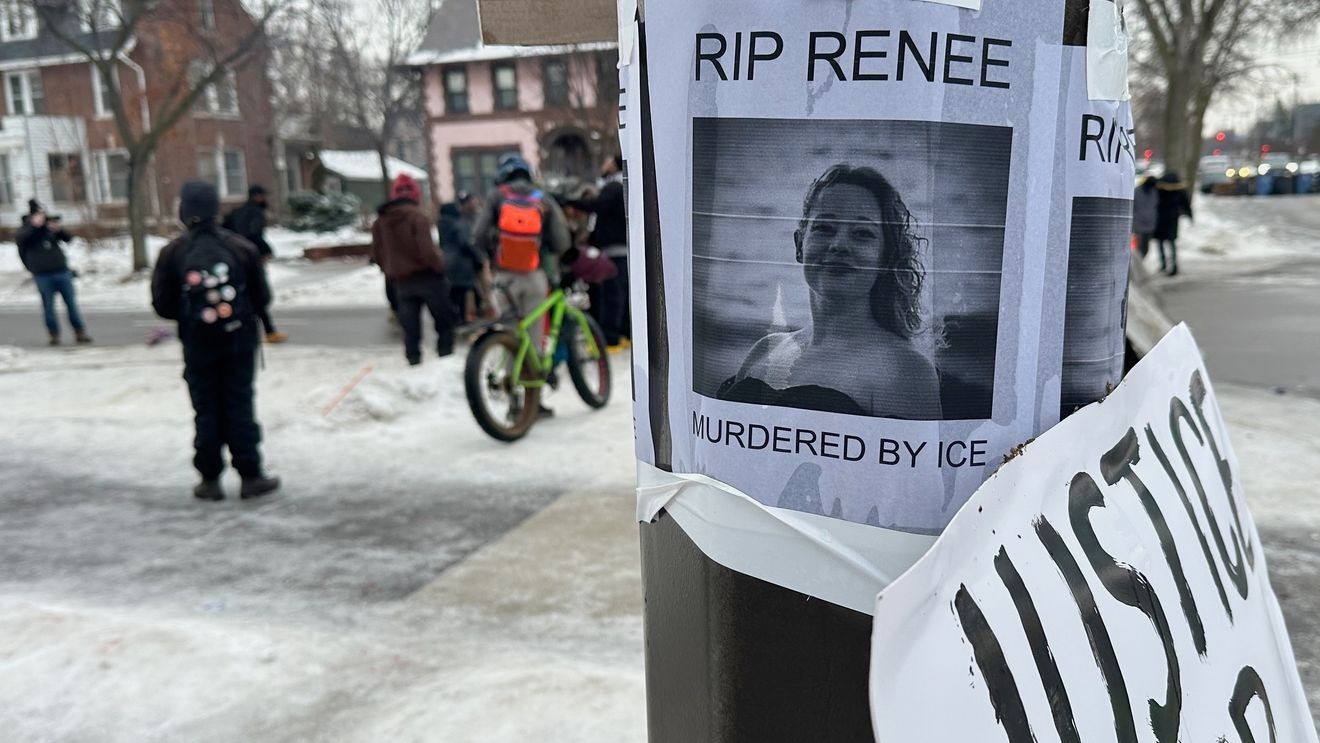
SAN ANTONIO – On Wednesday, an Immigration and Customs Enforcement (ICE) agent fatally shot Renee Nicole Good, a 37-year-old U.S. citizen and mother of three, during a large-scale immigration enforcement operation in South Minneapolis. While federal officials characterized the shooting as self-defense against “domestic terrorism,” local leaders and witness videos have fiercely disputed this claim, showing the agent firing into Good’s vehicle as she appeared to be maneuvering away from the scene.
The shooting of Renee Good has ignited a national debate on law enforcement, self-defense, and the role of ICE agents in American cities. Legal experts and former law enforcement agents are weighing in on the complex issues surrounding the use of force and the review and investigation of such actions.
Criminal defense attorney Joe Hoelscher commented on the incident, stating, “It doesn’t look to me like there’s any intent to commit an assault.”
He explained that Texas law provides citizens with many protections, but incidents like this are often challenging to evaluate.
Hoelscher added, “If the ICE agent reasonably believed that he was at risk of having deadly force used against him, or that somebody was in the active commission of a felony, then he would have been able to use deadly force to stop it.”
Abel Pena, a former FBI agent with over 25 years of experience, highlighted the training officers receive regarding the use of deadly force.
“We’re not supposed to fire into a moving vehicle. That’s not what we’re trained to do. We’re simply trained to stop the threat, and if the agent perceived that there was an imminent threat, then yeah, he was. He saw that, and he took the shot,” Pena said.
Annie Bright, a visiting assistant professor at St. Mary’s School of Law says another critical aspect of the debate is the constitutional protections granted to all citizens under the Bill of Rights.
“The Constitution protects primarily against, I think primarily in this case, against an unlawful, unreasonable seizure of this individual through the use of deadly force,” Bright emphasized.
Experts agree that investigations into incidents like this are particularly challenging due to the split-second decisions made by law enforcement officers.
Agent who shot Good was injured in previous incident
Federal court documents show the agent who shot Good was seriously injured in a prior incident in June in which he used force against the driver of another moving vehicle in Bloomington, Minnesota.
The agent got his arm stuck in the window of a vehicle of a driver who was fleeing arrest on an immigration violation, and was dragged roughly 100 yards down a street before he was knocked free. During the incident, the agent fired his Taser and prongs struck the driver but did not incapacitate him, according to prosecutors.
The driver later claimed he did not know the man trying to stop him was a federal agent. A jury rejected that argument last month and found the driver guilty of assaulting a federal officer with a dangerous or deadly weapon.
Vance says officer deserves gratitude
Vance says the ICE officer “deserves a debt of gratitude,” citing an earlier incident in which he was injured by a moving vehicle.
“This is a guy who’s actually done a very, very important job for the United States of America,” Vance said. “He’s been assaulted. He’s been attacked. He’s been injured because of it.”
DHS Secretary Kristi Noem said Wednesday that the officer who shot Good had been “dragged” by a vehicle during a previous incident in June.
According to court documents, the officer was part of a team trying to apprehend a man in the country illegally. He broke a window and reached into the vehicle, attempting to open the door when the driver sped off, dragging the officer the length of a football field in 12 seconds.
The officer’s right arm was bleeding, and an FBI agent applied a tourniquet. Eventually, he was transported to a hospital, where he received more than 50 stitches. Prosecutors said he had “suffered multiple large cuts, and abrasions to his knee, elbow, and face.”
Vance says Good’s death was ‘a tragedy of her own making’
Vance says the ICE officer was clearly justified in shooting Good and he’s not worried about prejudging an investigation that is just getting underway.
“What you see is what you get in this case,” Vance said in the White House press briefing room, downplaying ambiguity about the circumstances that led to the shooting.
The officer was clearly acting in self-defense, Vance said. He framed Good as “a victim of left-wing ideology” who was spurred by an alleged network of politically motivated groups to interfere with law enforcement.
“I can believe that her death is a tragedy while also recognizing that it is a tragedy of her own making,” Vance said.
State investigators say they can’t access ICE shooting evidence after FBI takes case
Minnesota’s investigations agency said Thursday that the U.S. attorney’s office has prevented it from taking part in the investigation into an Immigration and Customs Enforcement officer’s fatal shooting of Minneapolis woman Renee Good, a 37-year-old mother of three.
“The investigation would now be led solely by the FBI, and the BCA would no longer have access to the case materials, scene evidence or investigative interviews necessary to complete a thorough and independent investigation,” Minnesota Bureau of Criminal Apprehension Superintendent Drew Evans said in a statement.
It had been decided that the BCA would investigate Good’s shooting death along with the FBI, but the U.S. attorney’s office changed that, according to Evans.
The announcement came as protestors and law enforcement clashed Thursday morning outside a Minneapolis immigration court, with the governor urging restraint and schools canceling classes as a precaution. Asked about the development, Homeland Security Secretary Kristi Noem said Thursday that Minnesota authorities “don’t have any jurisdiction in this investigation.”
Walz authorizes Minnesota National Guard to get ready to deploy
Gov. Tim Walz authorized the Guard to get staged and ready to support local and state law enforcement to protect critical infrastructure and maintain public safety, should that become necessary. He signed the orders a day after directing the Guard to start making initial preparations.
In a statement, Walz noted that thousands of people had taken part in peaceful protests and added, “We have every reason to believe that peace will hold.”
The statement also said the Minnesota State Patrol has mobilized 85 state troopers to help support law enforcement efforts in the Twin Cities.
President Donald Trump and other Republicans have been critical of Walz’s handling of the sometimes violent unrest following the 2020 murder of George Floyd by a Minneapolis police officer, saying Walz should have deployed the National Guard sooner. Walz’s defenders have said he did an exemplary job under unprecedented circumstances.
After killing in Minnesota, Bernice King cautions political leaders and protestors
Bernice King, who leads the King Center for Nonviolent Social Change, said politicians and protestors must be intentional after an ICE agent’s killing 37-year-old Renee Good.
“We in this nation have got to find a way to change the climate of things,” she told reporters in Atlanta. Asked about Trump blaming Good, King noted differing conclusions from video of the incident and said “we need leaders to speak to the difficulty in these moments.”
King said she has watched video and believes Good was trying to leave and not escalate the situation.
“Why did she have to be a victim?” King asked.
She said “protest is essential” in a free society. But, citing lessons from her father and the Civil Rights Movement, King urged protestors to be “thoughtful about the process” and have a “strategy to elevate” the issues at stake.
“It’s not easy,” she said.
Vance scolds the media for Minneapolis slaying coverage
Appearing in the White House briefing room, the vice president’s voice rose as he decried what he called the “corporate media” for its coverage of a U.S. Immigration and Customs Enforcement officer having shot and killed a woman in Minneapolis.
“This was an attack on law and order. This was an attack on the American people,” said Vance, who maintained it has not been portrayed that way by many journalists.
“The way that the media, by and large, has reported this story has been an absolute disgrace,” he added. “And it puts our law enforcement officers at risk every single day.”
Noem doubles down on self-defense claim in Minneapolis shooting
In an unrelated news conference in New York, she said that while there would be an investigation into the officer’s use of force, she believed he followed his training and the shooting was justified. She again called the incident “domestic terrorism.”
“This vehicle was used to hit this officer,” Noem said. “It was used as a weapon, and the officer feels as though his life was in jeopardy. It was used to perpetuate a violent act, and this officer took action to protect himself and to protect his fellow law enforcement officers.
Noem also said that law enforcement authorities in Minnesota have not been shut out of the probe into the shooting.
“They don’t have any jurisdiction in this investigation,” she said.
What to know about the rules for officers firing at a moving vehicle
— When can officers fire at a moving vehicle? There is no universal training standard for law enforcement. But most police departments and federal guidance bar shooting at a moving vehicle unless the driver poses an imminent threat of deadly force beyond the car itself.
— Why are shootings at vehicles restricted? Experts say firing at a moving car is one of the riskiest forms of lethal force, increasing the chance of stray gunfire or a loss of vehicle control that can endanger bystanders.
— Are officers expected to move out of the way? Yes. Justice Department policy says deadly force is allowed only when no reasonable alternative exists, including stepping out of the vehicle’s path.