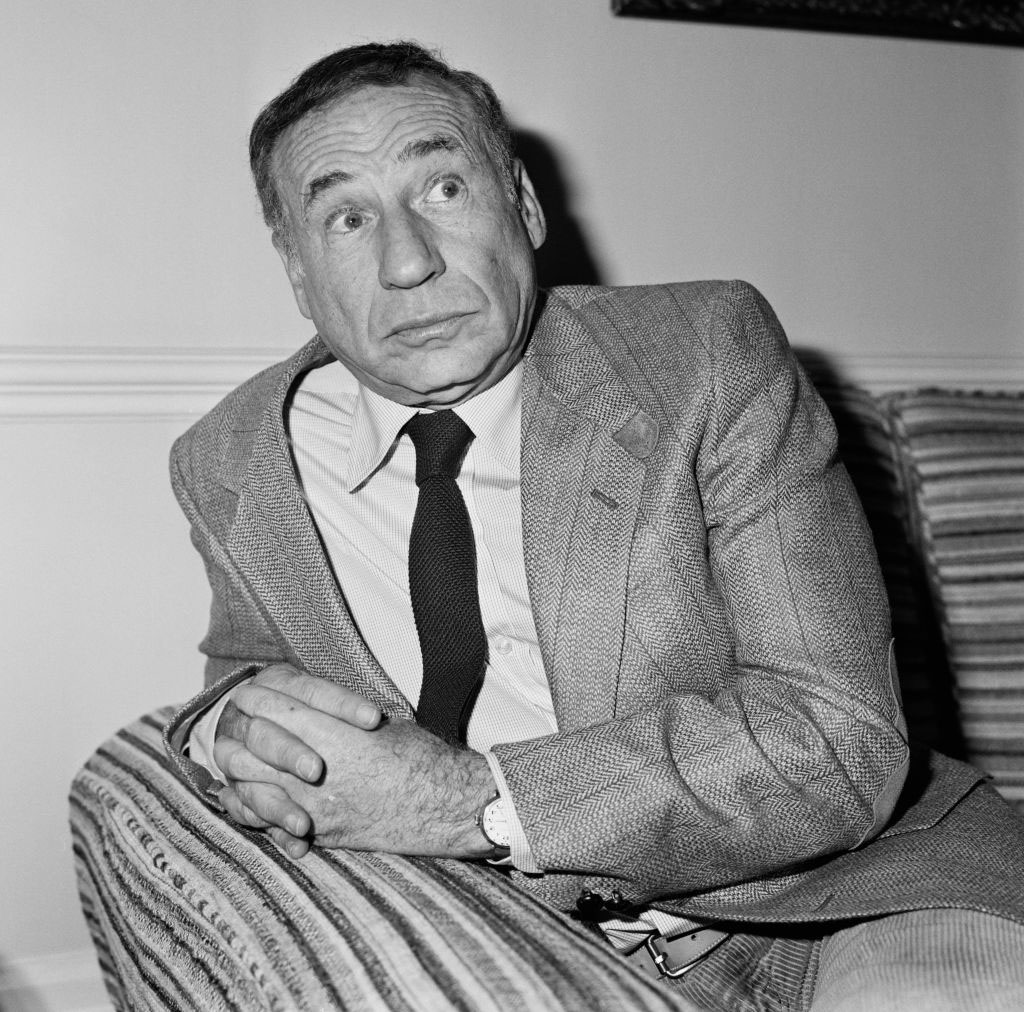
Concerning Leonard Bernstein, Woody Allen, and Mel Brooks, Saul Bellow and Bob Dylan
I cannot, unlike Portnoy, Philip Roth’s creation, make a complaint
that any of them chose to hide their Jewish identity, as do movies that prevent like Penicillin
exposure to this identity, ensuring its restraint,
not only in the movie about the Jewish Nobel Prize winner, Robert Allen Zimmerman – Bob –
but ones regarding Robert Oppenheimer and Neil Diamond which make a void of this unvaunted property.
For this offence, theft of it is not a correct accusation. Although evasive film directors seem to rob
these Jews of their identity, that it’s lost property is more due to the losers’ negligence than robberty.
In “Avalon,” a 1990 movie directed by Barry Levinson, “Avalon,” chronicling a Polish-Jewish immigrant family’s assimilation into American life in Baltimore from the 1910s to the 1960s, the word “Jew” seems not to be mentioned a single time, and the only ritual celebrated by its Jewish characters, besides a funeral, is a completely secular Thanksgiving dinner. The movie concludes with a fire of a large discount appliance store, caused by children playing with fire. I regarded the fire as a symbolic transformation of a secular auto da fe.
The fire caused temporary guilt, a supposed Jewish trait, but turned out to be in fact banal and accidental, like the assimilation of Jews in the mid-20th Century.
In “There’s Something Missing in Films About Jewish Cultural Figures: Why do films relating to Neil Diamond, Bob Dylan and Robert Oppenheimer barely mention their Jewishness?,” NYT, 12/31/25, Mireille Silcoff writes:
The stories are about us, but we’re not in them.
But in the movie, one type of American is not visible, unless you count a split-second image of the Fran Drescher sitcom “The Nanny” playing on a TV set in the background. There’s no reference to Diamond’s heritage, not even a sidelong hint; no Jews seem to be present. This absence might not be on the level of, say, a movie about white musicians trying to become the world’s best James Brown cover act without ever acknowledging race. But of course a movie like that would at least address the topic — as in 1991’s “The Commitments,” about a Dublin soul band.
Lately this feels like a pattern with Jewish stories. I got an odd feeling watching 2023’s “Oppenheimer,” a film that seems uninterested in the fact that its protagonist — leading the Manhattan Project in 1942, at the height of Nazi control of Europe — came from a Jewish German family. I got the same feeling watching Timothée Chalamet as Bob Dylan in 2024’s “A Complete Unknown,” a film that skirts not just Dylan’s origins but also the Jewishness of the Greenwich Village folk scene. I got it while watching Bradley Cooper play the muscularly Jewish Leonard Bernstein in 2023’s “Maestro,” with an absurd prosthetic nose substituting for Jewish interiority. I definitely got it watching Helen Mirren as the Israeli prime minister Golda Meir, with yet more nose prosthetics, in the film “Golda,” which turns the Yom Kippur War into an almost ethnically neutral war-room flick. In each movie, some bid for universality trumps the representation of Jewish experience, leaving behind a peculiar Jew-shaped hole: The stories are about us, but we’re not in them.
I would hate to think that this is because we have, in recent years, been deemed too problematic, too difficult to relate to or hard to like, for mainstream consumption. You could, of course, make a case that what we’re seeing is precisely the opposite — that this erasure actually represents some triumph of assimilation and acceptance. What followed that midcentury efflorescence of Jewish visibility, after all, was a period during which parts of the Jewish experience were absorbed into the mainstream, until millions of Americans could watch TV shows steeped in Jewish humor and sensibilities, like “Seinfeld,” and think of them only as New Yorkers Being Very New York. Somewhere along the path from “Goodbye, Columbus” and “The Odd Couple” to Judy Blume and “An American Tail,” from “Dirty Dancing” to Jon Stewart’s “The Daily Show” to “The Marvelous Mrs. Maisel,” the Jewish experience became capable of blending, sometimes invisibly, into the broader American one.
Gershon Hepner is a poet who has written over 25,000 poems on subjects ranging from music to literature, politics to Torah. He grew up in England and moved to Los Angeles in 1976. Using his varied interests and experiences, he has authored dozens of papers in medical and academic journals, and authored “Legal Friction: Law, Narrative, and Identity Politics in Biblical Israel.” He can be reached at gershonhepner@gmail.com.