SACRAMENTO — In his final State of the State address, Gov. Gavin Newsom shifted from the problem-solving posture that defined his early years in office to a more declarative accounting of California’s achievements, casting the state as a counterweight to dysfunction in Washington.
The address, which Newsom gave Thursday to a joint session of the Legislature, served as a capstone to his governorship, emphasizing policy results that included falling homelessness, lower crime rates and expanded education spending.
Delivered in the state Capitol, which was teeming with staffers, reporters and lawmakers, the speech marked Newsom’s first in-person address to the Legislature in five years — a return some lawmakers have vocally pressed for — and offered a glimpse of how he is positioning himself for a potential run for president.
“In California, we’re not silent,” Newsom said. “You’re not hunkering down. We’re not retreating. We’re a beacon. This state is providing a different narrative. An operational model, a policy blueprint for others to follow.”
But the confident tone of the address lands against conflicting fiscal forecasts for the state. In November, the nonpartisan Legislative Analyst’s Office warned that California faces a nearly $18-billion budget shortfall.
Although the governor’s Department of Finance does not always agree with the legislative analyst’s estimates, such a deep financial hole threatened to complicate Newsom’s final year of major policy decisions and diminish his national political appeal. Newsom, however, said his administration expects revenues to be $42.3 billion higher over the next three fiscal years than was forecast last year. Part of that windfall will be used to increase per-pupil funding at public schools and also to pay down the state’s pension obligations.
“Why? Because our economy is growing, our population is growing,” Newsom said of the revenue turnaround.
Republicans were quick to question whether the address focused on the state’s outlook for the year ahead, as intended, or served as a campaign warm-up, noting that Newsom made no mention of the legislative analyst’s warning about a looming budget shortfall.
State Sen. Tony Strickland (R-Huntington Beach) said Newsom’s speech was “largely directed at the Trump administration, largely directed at national issues.”
“That was more of a campaign speech,” Strickland said from outside the Assembly chambers. “If you’re doing a state of state address, what are you doing about the [budget] crisis?”
Assembly Speaker Robert Rivas (D-Hollister) sidestepped questions about the potential budget deficit, saying it would be discussed in-depth when the governor unveils his budget proposal Friday.
Newsom is not expected to attend the budget press conference, instead leaving his finance department to field reporters’ questions.
Newsom used the pulpit to announce an estimated 9% drop statewide in unsheltered homelessness last year, addressing a topic that has been a persistent political vulnerability for the two-term governor. Despite some improvements, California has been home to nearly a quarter of the nation’s homeless population, according to the Public Policy Institute of California.
Homelessness remains a significant problem in Los Angeles, although it has declined somewhat in recent years, according to official numbers. Last year, there were about 72,000 people living on the streets or in shelters in L.A. County, 4.3% fewer than in 2023, according to the Los Angeles Homeless Services Authority. Unsheltered homelessness — people living on the streets — dropped 14%.
Nonprofits and local Los Angeles officials have warned homelessness could start rising again because of a variety of budget cuts.
Newsom also said two of his top priorities — the mental health program known as CARE Court and Proposition 1, the statewide bond measure he championed to provide funding for mental health and homelessness — are achieving results ahead of schedule, with counties now equipped with funding, authority and tools to combat the crisis.
Newsom said since 2021, the state has “removed more than 19,000 encampments and worked with providers to help more than 61,000 people get services.”
“No more excuses — it’s time to bring people off the streets and out of encampments and into housing and treatment,” Newsom said.
The governor also took a swipe at California’s critics — President Trump and conservative commentators chief among them — who continually bash the state as a lawless hellscape where criminals prowl unabated.
That defies reality, Newsom said, furrowing his eyebrows and praising the Legislature for “leaning into public safety” that he said has had real impact: “double-digit” decreases in crime overall. Violent crime, burglary and robbery and car theft are all on the decline. Los Angeles, Oakland and San Francisco are seeing record-low homicide rates. In the city he once led as mayor, Newsom said that the homicide rate in San Francisco has dropped to its lowest level since 1954.
“To those with that California derangement syndrome, I’ll repeat, it’s time to update your talking points,” Newsom said.
A White House spokesperson, who referred to the governor as “Newscum,” dismissed the criticism, saying Newsom’s policies “are an abject failure and have completely destroyed the great state of California.’’
“Instead of using his state-of-the-state to lie about the President in hopes of courting left wing voters ahead of his doomed-to-fail Presidential campaign, Newscum should’ve talked about how he planned to undo the damage he’s done to California. Lucky for him, it’s unlikely anyone watched – we sure didn’t,” said spokesperson Abigail Jackson.
Calling affordability a multilayered crisis, Newsom signaled a tougher stance toward the buying spree of homes by private equity and institutional investors in California. That message is a rare point of rhetorical overlap with Trump, who has said the United States should bar such practices because they push prices beyond the reach of many Americans.
“I think it’s shameful that we allow private equity firms in Manhattan to become some of the biggest landlords here in our cities in California,” Newsom said.
Newsom offered a few previews of select budget priorities, with his office set to unveil the full proposed budget on Friday. The governor announced that his proposed spending plan would set a state record on per-student funding in public schools — at $27,418 per student — and fully fund universal transitional kindergarten.
That budget increase comes as California state tests are improving, but have not yet reached pre-pandemic levels. Despite high graduation rates, only 51.7% of California graduates met the state’s college and career readiness standard. This has created a troubling disconnect: approximately 9 in 10 students receive diplomas, but only about half are deemed ready for college or career pathways.
Newsom unveiled a major shift in how the state oversees education, unifying the policymaking State Board of Education with the California Department of Education, which is responsible for carrying out those policies.
Newsom said he believes the move is “long overdue” and will allow the state superintendent of instruction to “align our educational policies more efficiently.”
Sen. Suzette Valladares (R-Santa Clarita) hit back on the rosy image of California that Newsom painted.
“The reality is, costs are out of control, we have the highest gas prices in the nation, people can’t afford rent or to buy housing, families are struggling, our children are failing in education and that is the real state of the state in California,” she said.
One topic the governor said he had debated addressing was the state’s high-speed rail, a project long criticized as a boondoggle and a political albatross for Newsom and former Gov. Jerry Brown because of its cost and delays. The project is slated to receive $1 billion a year in funding through the state’s cap-and-trade program through 2045, with the current priority completing a 171-mile portion from Merced to Bakersfield by 2033.
“This is one of the great economic investments in those regions of our state and will make commute times shorter and make life more affordable for the people of the Central Valley, and they deserve it,” Newsom said.
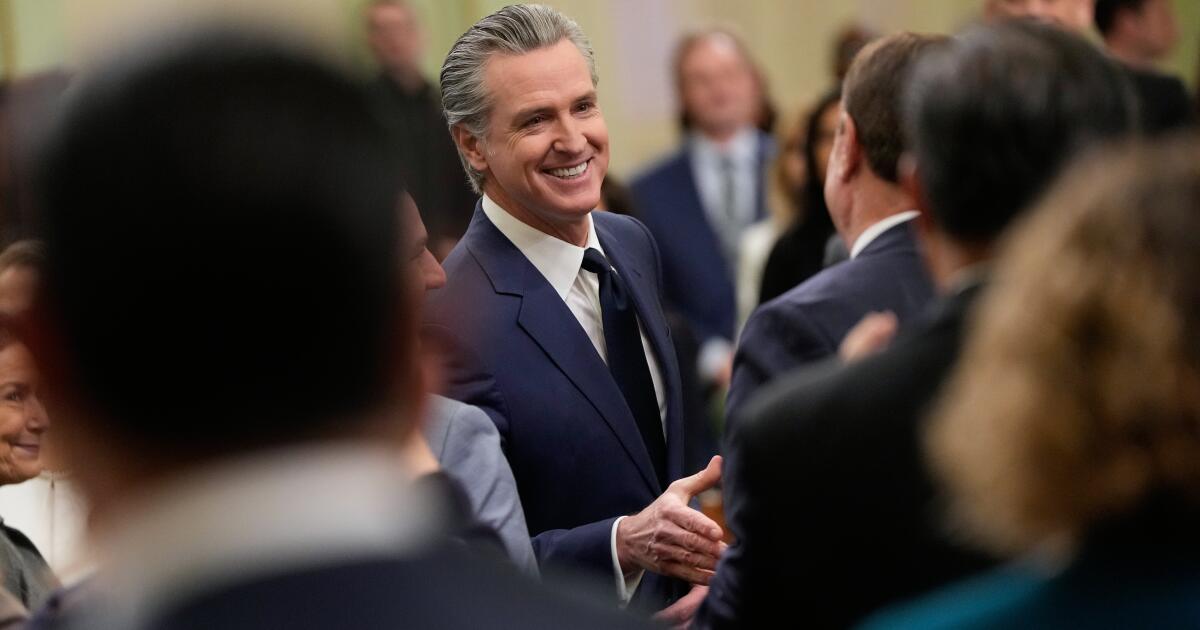
The address marked the first time in five years that Newsom delivered a State of the State from the Assembly rostrum. His last in-person address came shortly before COVID-19 shut down the Capitol in early 2020. As he entered the green-carpeted Assembly chambers, lawmakers stood to applaud, a few shaking his hand. Newsom addressed his absence, noting his longstanding hesitance to deliver such remarks because of his struggles with dyslexia.
“You know, I’m not shy or you know embarrassed about my 960 SAT score, but I am a little bit about my inability to read the written text and so it’s always been something that I have to work through and I’m confronting,” Newsom said while ad-libbing at the start of his speech and at times veering far off his prepared remarks.
Despite Newsom expressing discomfort, state Sen. Scott Wiener (D-San Francisco) said he was struck at how at ease the governor seemed.
“He was incredibly articulate and passionate, but it was relaxed and humble,” Wiener said. “It was a really effective presentation and a powerful speech.”
Before Newsom’s speech, the chamber held a moment of silence to honor Renee Nicole Good, a 37-year-old woman who was fatally shot by a federal immigration agent Wednesday in Minneapolis. Lawmakers also honored U.S. Rep. Doug LaMalfa (R-Richvale), who died Monday.
Newsom praised LaMalfa as a “wonderful human being” who didn’t play politics when it came to disaster funding. California has asked for nearly $34 billion in federal recovery aid following the Los Angeles County fires, but a year later, that request remains pending.
The governor praised firefighters who battled those fires, earning a standing ovation from the chamber. He then pointed to the Assembly gallery, recognizing victims of the Eaton and Palisades fires who were in attendance.
As in past speeches, Newsom touted the successes of California, now the world’s fourth-largest economy.
“California has never been about perfection,” Newsom said. “We’re about persistence, the courage of our convictions and the strength to embody them. That’s the California way and it lights the path for the rest of the world.”
Times staff writers Andrew Khouri and Howard Blume contributed to this report.