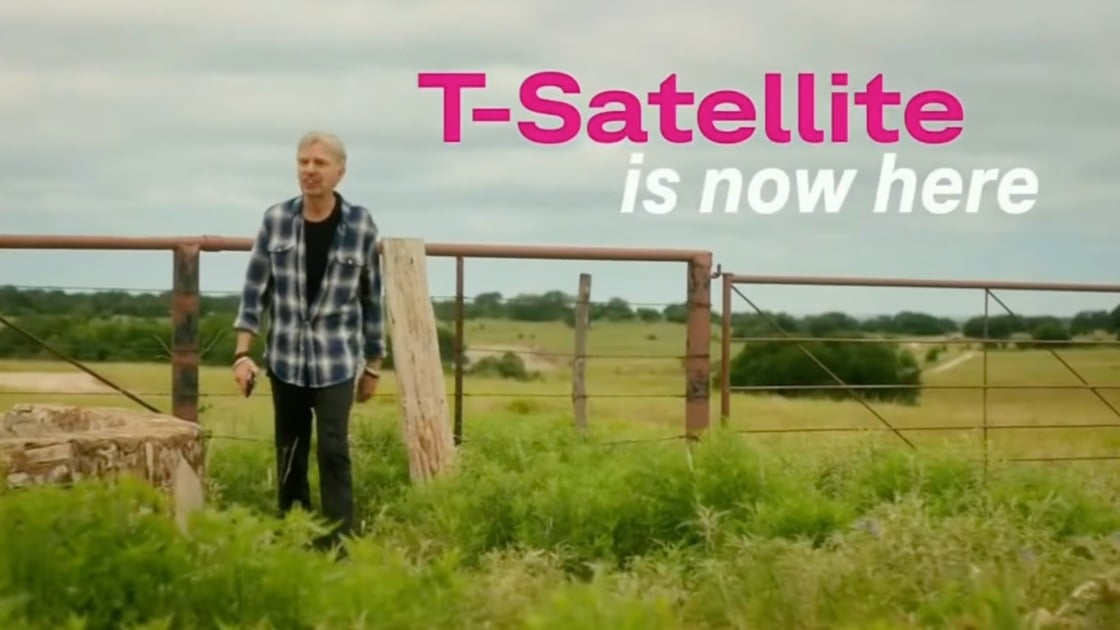
You may have spotted actor Billy Bob Thornton in TV commercials endorsing T-Mobile’s cellular Starlink service. But an industry regulator says the ads went too far when boasting about the satellite connectivity.
On Thursday, the National Advertising Division (NAD) indicated that some of the language in the commercials and T-Mobile’s press releases about the satellite connectivity were misleading.
The advertising division—part of an ad industry self-regulation system—took up the case after rival carrier AT&T filed a complaint about T-Mobile’s marketing. Some the language for T-Mobile’s implementation of SpaceX’s cellular Starlink, dubbed T-Satellite, implied it provided “100% coverage everywhere or everywhere the sky is visible,” the regulator said.
In press releases, T-Mobile also said, “If customers can see the sky, they’re connected [to T Satellite]” and “No matter where you are, you will never miss a moment.”
“NAD determined that these claims communicated universal coverage and cannot be properly qualified with a disclosure,” the regulator said.
We reached out to NAD to learn more, and the organization pointed to its final decision, which says, “T-Mobile acknowledged that T-Satellite service is not available in all geographic areas.”
T-Satellite is designed to only offer coverage in cellular dead zones, not major populated areas where the carrier has traditional cell towers. T-Satellite also isn’t offered in most of Alaska and certain pockets of the US, as the carrier’s coverage map shows.
To settle the dispute, T-Mobile wanted to add a disclaimer to the ads. But the regulator found “the challenged satellite claims cannot be properly qualified with a disclosure, since any such disclosure about geographic limitations would directly contradict the main claim that T-Satellite offers coverage no matter where you are or that it offers coverage if you can see the sky.”

Get Our Best Stories!
A Smart, Bold Take on the Wireless World

Sign up for the Fully Mobilized newsletter to get our top mobile stories delivered right to your inbox.
Sign up for the Fully Mobilized newsletter to get our top mobile stories delivered right to your inbox.
By clicking Sign Me Up, you confirm you are 16+ and agree to our Terms of Use and Privacy
Policy.
Thanks for signing up!
Your subscription has been confirmed. Keep an eye on your inbox!
The regulator also said advertisers should “exercise caution” when promoting satellite-to-phone services since they remain a new technology to many consumers. “Consumer understanding of the coverage limitations of traditional cellular service does not necessarily translate to an understanding of the limitations of brand-new satellite service,” the decision says.
(It’s also important to note that T-Satellite is an add-on service for most T-Mobile plans, requiring interested customers, including consumers on rival carriers, to pay $10 extra per month.)

(Credit: PCMag/Michael Kan)
Outside of satellite coverage claims, NAD also took issue with another T-Mobile promotional video that claimed both AT&T and Verizon announced price increases “a combined ten times in the past two years.” The advertising regulator found this to be false. It’s now recommending T-Mobile modify or discontinue the marketing language, including another claim that says the carrier’s “Experience Beyond” plan can offer $600 in extra value for a family of three.
Recommended by Our Editors
According to the advertising board, T-Mobile is appealing the decision, meaning the case will head to the National Advertising Review Board for a hearing.
In a statement, T-Mobile also told PCMag: “AT&T has meticulously orchestrated the vast majority of NAD challenges against T-Mobile referenced in their ads, and those challenges have resulted in almost no significant changes, underscoring a familiar pattern in which AT&T repeatedly disputes fact-based claims it does not like.”
“AT&T ads accusing us of being the most challenged is the height of hypocrisy from a company that is no stranger to seeing their ads removed,” T-Mobile added. “We support the NAD’s efforts and appreciate that it agrees with us on several important claims, though we categorically disagree with parts of the decision and will vigorously pursue an appeal. Our advertising reflects well-substantiated facts on the value we deliver from industry-leading savings to innovations like T-Satellite, which is redefining connectivity beyond traditional networks and setting a benchmark for the industry.”
The top US carriers have been scrutinizing each other’s ads concerning satellite-to-phone services. In 2024, the advertising regulator also flagged an AT&T ad featuring Ben Stiller about its satellite connectivity as misleading because the technology had yet to launch.
About Our Expert

Michael Kan
Senior Reporter
Experience
I’ve been a journalist for over 15 years. I got my start as a schools and cities reporter in Kansas City and joined PCMag in 2017, where I cover satellite internet services, cybersecurity, PC hardware, and more. I’m currently based in San Francisco, but previously spent over five years in China, covering the country’s technology sector.
Since 2020, I’ve covered the launch and explosive growth of SpaceX’s Starlink satellite internet service, writing 600+ stories on availability and feature launches, but also the regulatory battles over the expansion of satellite constellations, fights with rival providers like AST SpaceMobile and Amazon, and the effort to expand into satellite-based mobile service. I’ve combed through FCC filings for the latest news and driven to remote corners of California to test Starlink’s cellular service.
I also cover cyber threats, from ransomware gangs to the emergence of AI-based malware. Earlier this year, the FTC forced Avast to pay consumers $16.5 million for secretly harvesting and selling their personal information to third-party clients, as revealed in my joint investigation with Motherboard.
I also cover the PC graphics card market. Pandemic-era shortages led me to camp out in front of a Best Buy to get an RTX 3000. I’m now following how President Trump’s tariffs will affect the industry. I’m always eager to learn more, so please jump in the comments with feedback and send me tips.