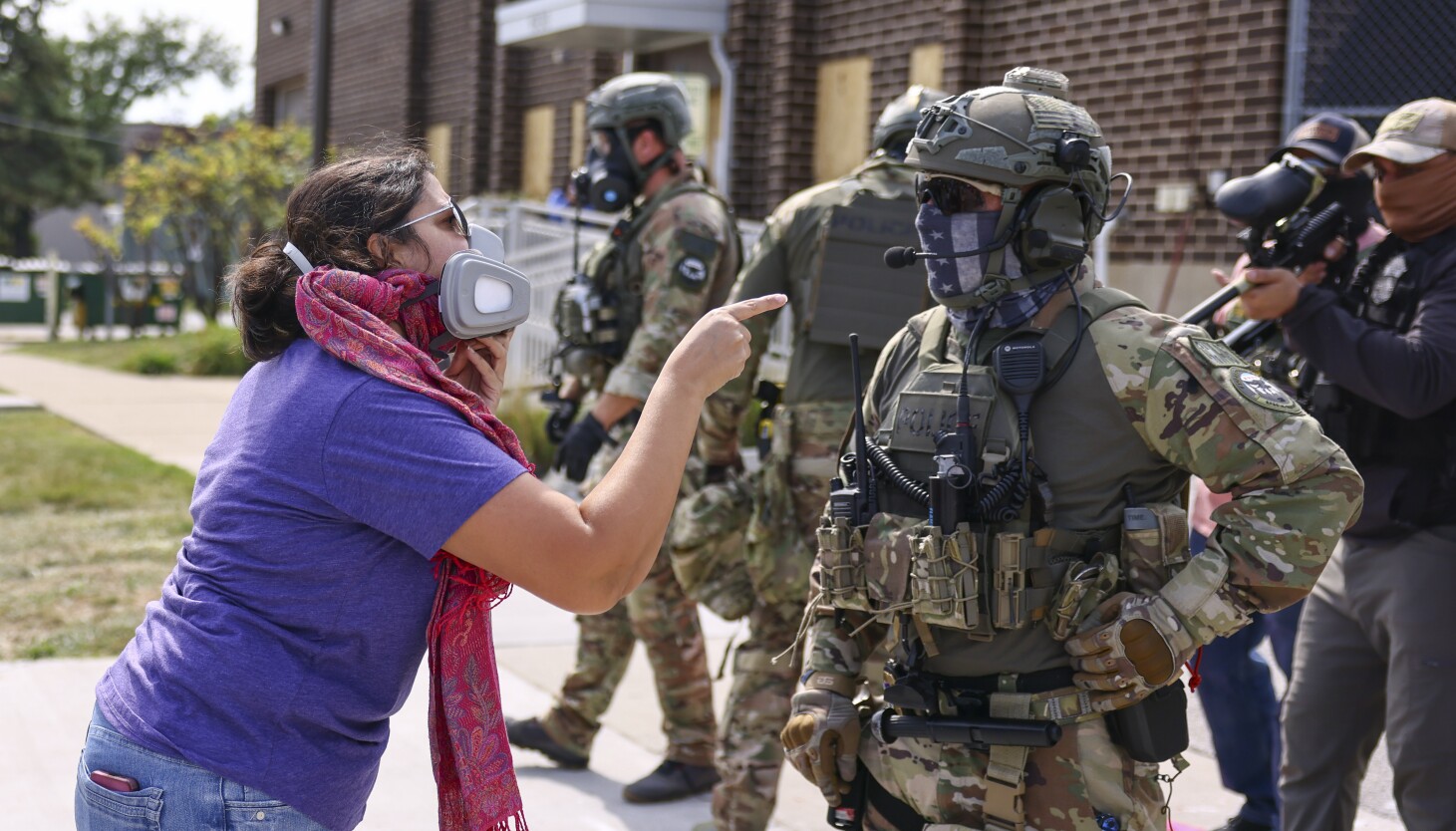
A federal judge in Chicago cited this week’s fatal shooting of Renee Nicole Macklin Good by an immigration officer in Minneapolis as she declined Thursday to immediately dismiss a lawsuit used to limit the feds’ use of force during similar deportation efforts in Chicago.
U.S. District Judge Sara Ellis was expected to formally end the case brought last fall by clergy, protesters and media organizations — who are now seeking its dismissal in an apparent strategic move.
The case culminated in November with an historic order by Ellis that restricted the feds’ use of tear gas, chokeholds and other measures.
But Ellis on Thursday cited her obligation to protect the class governed by that preliminary injunction and told lawyers she wants to do more research before closing the matter entirely. She told lawyers to return to her courtroom Jan. 22.
“It doesn’t give me much comfort, in reading news reports, that someone — who, in some news reports anyway, was described as a legal observer — was shot yesterday in Minneapolis,” Ellis told the lawyers during the hearing.
The class certified by Ellis includes anyone who “will in the future non-violently demonstrate, protest, observe, document, or record at Department of Homeland Security immigration enforcement and removal operations in the Northern District of Illinois.”
Sub-classes include people who will engage in religious expression there or gather and report the news there.
The plaintiffs in the case seem to be seeking its dismissal to avoid a three-judge panel from the 7th U.S. Circuit Court of Appeals that signaled plans to narrow Ellis’ order. Such a ruling could tie the hands of other lower-court judges, as well.
In the meantime, the appellate panel also put a hold on Ellis’ order, meaning it hasn’t been in effect for 50 days, and counting.
Still, plaintiffs’ lawyer Steven Art said after court that he and his team “don’t have any concerns” about what the judge might decide.
“The judge has an independent duty to the people within her jurisdiction to protect them and to protect their rights,” Art said.

Steve Art, attorney at Loevy & Loevy, (left) alongside Craig Futterman, Clinical Professor of Law at University of Chicago Law School, speaks about the judges no decision in a lawsuit challenging federal immigration enforcement actions in Chicago in the lobby of the Dirksen Federal Courthouse in the loop, Thursday, Jan. 8, 2026. | Anthony Vazquez/Sun-Times
Anthony Vazquez/Sun-Times
The Chicago Headline Club, Block Club Chicago and the Chicago Newspaper Guild — which represents journalists at the Chicago Sun-Times — are among the plaintiffs in the case.
Among the many legal setbacks experienced by the Trump administration at the Dirksen Federal Courthouse last fall, no case seemed to garner quite as much attention as the case before Ellis, who was named to the bench by President Barack Obama in 2013.
The judge famously read Carl Sandburg’s poem “Chicago” before handing down her preliminary injunction Nov. 6. The lawsuit became a vehicle for complaints about federal agents’ use of force, including the use of tear gas while children made their way to a Halloween parade.
Ellis also concluded that U.S. Border Patrol Cmdr. Gregory Bovino lied when he said he personally deployed tear gas in Little Village after nearly being hit in the head with a rock.
Federal officials have warned that “Operation Midway Blitz” is not over. Bovino wrote on social media last month that “we’re gonna be here for years.” And Justice Department lawyers have argued that a dismissal of the lawsuit could preclude future claims by class members.
Ellis has disagreed with that analysis.
Neither the reporter nor editors who worked on this story — including some represented by the Newspaper Guild — have been involved in the lawsuit described in this article.