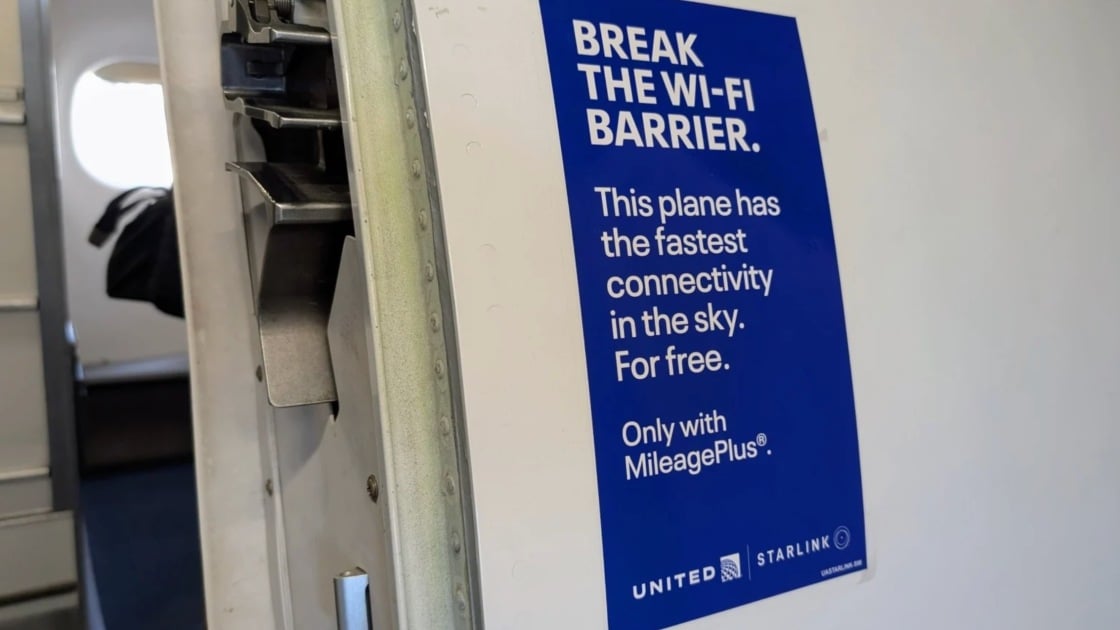
LAS VEGAS—As more airlines adopt Starlink for in-flight Wi-Fi, will that result in paid tiers for faster service? At CES, a SpaceX exec said he expects airlines to continue offering free access while exploring ways to commercialize in-flight Wi-Fi thanks to Starlink’s higher data capacity.
“It’ll be specific to each brand, some brands will handle it differently. But ultimately, free. Just like at home, or in any terrestrial internet experience, free products are generally the most profitable products,” Nick Seitz, global head of Starlink’s aviation business, said during a panel here.
Seitz noted that before joining SpaceX, he was an executive at T-Mobile, and “leading the charge on bringing free internet to the US passenger.”

Nike Seitz (center) (Credit: Michael Kan/PCMag)
“If you’re not paying for the product, you’re probably the product. So, I think ultimately you’ll see a lot of airlines move into that direction,” he said.
However, Seitz indicated that low-cost and ultra-low cost airlines could charge for in-flight Wi-Fi to make up for the cost of adopting Starlink. For commercial airliners, that can easily soar into the millions, depending on the fleet size.
A representative for Air France who appeared on the CES panel with Seitz agreed with the free approach. “If you’re a premium airline, you have to offer free…best in-class Wi-Fi,” said Alexandre Groshenny, head of Inflight Connectivity at Air France, which is also adopting Starlink.
Recent testing has found that Starlink-powered in-flight Wi-Fi is exceptionally fast compared with other satellite internet providers. On a United Airlines jet last year, the Starlink access we saw averaged at around 100Mbps.

Get Our Best Stories!
Your Daily Dose of Our Top Tech News

Sign up for our What’s New Now newsletter to receive the latest news, best new products, and expert advice from the editors of PCMag.
Sign up for our What’s New Now newsletter to receive the latest news, best new products, and expert advice from the editors of PCMag.
By clicking Sign Me Up, you confirm you are 16+ and agree to our Terms of Use and Privacy
Policy.
Thanks for signing up!
Your subscription has been confirmed. Keep an eye on your inbox!

(Credit: Rob Pegoraro/PCMag)
The catch is that need to join United Airlines’s free loyalty program to access Starlink, which is currently available only on select flights. The stronger internet access also means the company can monetize it like ground-based broadband. Case in point: the airline will show ads during the login process as the company works to personalize the commercials to each passenger.
“I would say that personalization is the holy grail of commercialization,” Seitz said. “For an advertiser, they want to know who exactly it is sitting in that seat, and who they’re advertising to.
Recommended by Our Editors
“It’s probably no secret: Airlines would love to have better economics in every aspect of their business,” he added. “It’ll make the industry healthier overall. So I think the [Starlink] technology is going to underpin the ability to personalize the journey throughout every element, I think it even starts pre-flight.”
Seitz did not outline company’s roadmap for improving Starlink in-flight Wi-Fi. But he noted that passengers want the same Wi-Fi experience they have at home.
“They watch TV, they have it on their phones. It’s a multi-screen environment. And in those environments, you really do need a gigabit-level connectivity because you’re connecting hundreds of screens, seat-back screens, and hundreds of passenger devices,” he said.
“So I think these experiences are evolving quite quickly,” he added. “The more we can do to connect the sit-back screen with their device, and allow casting and allow for the streaming content that they want the most on those screens, the happier people will be.”
About Our Expert

Michael Kan
Senior Reporter
Experience
I’ve been a journalist for over 15 years. I got my start as a schools and cities reporter in Kansas City and joined PCMag in 2017, where I cover satellite internet services, cybersecurity, PC hardware, and more. I’m currently based in San Francisco, but previously spent over five years in China, covering the country’s technology sector.
Since 2020, I’ve covered the launch and explosive growth of SpaceX’s Starlink satellite internet service, writing 600+ stories on availability and feature launches, but also the regulatory battles over the expansion of satellite constellations, fights with rival providers like AST SpaceMobile and Amazon, and the effort to expand into satellite-based mobile service. I’ve combed through FCC filings for the latest news and driven to remote corners of California to test Starlink’s cellular service.
I also cover cyber threats, from ransomware gangs to the emergence of AI-based malware. Earlier this year, the FTC forced Avast to pay consumers $16.5 million for secretly harvesting and selling their personal information to third-party clients, as revealed in my joint investigation with Motherboard.
I also cover the PC graphics card market. Pandemic-era shortages led me to camp out in front of a Best Buy to get an RTX 3000. I’m now following how President Trump’s tariffs will affect the industry. I’m always eager to learn more, so please jump in the comments with feedback and send me tips.