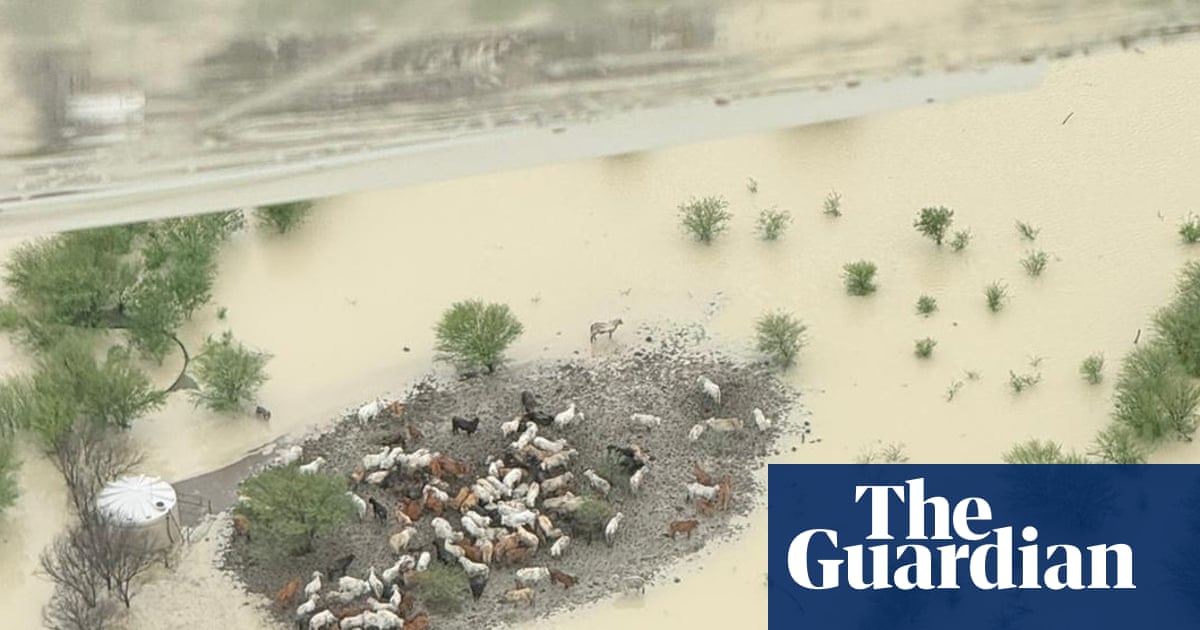
Stranded upon sodden islands that dot the submerged plains of outback north-west Queensland, encircled by fresh water and with grass growing before their eyes, tens of thousands of cattle are dying of thirst and hunger.
“It sounds completely absurd,” grazier Angus Propsting says. “But they are actually perishing because they are not drinking, even though they are surrounded by water.”
Some of the famished cattle look upon grass tens of metres from where they perch.
“But if there is a body of water between them, they will starve themselves before they will walk back through any water,” the 31-year-old cattleman says. “They are not leaving their little islands, they are just starving themselves to death. It is like they have given up – or they are too fearful to leave.”
Sign up: AU Breaking News email
The water is not too deep for the cattle to wade through on these rolling downs and timbered, sandy hills at the headwaters of Queensland’s longest river, the Flinders. It is fresh rainwater. There are no crocodiles on Propsting’s station, about 40km north-east of Richmond, a town that sits more or less halfway between the inland mining city of Mount Isa and Townsville.
“It makes no sense,” Propsting says of the Brahman and Droughtmasters’ refusal to drink or enter the water.
“No one knows why,” he says. “They are a bit shell-shocked, I suppose. Fearful of the mud and water”.
This is not the first time the phenomenon has been observed. It happened in 2019, Propsting says – “the exact same thing”.
Then half a million head of cattle and sheep drowned, starved and died of cold and illness in flooding that inundated 11.4m hectares of grazing country in the state’s north-west.
On Thursday, as blue skies gloried above much of the waterlogged outback for the third consecutive day, many graziers were beginning to take stock of their losses and preparing to head out on buggies and dirt bikes to coax cattle to fodder and water troughs – beasts so utterly dispirited they could no longer be driven by helicopter.
Flooding in Maxwelton, just west of Richmond, on the Flinders Highway. Photograph: John Wharton
Tens of thousands of stock are estimated to have died in the weeks of rain since Christmas but the Richmond shire mayor, John Wharton, reckons the estimate is conservative.
“There won’t be the losses of ’19, because this is more isolated,” he says. “I would hazard a guess, probably 100,000 [dead cattle]. They are talking 16,000 – well, some of those big properties up in the Gulf will lose that many just themselves”.
But the councillor of 35 years and mayor since 1997 says it could take up to five months before the scale of the devastation is known – all the fences have been washed away, he says, cattle swept down rivers on to different properties.
In the meantime, as the frantic work of saving as many head of cattle as possible begins in earnest, it is not just the livestock in danger of shell shock.
“People are very mentally stressed and traumatised,” Wharton says. “It does have an effect on you, that’s for sure”.
As water recedes, and they see “more and more bodies” emerge from the muck, Propsting says, everyone is left “a bit mute and confused”.
Cattle in flood water on a station near Julia Creek. Photograph: Cody Rogers
But, he stresses, he is comparatively fortunate. His land is full of red and sandy hills that drain and provide high ground. Farther west, on the “dead flat black soil plains” around Julia Creek, he says, the water rises half a metre “and the whole lot has gone under”.
“I’m sort of at the very start of where all this trauma is,” he says.
Guy Keats runs Beefmaster across those drowned plains.
“This country here just floods straight across it and they’re all standing in water,” he says of his cattle. “They’ve been standing in water for a week – we’re losing them. We’re losing a lot of calves.”
It is all “fairly exhausting and sickening”, he says – “and it’s too close to 2019”.
“I’m doing what I can,” he says. “Flying around and shooting them … I’m just about at the end of it, you know?”
While some are nearing the end of their tether, the work of recovery is only beginning – the danger not yet passed.
Trouble on the horizon
North of Julia Creek, Cody Rogers says, the Flinders River “keeps getting bigger and bigger”.
“Just three or four inches of water but it is just spreading and spreading, just creeping out further and further,” the grazier says. “The cattle we thought were safe – now they’re not”.
Rogers says he sank knee-deep in mud following cattle.
“The black soil mud here, it’s just like a slurry, almost, in places,” he says. “There’s no hard bottom. It is just so tiring for everything trying to walk through it, man and beast”.
The cattle, he says, are physically weak – mentally “they’re traumatised”.
“The best way I can explain it is: go and put a pair of jeans on and tape up the bottom and fill it with sand,” he says. “Try and walk around with just heavy, heavy legs for days and days and days on end. That is what they are trying to put up with, poor buggers. It’s horrible.”
And despite the blue skies, storm clouds gather beyond the horizon.
The Bureau of Meteorology is forecasting a tropical low over the Coral Sea will begin to move towards the north-east coast over coming days – with the potential to form a cyclone. The heavy rain it will bring is expected to move inland over the weekend.
If heavy rain hits soaked catchments, Keats fears flooding as devastating as that of seven years ago.
“At the beginning of next week, they are talking about it raining at the top of the system,” the cattleman says. “And, if it does that, it’ll be a bloody disaster”.