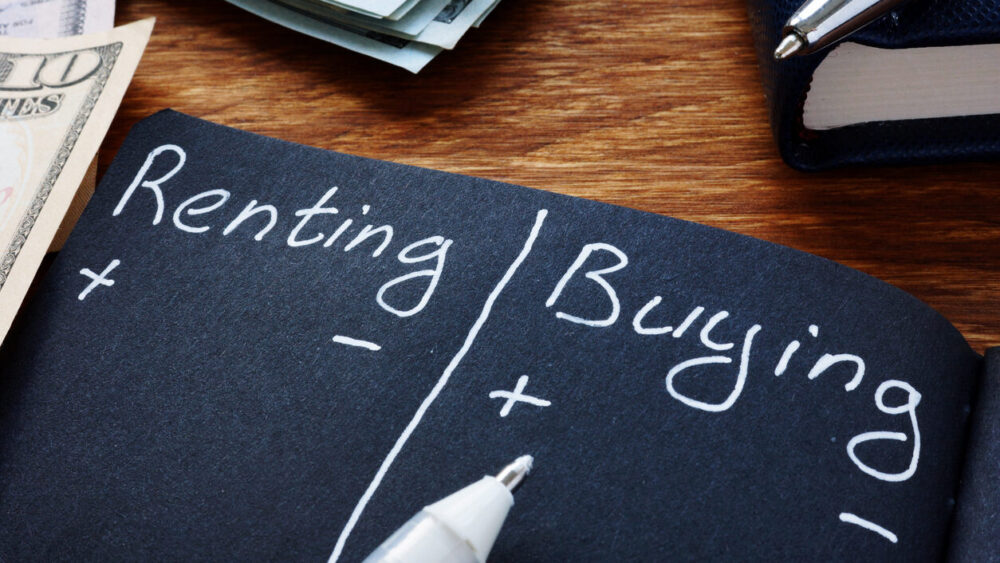
Deciding whether to rent or buy a home is one of the most important financial and lifestyle choices many people will ever make. It’s a decision that goes far beyond monthly payments and square footage — it also involves long-term economic health, flexibility, stability and personal goals.
There’s no one-size-fits-all answer but understanding the advantages and challenges of each option can help you move forward with confidence. And Vikki Gorman of Fathom Realty – a Rosie on the House Certified Partner – is here to help explain.
The case for buying a home
For many Americans, homeownership represents stability, pride and long-term financial opportunity. According to the National Association of Realtors, there are several core benefits to owning a home, beginning with appreciation. Real estate has shown steady, long-term growth. In fact, data shows that the median home price rose from $172,900 in the fourth quarter of 2000 to $417,700 in the fourth quarter of 2023. Of course, the economy determines how well a home’s value appreciates. Those who own their home during a period of inflation will see their equity rise.
The Rosie on the House Team is very pro homeownership and says, “Appreciation has historically been one of the best arguments for buying a home. There are pockets of residential real estate that have seen their values double in the last 5-6 years. That kind of jump can represent a substantial percentage of your net worth. You can’t count on that kind of appreciation continuously but, in America over the past 100 years through the peaks and valleys of our economy, homeownership has proven itself an overall positive performer.”
Gorman agrees, “Historically, real estate has had long-term, stable growth in value and served as a good hedge against inflation. This appreciation can significantly increase a homeowner’s net worth over time, especially for those who stay in their homes for several years.”
Another advantage is equity. Unlike rent, which offers no financial return, mortgage payments gradually increase your ownership stake in the property.
“Money paid for rent is money that you’ll never see again,” Gorman said, “But paying your mortgage month over month and year over year lets you build equity ownership in your home.”
That equity can later be leveraged for renovations, future purchases or financial security in retirement. Tax benefits also play a role. Homeowners who itemize deductions may be able to deduct mortgage interest and property taxes, and many sellers can exclude a significant portion of their home-sale profit from capital gains taxes. While tax rules vary and should always be discussed with a professional, these incentives can add meaningful long-term value.
Beyond finances, homeownership offers predictability and control. Fixed-rate mortgages create stability, protecting homeowners from rising rents. Over time, housing costs could become more manageable relative to income. There’s also the personal satisfaction of ownership: the freedom to renovate, decorate and truly make a space your own.
“Remaining in one neighborhood for several years allows you and your family time to build long-lasting relationships within the community,” Gorman said.
That sense of belonging can be just as valuable as any financial return.
…on the flip side…
Buying a home is not without challenges. The upfront costs alone can be daunting. Down payments, closing costs, inspections and moving expenses often require a significant amount of cash before you even receive the keys.
Ongoing costs are another consideration. Property taxes, homeowners’ insurance, maintenance and unexpected repairs can strain even well-planned budgets. Unlike renting, where a landlord typically handles maintenance, homeowners are responsible for everything from replacing a water heater to repairing a roof.
There’s also market risk. Gorman said that home values can fluctuate, and while real estate tends to appreciate over time, short-term dips can make selling difficult or lead to losses if you need to move quickly.
“Homeownership can create an emotional attachment to a property, making it harder to sell or move when necessary,” Gorman said. “This emotional investment can complicate decisions about relocation or downsizing.”
Why renting is still a good option
On the other hand, renting offers flexibility and simplicity that appeals to many people, especially those who value mobility or are still determining long-term plans. Renters typically face lower upfront costs, usually limited to a security deposit and the first month’s rent. Maintenance and repairs are handled by an owner or landlord, eliminating surprise expenses.
“Renting typically requires a security deposit and the first month’s rent, which is significantly less than the down payment and closing costs associated with buying a home,” Gorman said.
This can free up cash for savings, travel or other financial goals.
There’s also lifestyle flexibility. Moving for a new job, downsizing or relocating to a different city is far easier without the responsibility of selling a home. For people early in their careers, those unsure of where they want to settle or those who value flexibility, renting can be the right fit.
Downsides include no equity and rent increases can create financial uncertainty. There may also be restrictions on children, pets, renovations or personalization. Still, for many, the trade-off is worth it for freedom and lower commitment.
Consider the Arizona market
In Arizona specifically, the rent-versus-buy decision depends heavily on location and timing. In areas like Phoenix, Scottsdale and Tempe, renting often remains more affordable month to month than buying, especially when factoring in taxes and maintenance. At the same time, parts of the state are seeing more balanced market conditions, giving buyers greater negotiating power than in recent years.
According to Gorman, in Phoenix apartment rents typically range from about $1,300 to $2,000+ per month depending on size and location, while purchasing a median-priced home around $450,000 often results in mortgage payments of roughly $2,200 to $2,500+ per month before property taxes, insurance, maintenance and other ongoing expenses.
“In Scottsdale, the gap is even more pronounced: average rents commonly exceed $2,000 per month, with many three-bedroom rentals over $3,000. Buying a home at an average value near $825,000 typically carries a significantly higher monthly obligation once mortgage and ownership costs are included,” Gorman said. “Mesa and Tucson offer more accessible entry points, and Phoenix sits in the middle with broad appeal across buyer profiles.”
For qualified buyers in late 2025, Arizona represented a uniquely balanced opportunity: growing inventory and steadier pricing enhance negotiation power, long-term economic and population growth support demand and relative affordability remains compelling compared with higher-cost coastal states.
“That said, local market dynamics matter. Micro-market analysis using current comps and forecasts is essential to identifying the best opportunities,” Gorman added.
Making the right choice
For someone deciding whether to rent or buy in Arizona’s current housing market, Gorman said the most practical advice is to anchor the decision in time horizon, cash flow and lifestyle flexibility, rather than trying to time the market.
Renting often makes sense if you value short-term flexibility, want lower upfront costs or expect to move within the next two to three years, since rents are typically lower than the full monthly cost of ownership once mortgage, taxes, insurance and maintenance are included.
Buying, on the other hand, tends to be better suited for those with stable income, sufficient savings for a down payment and reserves and plans to stay put for several years, as ownership allows you to build equity, benefit from long-term appreciation and lock in housing costs with a fixed-rate loan.
Ultimately, the right choice depends less on headlines and more on whether you prioritize short-term affordability and flexibility (renting) or long-term wealth building and stability (buying), aligned with your personal finances and future.
