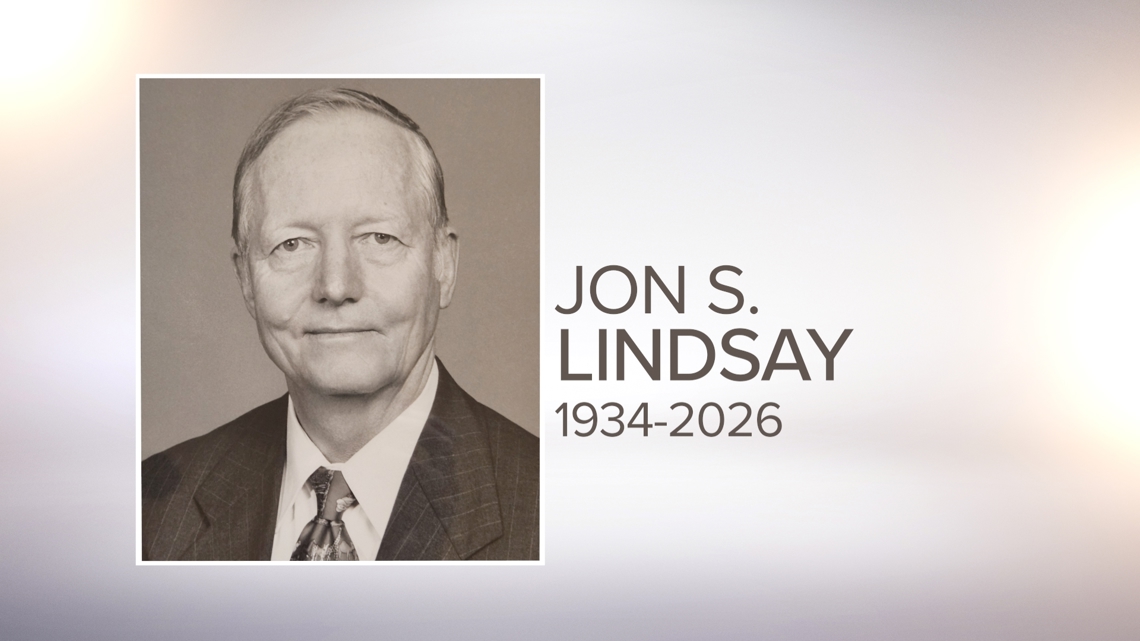
Former Harris County Judge Jon Lindsay has died at 91, leaving behind a legacy that reshaped Houston’s transportation, health care, and flood control systems.
HOUSTON — Former Harris County Judge Jon Stephen Lindsay died Wednesday, according to his son. He was 91.
Lindsay was a towering figure in Harris County and Texas politics, known for blending his engineering background with public service to reshape transportation, health care and flood control across the Houston region.
Early life and engineering background
According to the Harris County Archives, Lindsay was born Dec. 4, 1935, in Santa Fe, New Mexico. He earned a Bachelor of Science degree in civil engineering from New Mexico State University in 1959.
Lindsay served three years as an Air Force officer at James Connally Air Force Base in Waco, Texas, before moving to Houston in 1962, where he formed his own construction company, according to county archives.
Longest-serving Harris County judge
Lindsay was elected Harris County judge in 1974 after running as a Republican against incumbent Democrat Bill Elliott, according to county archives. He went on to serve 20 years, becoming the longest-serving county judge in local history.
According to the archives, Lindsay was widely known as a strong administrator who applied his engineering background to large-scale public projects. His work included the construction of the Harris County Toll Road system, the Sam Houston and Hardy Toll Roads, LBJ Hospital and Ben Taub Hospital, jail and juvenile detention facilities, a joint state and county psychiatric facility, and multiple flood control projects.
The archives also note that Lindsay supported increased funding for Child Protective Services and flood control and led Harris County’s approach to the AIDS crisis.
In 1986, the Texas Society of Professional Engineers named Lindsay “Engineer of the Year,” citing his foresight and leadership in the development of the Sam Houston and Hardy Toll Roads, according to Harris County Archives records.
Texas Senate service
Lindsay announced on Aug. 1, 1993, that he would not seek re-election as county judge.
He was elected to the Texas Senate in 1996, representing District 7, which covered the northern portion of Harris County. He served for 10 years and chose not to run for re-election in 2006.
During his time in the Legislature, the archives note that Lindsay served on the Intergovernmental Relations, Natural Resources, Health and Human Services, and Nominations committees.
A biography from New Mexico State University adds that while serving as a state senator, Lindsay helped drive the initiative to create freight rail districts with domain authority and the ability to issue bonds.
Transportation legacy and later leadership
According to the New Mexico State University biography, Lindsay was inducted into the Texas Transportation Hall of Honor in October 2011 for his role in creating the Texas Toll Authority in 1983.
Lindsay is also credited with guiding the Harris County Toll Road Authority from its early development through implementation of the roadway system. He also helped create park and flood systems along major bayous in the Houston area.
According to NMSU, Lindsay later served as president of the North Houston Association, a nonprofit organization focused on improving quality of life through collaboration between government and business. He also led efforts to defend the Astrodome through a proposed $217 million bond issue after the structure was placed on the National Trust for Historic Preservation’s list of “11 Most Endangered Historical Places.”
Personal life
Lindsay was married to Tony Lindsay, who served as judge of the 280th Civil District from 1989 to 2009.
Lindsay was an Air Force veteran, remained active in ranching, and had three sons, all of whom graduated from Texas A&M University with engineering degrees.
Much of the infrastructure that defines modern Harris County, from toll roads to hospitals and flood control systems, reflects projects Lindsay initiated or guided during decades of public service, according to historical records.