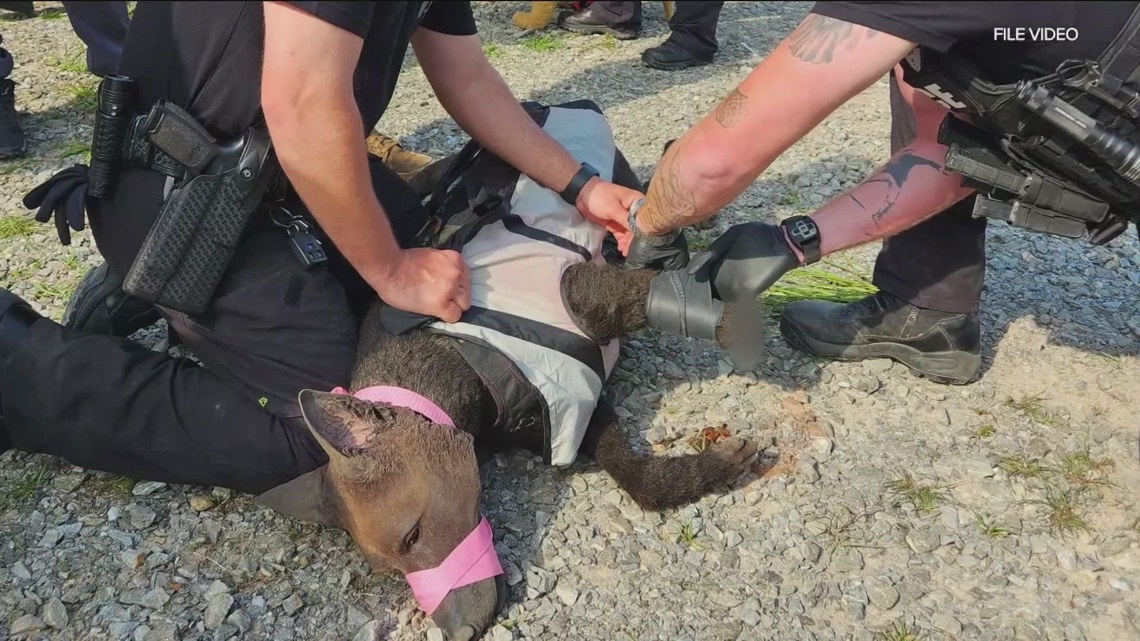
A lifelike K-9 simulator and emergency medical training are preparing officers for worst-case scenarios.
SAN DIEGO — Law enforcement K-9s are often the first through the door and the last to back down, but when they’re injured in the line of duty, every second matters. That urgency was on full display during a specialized K-9 medical training held in downtown San Diego, bringing together officers from across Southern California to learn how to save their four-legged partners.
At the center of the training was “Diesel,” a highly realistic K-9 medical simulator designed to replicate the kinds of emergencies handlers may face in the field. Diesel can breathe, bark, bleed and even simulate severe injuries, including amputations, allowing officers to practice treating life-threatening wounds under pressure.
“He is a SWAT-quality, military-grade training simulator of a dog,” said Mitzi Nash with Irondog K9 International.
K9 Medic, a company focused on emergency medical care for working dogs, led the training for ten K-9 handler teams from agencies across the region.
“Our mission is to provide the same level of care to our K-9 partners in a pre-hospital environment that we would provide to our human partners,” said Joy Brenner, executive director and founder of K9 Medic.
Brenner says the training is intensive and hands-on, designed to build real-world skills rather than relying on classroom instruction. Handlers practiced everything from controlling severe bleeding and treating chest injuries to responding to toxin exposure and heat illness, one of the leading causes of preventable K-9 deaths.
“We make sure handlers have all of the skills in muscle memory, not just PowerPoint, to be prepared to deal with any kind of challenges and life threats they face in the field,” Brenner said.
The training was organized, funded, and sponsored by Irondog K9 International, a nonprofit organization that also donated specialized first aid kits to each K-9 team. The kits are designed to treat both the handler and the dog and include pressure dressings, tourniquets, hemostatic gauze and chest seals.
“We have a chest seal that works on dogs and people, and that’s for any chest injuries, any holes in the chest,” Brenner said.
Nash says the investment reflects how vital K-9s are to public safety.
“The dogs have a lot of responsibility in the community,” she said. “They’re really there for the safety of the public.”
Organizers say the training is critical because when a K-9 is injured in the field, a medic or veterinarian is not always immediately available.
“It’s really up to the handler and any medics we can get into that training to provide that life-support care between the point of injury and the time it takes to get to definitive care at a veterinary hospital,” Brenner said.
For the officers taking part, the message is simple: K-9s aren’t just tools — they’re trusted partners. And this training is about making sure they all make it home safely.