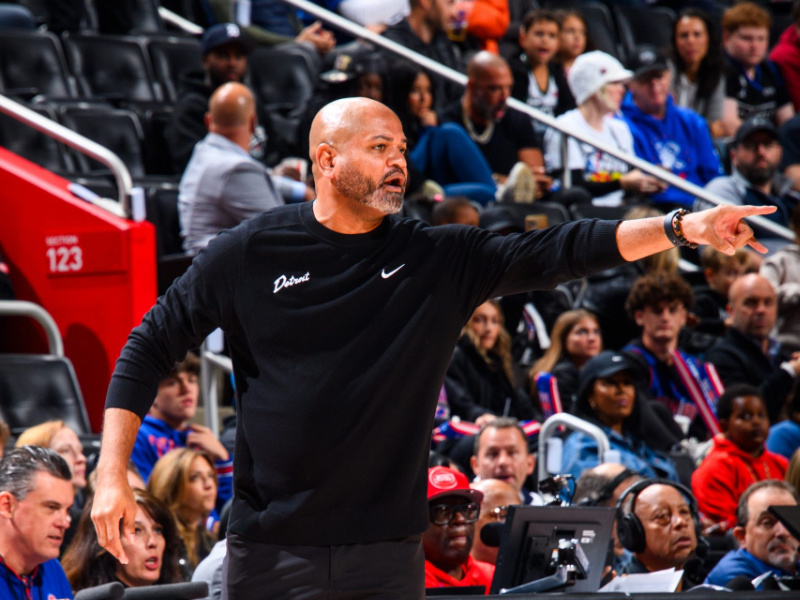
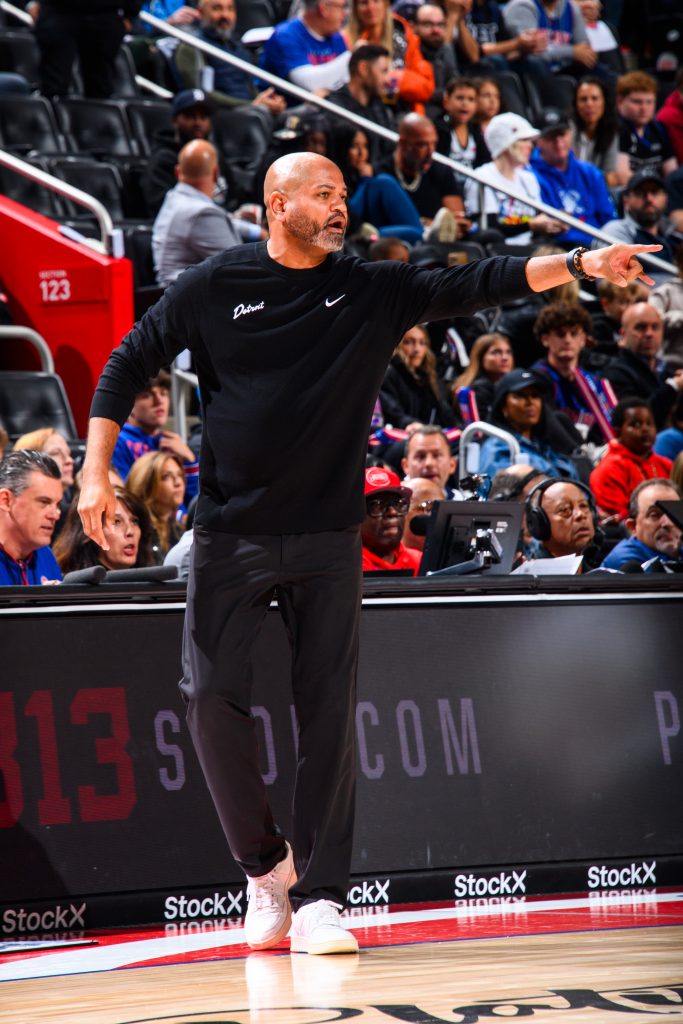
 J.B. Bickerstaff coaches the Pistons to a 135-116 victory over the Orlando Magic on Oct. 29, 2025, at Little Caesars Arena. // Courtesy of Detroit Pistons
Every team wants to earn a place in the history books — but none want to do it the way the 2023-24 Detroit Pistons did. Finishing the season with a 14-68 record, including a record-tying 28-game losing streak, put the Pistons in the ranks for one of the worst seasons in NBA history.
Seasons change, and with that comes roster moves and coaching staff shake-ups. To little surprise, the Pistons fired head coach Monty Williams in June 2024. But their pick to replace him surprised many fans and experts around the league.
Enter J.B. Bickerstaff.
Amid a pool of rumored candidates, including New Orleans Pelicans assistant coach James Borrego and Miami Heat assistant coach Chris Quinn, the former Cleveland Cavaliers head coach came out on top. Handpicked by newly minted president of basketball operations Trajan Langdon, Bickerstaff had a strong track record of being a culture changer and a true “players’ coach.”
Caris LeVert, who played two and a half seasons under Bickerstaff in Cleveland before joining the Pistons this season, credits the coach with molding him into the player he is today.
“Before I went to Cleveland and played under J.B., I was a different player, and I think he challenged me to be the more well-rounded player I am today, so I’m definitely looking forward to this time around,” LeVert said in a July 2025 press conference.
A young, inexperienced Pistons team needed a lighthouse to guide them out of the dark, and it seemed they had found their guy.
Coaching is in Bickerstaff’s blood. His father, Bernie Bickerstaff, is a 10-year head coaching veteran, who also spent time as an assistant coach for the Cavaliers in 2013-14. During his father’s stint with the Seattle SuperSonics, J.B. was a ball boy for the Sonics, so to say that he was exposed to the game from an early age is an understatement. J.B. inherited more than just his father’s love of the game — he shares many of the same coaching philosophies, most notably the importance of creating a locker room built on mutual respect and accountability.
In an interview with Hour Detroit, Bickerstaff discussed the lessons he learned from his father about how to be a successful coach and, more importantly, a great man.
“He uplifted people and told people the hard truths, even when they might not want to hear it,” Bickerstaff says. “He cared about the people he worked with in the way that he built long, lasting relationships with guys I still consider to be my older brothers.”
That mindset is infectious and trickled down to the rest of the team. The following season, they made history again — this time for something worth celebrating.
The 2024-25 Pistons finished the regular season 44-38, becoming the first team to triple their win count in one season. It was clear that the culture had shifted, and while Bickerstaff was the catalyst, the change didn’t stop there.
In desperate need of playoff experience, the Pistons added Tobias Harris, Malik Beasley, Dennis Schröder, and Tim Hardaway Jr. to their young roster. These additions, specifically Beasley, provided fourth-year guard Cade Cunningham with much-needed shooting support, giving him room to come into his own and grow into the leader the first-round pick was drafted to be.
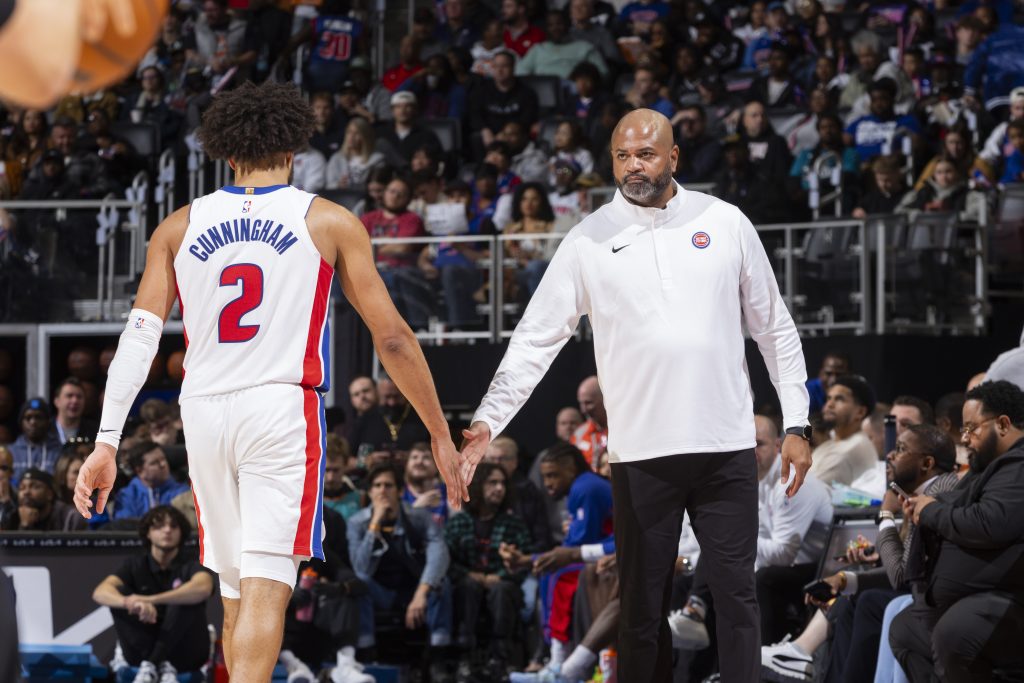 On Dec. 2, Cunningham and Bickerstaff were awarded Eastern Conference Player of the Month and Eastern Conference Coach of the Month, respectively. // Courtesy of Detroit Pistons
Bickerstaff has high praise for the All-Star point guard.
“When your best player has the character that Cade has, it makes everybody else’s job easier,” Bickerstaff says. “He is capable of being a superstar, but he doesn’t see himself any differently than another one of the guys on the team. Cade can continue to grow while not taking anything away from the people around him.”
At the core of this turnaround was young draft talent. With Cunningham at the helm, Isaiah Stewart, Jalen Duren, and Jaden Ivey filed in behind and provided a much-needed spark to the lineup. These four were there for the 14-win season. They knew what losing 28 games in a row felt like and came into the 2024-25 season prepared to never feel that again.
After losing the first four games of the season, the Pistons soon found their groove, snapping an eight-game losing streak to the Philadelphia 76ers on the road. That was the last time they would lose more than three games in a row for the rest of the season.
This was a new Pistons team, one not defined by past failures but optimistic for a brighter future. By Jan. 1, 2025, just three months into the season, the Pistons had already surpassed their total number of wins in 2023-24. Despite Ivey’s season-ending injury on Jan. 1, February saw an eight-game winning streak that helped propel the Pistons to their first playoff appearance since 2019. It took just two games before they snapped a 17-year playoff win drought, smothering a Knicks comeback to win 100-94 at Madison Square Garden. Although the team would ultimately fall short, losing six games, many still considered it a miracle season with an unceremonious end but lots to be proud of.
The series gave Pistons fans hope — something they had long learned to do without. It showed that all those years of disappointment were not for nothing. The Pistons never lost faith in their draft picks and continued to trust the decision-making of a fresh Detroit head coach and a green president of basketball operations. And they were rewarded for that trust.
While the 2025-26 season is still in its infancy, it looks as though the faithful will keep being rewarded. At press time, the Pistons just came off a franchise-record-tying 13-game winning streak, boasting an Eastern Conference-best 16-4 record. It’s the way the Pistons are winning that makes this feat even more impressive. Plagued by injuries to top performers like Cunningham, Ivey, Stewart, Harris, Ausar Thompson, and Marcus Sasser, the Pistons have had to dig deep into their roster to earn these wins. Turning to guys like Daniss Jenkins, Javonte Green, and Paul Reed off the bench, the team has found a gear it wouldn’t have discovered without adversity.
For other lesser-coached teams, these setbacks could spell disaster. Thankfully, the Pistons are not one of those teams. Their success is a result of a whole-unit effort, but the tone Bickerstaff has set is what allows them to continue winning. They’re playing their own brand of basketball, and it’s paying off. It’s the kind of identity that a franchise can build legacies on, and the culture only seems to be getting stronger. Last season was no flash in the pan: The ethos and grit that defined the 2024-25 team is here to stay.
As for what Bickerstaff believes the Pistons need to do to succeed in the postseason, the answer is simple. “We’re about the process, and the process is every single day,” Bickerstaff says. “What are we doing every day to get to where we want to be in June? You don’t get to skip those steps. You don’t get to just show up in June and expect everything to be perfect, and I think that’s what our guys have understood.”
The NBA is better when the Pistons are good, and right now they’re great. It’s a long season, with plenty of time for more obstacles to come their way, but one thing’s for sure — “Deeeeee-troit basketball!” is back.
This story originally appeared in the January 2026 issue of Hour Detroit magazine. To read more, pick up a copy of Hour Detroit at a local retail outlet. Click here to get our digital edition.