My first tattoo was a 21st birthday present to myself, and I couldn’t tell you what it was.
I was backpacking up the east coast of Australia and heard about a Sydney artist who would take a tab of acid, chat to you for a bit, then draw something he thought captured your aura.
It was the 90s, and I hadn’t yet decided if I was a grungehead or a New Age type, so a tattoo of a vaguely mystical symbol that looked a bit like a spiral and a bit like a star seemed spot on.
Back then, it was still a bit edgy to get inked.
Only about one in 10 Australians – 11.9% of men and 8.5% of women – had a tattoo. According to research by McCrindle, by 2023 30% of Australians were inked, and women have overtaken men – 33% of women have at least one, compared with 26% of men.
Once someone gets their first piece, they tend to keep adding to their collection. More than a third of those with tattoos have five or more. About one in four (26%) stop at just one, while 19% have two, 12% have three, and 9% have four.
“Once you break that first barrier, it’s much less scary,” Paige Klimentou says.
Klimentou is an expert in hardcore music and tattooing from RMIT University who also works at the front counter of Melbourne’s oldest tattoo studio, Vic Market Tattoo.
She describes herself as “moderately to heavily tattooed”.
“For some people it is very much an adrenaline thing … it’s a collectible thing,” she says.
“They may really agonise over that first tattoo, but once they’re on their third they’re like, ‘oh, I just saw a funny bird’.”
People talk about their “collecting” as an addiction, or a compulsion.
The Australian & New Zealand Mental Health Association says there is no proof you can get hooked on ink in the same way you might with drugs, but you can get a rush of adrenaline and endorphins that ameliorate the impact of the pain and keep people coming back.
From cavemen to convicts to cover-ups
Tattoos date back thousands of years to the markings found on Ötzi the iceman, Gebelein Man A’s bull and sheep figures, and the Chinchorro mummy’s moustache.
There are tribal tattoos, sacred tattoos, tattoos to indicate status, power and ownership.
The scarification practices of Aboriginal and Torres Strait Islanders can be considered tattoo-adjacent – the Australian Museum says “each deliberately placed scar tells a story of pain, endurance, identity, status, beauty, courage, sorrow or grief”.
Convicts sent to Australia commonly had tattoos of anchors, letters and hearts.
The stigma associated with those earlier tattoos has well and truly faded.
Klimentou says tattooing has constantly evolved.
“In a western setting, tattooing was associated with criminals, sailors, the lower social classes,” she says. “But it’s been co-opted by the middle class … We see people wanting to frame them as fine art, bestowing meaning on them.”
Jeff Rhodes, the president of the Professional Tattooers Association of Australia, says tattooing was a “small, frowned-upon industry”.
“Now it’s the trend,” he says.
“I’m from the old school, and for me, tattoo shops were a little bit naughty. Now they’re acceptable.”
When he started out more than four decades ago, there were five tattoo shops in his home state of Western Australia.
“Now I’ve got a shop in Penrith,” he says. “And there are five shops on the same street.”
Rhodes says he used to do a lot of hearts, skulls, tigers and snakes. “Then it was tribal, Celtic, American Indian stuff, but it all comes back around,” he says.
“It’s gone back to fine lines, traditional stuff.”
And in some cases, tattoos have become part of a healing process.
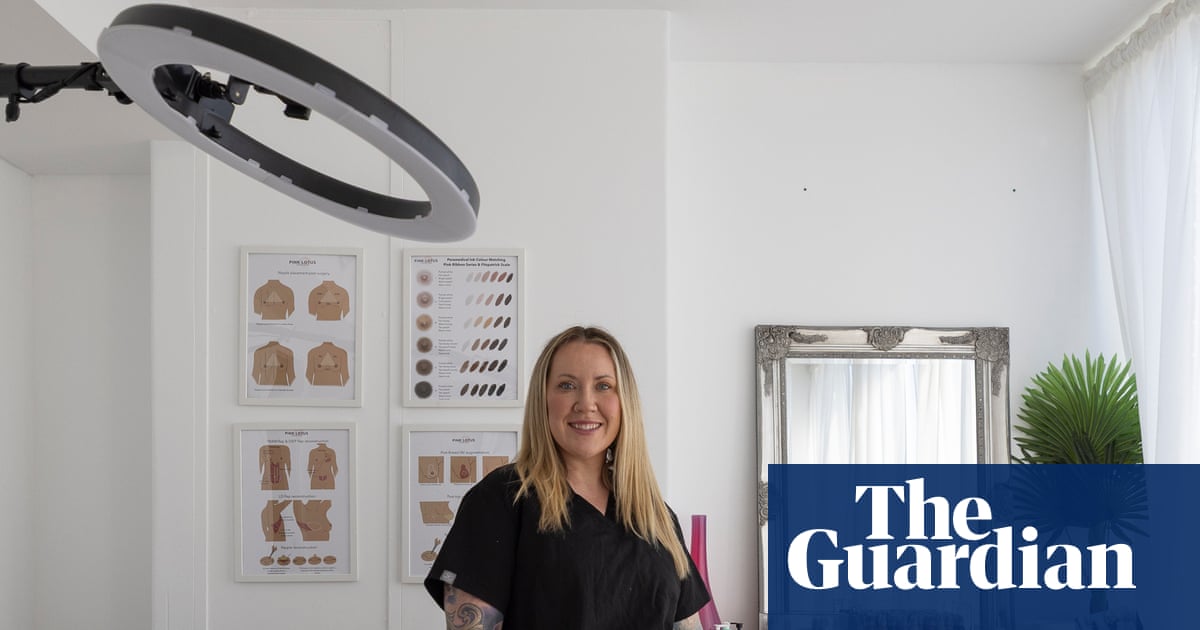
Aleisha specialises in inking hyper-realistic 3D areola and nipple tattoos for clients. Adelaide, South Australia. 14/11/2025 Photograph: Sia Duff/The Guardian
Paramedical tattoos can be used to camouflage scars (including from self-harm), burns or skin abnormalities. Tattoo artist Aleisha Michael tattoos realistic 3D nipples on women who have had surgical breast reconstructions after cancer.
“It’s a healing aspect, a closure to their journey [that] restores their sense of femininity, of sexuality,” she says.
She founded the Pink Lotus Australia Foundation to subsidise the cost of nipple tattooing, while also donating temporary nipple tattoos via breast care nurses and campaigning to broaden Medicare subsidies and train nurses to do them.
“A lot of the time when I’ve done a nipple tattoo … they say, ‘I didn’t realise how much it meant to me’.”
Today, there are robot tattoo artists that use artificial intelligence, tattoos done with disappearing ink that manufacturers claim last a year or two, software and apps for better design, temporary face tattoos that supposedly decode brainwaves to measure mental strain, and an increasing demand for laser tattoo removal.
Removal techniques are not perfect, but they are better than they were in the 90s. I eventually got tired of explaining the psychedelic origin of that nebulous first tattoo that was supposed to be a representation of my aura. Off I went to another Sydney artist for a cover-up, which unfortunately came out as an even more nebulous black splodge. A third cover-up means the black splodge now has some pretty trimmings.
Rhodes is nostalgic for the old days and bemoans the commercialisation of the sector, where artists have been replaced by franchises and the craft of mixing inks has been replaced by buying colour ranges online.
“The skills of the trade are dying out,” he says. “In the old shops you’d walk in and it was wall-to-wall flash cards [of designs]; they don’t even have that any more.
“They’ll send it to you on the computer.”
But Klimentou sees tattoos as a powerful way to assert control and signal identity.
“For women in particular,” she says, “we’re socialised as young girls into this idea of purity, of a clean girl aesthetic.
“[Tattoos] can be a way of rebelling against gender norms.
“That’s not what the patriarchy wants.”