
SAM DINGMAN: On yesterday’s show, I sat down with The Show’s senior producer Nick Sanchez and KJZZ political reporter Camryn Sanchez to debrief about what we saw at Turning Point USA’s AmericaFest convention.
Among other things, we wanted to understand the young people who are powering the rise in cultural influence of extreme right-wing ideas. This phenomenon of young people shifting to the right politically was arguably one of the biggest storylines of last year.
You may have seen some of the big headlines about AmericaFest. But while what happened on stage at AmericaFest is important, it’s also critical to understand what was happening out in the crowd.
Unsurprisingly, one of the other major stories was the attempt by Democrats to get those voters back. And as you may recall, shortly before Christmas, we brought you an interview with a political organizer who has a plan to do just that.
Zee Cohen-Sanchez runs a group called National Ground Game, which envisions itself as “the Turning Point of the left.” During AmericaFest, National Ground Game put together an event with a name we can’t say here on the radio. As we put it last time, let’s just say it rhymes with “Un-stuck America.”
The group is called National Ground Game, and they’re calling their event something we can’t say on the radio.
The idea, Zee told me, was to counter-program AmericaFest. At Majerle’s bar, just down the street from the Turning Point event, a group of left-wing influencers took the stage for a series of debates about hot-button issues. The goal was to entice some of the young people who were in town for AmericaFest to wander in and get to know a new version of the left.
So — did it work?
Well, Camryn Sanchez was in the crowd at Majerle’s for [Unf-ck] America, and after our conversation about AmericaFest, we sat down for a follow-up about what she saw.
Full conversation
CAMRYN SANCHEZ: We’re talking about a crowded bar, so obviously not the scale of AmericaFest, which is taking up a chunk of the Phoenix Convention Center. Thousands and thousands of people. In this case, we’re talking about more like maybe 100 people, as many as can fit in there. It’s loud and definitely raunchier kind of environment, you know, where people are drinking and kind of yelling and being rowdy.
And I think what was interesting to me off the bat was there were a lot of people there from Turning Point and from AmericaFest who were going to both of these events. And I was like, huh, I wonder what these people are thinking.
DINGMAN: OK, so this is extremely interesting to me because I was listening to some of the tape that you gathered from the Turning Point folks who were there. And it struck me that they are exactly the audience we might imagine that Zee Cohen-Sanchez and National Ground Game are looking to attract.
At least one of them actually explicitly told you he was there in what sounded like good faith. I want to listen to a clip of him talking. His name is Luke Tagle.
LUKE TAGLE: I tend to hang out with conservatives. I think that’s sometimes a problem because I don’t want to live in a country in which everyone thinks exactly like I do. I like to live in a country with people that have different opinions than me.
DINGMAN: So not exactly the sentiment one might guess one of these very passionate Turning Point folks would have.
SANCHEZ: I agree. And I was kind of expecting that if anyone from Turning Point came, there might be more drama of them. Just sort of like catcalling and heckling and whatnot. But no, I think the people I spoke to who were there were actually genuinely interested and wanted to participate in that debate.
DINGMAN: What was going on on stage? Was it like a show? Were people giving speeches the way they were at AmericaFest? What was happening exactly?
SANCHEZ: So the UNF America tour had these folks who were on the left, obviously, and they were debating a series of predetermined topics with speakers who had been chosen from the Republican side of things. And this went on for a few hours. And then at the end it was the, I would call it the Prove Me Wrong format, where there were two left wing streamers on the stage.
One of them’s very famous. His name’s Destiny. I had never heard of him because I’m old, but a lot of the people in the crowd who are more hip definitely knew who that was and were there for him specifically. So they had a microphone and then anyone in the audience was welcome to come up and ask them to sort of debate or talk about a particular topic. So that was the last part of the show.
DINGMAN: So Luke, for example, who explicitly said, I’m here because I’m interested in debate.
What was your sense of how he and the other Turning Point folks who were there were reacting to all this? Were they participating? Did they seem like they were compelled by anything that was happening?
SANCHEZ: The sense I got was that everyone had a good time and they did feel, when I asked them whether they think there’s an opportunity that there could be a Turning Point on the left, they don’t agree that the UNF America tour is there yet, but they think that it’s something, something that could happen.
And it’s something that they claim that they would welcome also. Like on college campuses, for example, where many of these kids have schools, high schools or colleges with Turning Point chapters, but there’s not really an equivalent. And they’re like, we want to debate, and there’s nothing on the other side. And that’s kind of disappointing to us actually.
DINGMAN: This reminds me of something that you were speaking about in our conversation yesterday, which is how much of the appeal of Turning Point for a lot of these kids seems to be the creation of a space to come and talk things out. And I know that there are a lot of observers on the left of Turning Point who have their doubts about whether or not that is what is happening in earnest.
But the conversations that you and I have both had with the students who are involved in Turning Point would seem to suggest like this is as much about belonging as it is about any particular set of ideas.
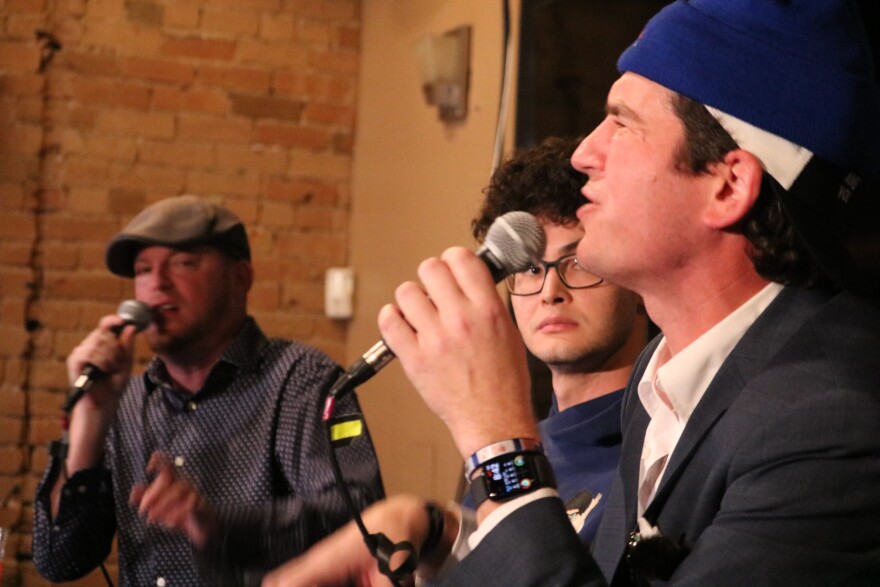
Alex Stein at the Unf-ck America Tour in Phoenix in December 2025.
SANCHEZ: Yes.
DINGMAN: So in the vein of Destiny, who neither of us were familiar with before the UNF America tour, when I had my conversation with Zee, I asked her, “do you feel like the left needs a Charlie Kirk, a charismatic figure like Charlie, to create this space that we were just talking about?”
And her answer was, quote, “I don’t think we need one because there isn’t one on the right.” Which I guess was a reference to the fact that Charlie Kirk has now passed away.
SANCHEZ: Yes. And Zee and I actually had somewhat parallel conversations. So that’s funny that you say that.
DINGMAN: Oh, interesting.
SANCHEZ: Because I was saying, who’s the figurehead here? Basically, Is it you? Because Zee herself was not on the stage, was not one of the speakers, and says that she’s not really a debater.
But she did say, you know, there are some younger folks, folks who have clout, who are more like symbols of the movement, including Destiny and few others, but kind of said the same thing and is actually questioning herself, what Turning Point is going to look like without Charlie Kirk? Because it was a movement that was so formed around him.
DINGMAN: Right. Well, this is a clip from a guy named Nathan Howell from Oklahoma. You were asking him, I believe, if he felt more aligned with Charlie Kirk or with Donald Trump. This is what he said.
NATHAN HOWELL: I would say that I more align with Charlie Kirk simply because I believe that Charlie Kirk had a very strong faith. And that’s something that’s very important to me.
DINGMAN: And just one more person in this vein, this is another guy, named Charles Rasmussen.
CHARLES RASMUSSEN: I think Charlie Kirk, I feel like he was a bit more virtuous. And I believe that there’s something to be said about having even basic virtues when being a political leader.
DINGMAN: So these comments to me would suggest that the allegiance of at least these guys is very much with Kirk specifically and not necessarily even Turning Point or the Republican Party.
Did you get the sense that they were compelled by any of the Destiny’s or the other folks with clout that were on hand at Majerle’s?
SANCHEZ: I know that Rasmussen was, because he told me so specifically that he was excited to talk to Destiny. And he’s one of the people who actually went up to the mic and had a question. And the question was, what’s so wrong about authoritarianism? And they talked about that for a while, and it was certainly an interesting conversation.
And so, yes, I do think that there’s an appetite for that. And I agree about the Charlie Kirk being being the central figure or idea that people were there for, both at AmericaFest and more broadly. I asked that question about who do you prefer, Kirk or Trump, to even more folks. And they all said the exact same thing, which is Kirk.
I think of Turning Point as an intense, originally far-right, almost fringe extreme, very passionate group of people who sort of pulled the needle and shifted the middle of politics further to the right.
So when I think of a Turning Point on the left, quote unquote, I think of a group that’s far left and talks about social issues, right, abortion, for example, and tries to pull the needle and pull the political center further to the left by being on the extreme.
And that is not what Zee was talking about. And I think that’s one of the fundamental differences I see between her organization and how Turning Point started out. And I don’t know if that means they can’t be successful.
I think one of the other questions that I had for Zee is what does the Democratic Party, capital P, established party, think of what you’re trying to do? And her answer was, basically, they’ve not been responsive and not been open to it, which I think is really interesting.
DINGMAN: That is very interesting to me because in my conversation with Zee, the two politicians that she name-checked twice in the conversation as representing what she sees as the future for the Democratic Party are Gavin Newsom and Pete Buttigieg, who I would argue are fairly establishment Democratic figures. They have their controversies, but it’s not like, she said, AOC.
SANCHEZ: Mamdani.
DINGMAN: Right.
SANCHEZ: Bernie, exactly. I really do believe that Turning Point makes people feel more like they have a purpose and that they are cared for and seen.
And the Democrat message, I’m going to recite something someone told me, a random Democrat at the UNF America event. He said the left is inundated with a sense of demoralization. It’s sort of a doom and gloom. You know, everything’s rough, but we’ll get through it, rather than a you really matter and this is your purpose in life. And as a father and as a husband and as a person of God, you know, which is really more …
DINGMAN: It’s moralizing.
SANCHEZ: Yes. And I think probably makes people feel a little bit more engaged. So I wonder if that’s something that they can conquer.
DINGMAN: Well, even the name UNF America is starting from a place of demoralization.
SANCHEZ: Yeah.
SAM DINGMAN: Well, lots more to watch here. And I’m sure we’ll be talking much more about this. I’ve been speaking with KJZZ’s Camryn Sanchez. Camryn, thank you. As always.
SANCHEZ: Thank you.
KJZZ’s The Show transcripts are created on deadline. This text is edited for length and clarity, and may not be in its final form. The authoritative record of KJZZ’s programming is the audio record.