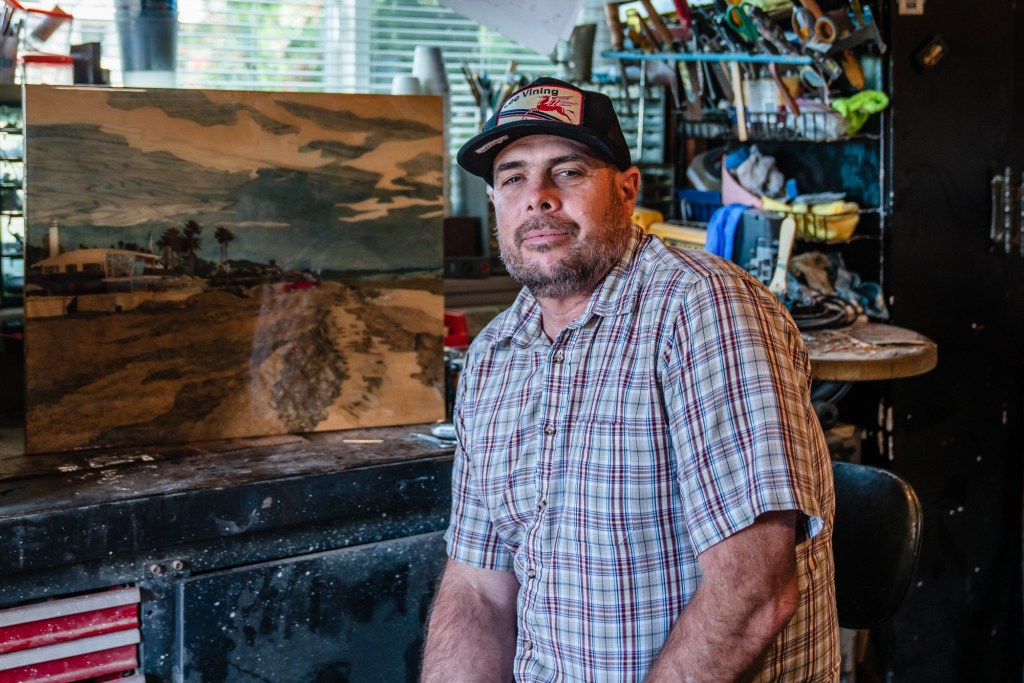
An allergy put an end to Mac Hillenbrand’s work as a licensed painting contractor, and it opened up a return to the woodworking he’d enjoyed as a teen.
“I used to refinish cabinetry and I would sand boards, like, all day long. I would see scenes in the wood grain, staring deeply at the grain for, like, eight hours a day,” he says. “I would imagine the grain lines to be surf breaks and beaches, I would see all these fantasy coastlines and little fantasy surf breaks in the grain.”
He developed a severe allergy to latex paint — to all neoprene, which was devastating for him as a surfer — from years of overexposure, so he had to figure out what he could do next to take of himself and his family. With these visions that were showing up in the pieces of wood he’d been staring at day in and day out, he wanted to work out how to make a painting out of wood. The answer was wood inlay, or marquetry. He attended the American School of French Marquetry in San Diego’s North Park neighborhood, studying under instructor and school founder W. Patrick Edwards, and went on to open his own marquetry art business, Amber Waves of Grain. Hillenbrand’s work is among that of more than 30 other artists on display in the Escondido Arts Partnership’s 16th annual exhibition, “Wood: A Furniture Show,” opening Saturday and continuing through Feb. 27 in their main gallery (an opening reception is scheduled for 4 to 6 p.m. Saturday). The show features handcrafted furniture in various types of wood, with techniques ranging from contemporary to traditional and whimsical, along with functional pieces, sculptures, and wood art, according to the arts organization.
Hillenbrand, 45, grew up in Del Mar and lives in Carlsbad taking care of his kids and his parents, while working as a full-time artist. He’s been displaying his work in this annual exhibition for the past eight years and took some time to talk about his contribution to this year’s show, his creative process, and his perspective on his purpose as an artist. (This interview has been edited for length and clarity. )
Q: You have a degree in film and digital media, with an emphasis in production, from UC Santa Cruz, and you’re also a DJ, licensed painting contractor, and run your marquetry art business Amber Waves of Grain; how did you get started in woodworking? Can you talk a bit about this path and transition?
A: When I was growing up, my dad was disabled, so it would be like expected that I would help do handyman stuff. My parents were both lawyers — my mom was a civil servant lawyer and worked in the juvenile court system, and my dad had a family law practice — but their fun side business was that they bought a hostel in Mammoth in 1993. It was an old, 1970s backpackers hostel, so I would go up there and do stuff like tear down the old deck and help build a new deck, build all the bunk beds in there, and basically do uncompensated teenage labor. I found it really rewarding to sand the Redwood boards down for four days straight, and then finally varnish them and have the wood sparkle and shine. You could make something really beautiful by just treating the wood really nicely and putting a lot of time and effort into that.
Like, my folks would sign me up to play T-ball, and I would just go climb a tree and collect leaves and stuff. I was a weirdo outsider kid and a lot of my friends were all the other kind of loser weirdos, and we all got into, like, skateboarding and surfing and stuff when those were activities for losers. In the ‘90s in San Diego, people shot a lot of skate videos, so my first artistic passion was to make skate videos and surf videos with my friends. I barely got myself into college, but I did, and I had to pick a major, so I said I was going to continue on with the film and video stuff as a film major. I started watching all the high minded art films, all the French New Wave films and all the independent cinema from the ‘70s through the ‘90s. I wanted to make high-minded, super intelligentsia, sophisticated movies that were on the level of all these French masters and stuff, but the film people are kind of egotistical. I was also hanging around with a bunch of musicians and the people in bands are way friendly. They just want to play music with you and have you come to the show, whereas film people are kind of egotistical and self righteous and high minded. As a result, once I finished college, I followed a bunch of my friends and their bands up to Oakland, where there was a really vibrant music scene at the time taking place in all the abandoned warehouses after the dot-com bust.
I ended up convincing an old landlord guy with a produce warehouse to let me rent his warehouse and move in and, because I was handy, do some improvements to it. I ended up moving into an 8,500-square-foot produce warehouse and turning it into my own underground art space and music venue when I was 23. People called it The French Fry Factory because they used to make French fries in there. I did that from 2003 to 2005 and put on hundreds of shows. I would work with local community groups to do nonprofit fundraisers, so the local all-Black theater group would rehearse there; The History Channel would do TV production there and shoot there; I would be throwing rock shows and having art openings, but not even with my art. I would help all these different community organizations and I helped everyone else do their art and people loved the spot. It wasn’t permitted, it was underground, but it was a positive thing for the city. You don’t make any money running underground rock shows; you do it for the sake of wanting to participate in community and help everyone and have that experience. I would do all sorts of odd jobs the whole time, so I was really exhausted at the end of that. When the whole thing had run its course, I just moved to San Francisco and lived in a house with some friends and started doing my painting business and became a tradesman. I did that until I eventually moved back to San Diego so I could be around to help my family.
I was working as a tradesman with my painting business for so long that I got this career-ending allergy that made it so I’m also allergic to all neoprene, including wetsuit material, which is a huge, huge bummer if you’re a surfer guy. So, I dared myself to try and surf every day through the winter without a wetsuit. By the end of that ambition, that year of trying to get in the water every day without a wetsuit, I had my epiphany that I wanted to change my life around to doing the seascapes out of wood. I knew what I wanted to do with myself, which was essentially dedicate my life to pursuing this art form because I love using nature and celebrating nature because nature did a lot for me as a weirdo kid. The ocean saved my life, so I celebrate the ocean because of its role in my life.
Q: Are there types of wood that you prefer to work with, over others?
A: I work with whatever speaks to me. I really love working with locally felled trees when I can do that. In San Diego, we’re very fortunate that so many trees can grow here. We have coniferous trees, deciduous trees, tropical plants, all the Chaparral stuff. There’s a lot of the basic invasive species, so we have different types of wood to draw upon, which is really cool. Sometimes I’ll work with some stuff that comes out of Northern Europe that I’ll go up to a specialized lumber yard in LA to look for this one type of wood called mappa (a European black poplar) that ticks all the boxes for my art because it’s like light enough to be able to make a beautiful turquoise color. It’s got crazy three-dimensionality in the grain, the live edge is super beautiful, there are all these little knot holes that look like submerged reefs when I do my thing to it. I basically will dumpster dive for wood. If I see some boards in the gutter or a dumpster, it is my moral imperative to retrieve them because I can put them to use in my livelihood.