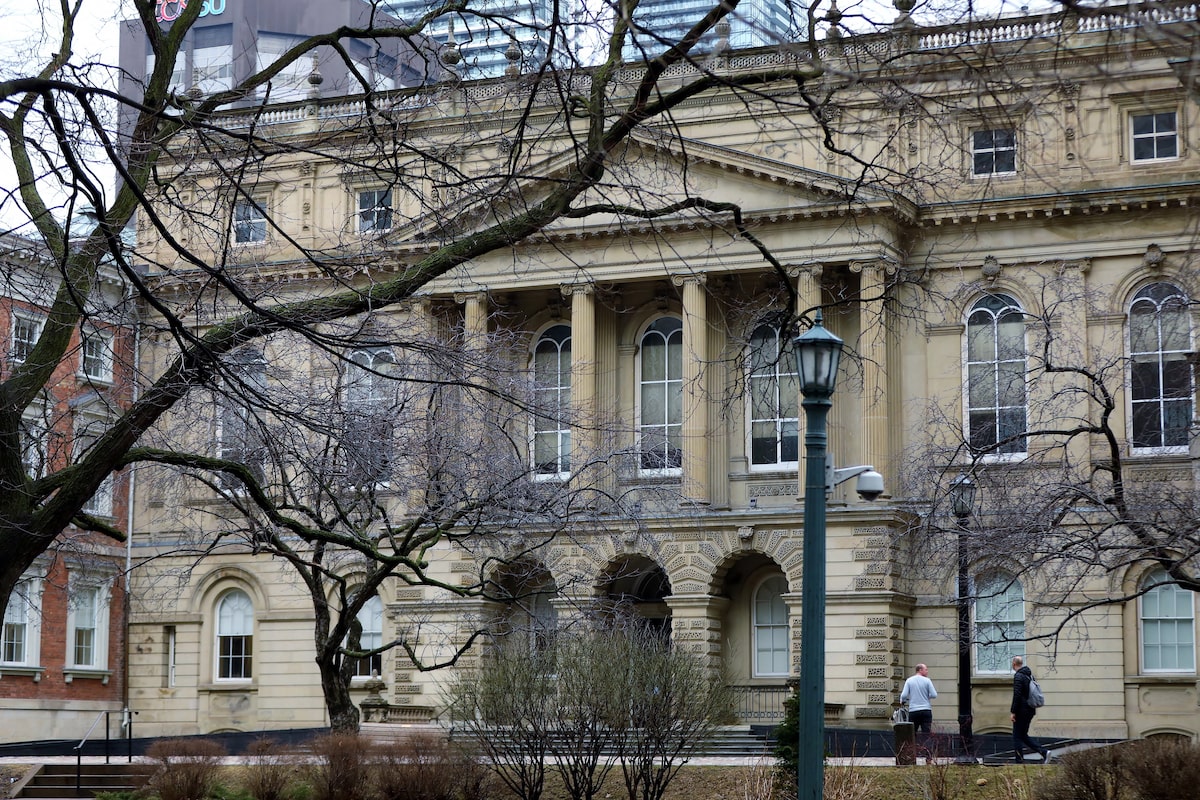
The Ontario Court of Appeal’s ruling said that Camelot Hamblett ‘has been in some form of seclusion for almost the entirety of the 20-year period’ of his detainment at the Waypoint mental-health care centre.Colin Perkel/The Canadian Press
Ontario’s top court on Friday ordered an independent psychiatric assessment of a 43-year-old man who has spent half his life detained in isolated seclusion at a mental health care centre north of Toronto.
Camelot Hamblett, detained at the Waypoint Centre since 2004, lives in what is called the High Secure Forensic Program. He is rarely allowed to exit his room.
In 2007, when he was 23, he was found not criminally responsible for charges of sexual assault, and assault. He continues to experience severe and persistent schizophrenia.
Last spring, Mr. Hamblett sought an independent assessment of his situation at the Ontario Review Board, which looks at cases such as his. The request was later rejected. He then sought redress at the Ontario Court of Appeal, which heard his case on Monday. A judgment in his favour was issued Friday.
The ruling stated Mr. Hamblett does not contest that he is a threat to public safety, nor does he currently seek release from Waypoint. But he insisted there was an impasse in his treatment. The review board disagreed. The Ontario appeal court overruled the board, declaring its finding that there was no impasse was unreasonable, and calling the rejection of an independent assessment plainly unreasonable.
The unanimous appeal court ruling, written by Justice Grant Huscroft, observed that Mr. Hamblett “has been in some form of seclusion for almost the entirety of the 20-year period in which he has been detained at Waypoint.”
“No meaningful progress has been made with his treatment, and there appears to be no real prospect of his situation improving. The hospital expressed little confidence that any progress will be made.”
Justice Huscroft concluded: “After 20 years, this will not do.”
He went on to chide the review board, writing: “It was incumbent on the Board to address the clear lack of progress in treating the appellant and to seek out more effective treatment opportunities.”
He further stated: “There is no reasonable basis to continue the current course of treatment without seeking an independent assessment. Such an assessment can do no harm and may do some good. But something must be done: [Mr. Hamblett] cannot continue to languish in seclusion with no real prospect for improvement.”
The Waypoint Centre said in a statement on Friday that it welcomes the court ruling’s order for an independent assessment.
Spokesman Paul McIvor said seclusion is used as a measure of last resort and is subject to ongoing review, including daily checks by a doctor.
At the court hearing on Monday, before justices Huscroft, Steve Coroza and Sally Gomery, Mr. Hamblett’s lawyer Anita Szigeti urged intervention.
“Someone has to care about what’s happening. He needs help,” she told the judges, as reported by the Toronto Star. The Ontario government, however, argued in court that the board’s decision was, in fact, reasonable because some new treatments had been planned for Mr. Hamblett.
The legal standard of reasonableness in administrative decision-making stems from a landmark 2019 Supreme Court of Canada case called Vavilov. The top court ruling clarified long-standing confusion in the lower courts when looking at administrative law decisions, such as those made by the Ontario Review Board. The board is a tribunal that reviews cases of people found unfit to stand trial or not criminally responsible because of mental illness. It has more than 100 members, including legal and mental health experts, and the public.
According to a board ruling last August, Mr. Hamblett was born in Toronto, the oldest of three kids. Their mother had immigrated from Jamaica. Mr. Hamblett’s childhood was stable but when he was in high school, in 1999, his lower lip was bitten off in an altercation. Doctors could not successfully mend the injury.
As of last year, based on legal filings, Mr. Hamblett was rarely allowed to leave his room and only in physical restraints. Isolation weighed on him. His room was in disarray, crowded with detritus, and he disregarded self-care, including showering.
In the Ontario Court of Appeal order, an independent psychiatric assessment of Mr. Hamblett is to be conducted as soon as possible. The Ontario Review Board is supposed to look at that assessment as soon as possible thereafter and no later than this June.
A medication assessment program for schizophrenia referral – known as MAPS – and pharmacogenetic testing are also supposed to be considered at the review hearing.